

Rotting of Apple Fruits During Storage
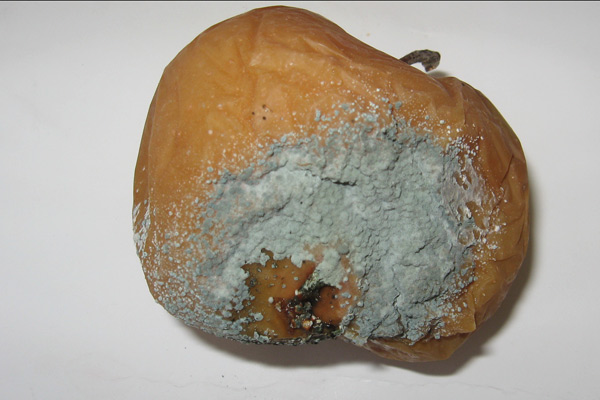
Soft rot caused by Penicillium expansum develops rapidly and affects the entire fruit, which is easily crushed under pressure. On the decayed tissue, more precisely around the injured part, white to pale green sporulating tufts initially appear, which later acquire a blue-green color and cover a larger part of the decayed surface. Fruits that are not entirely affected are also unfit for consumption, as the healthy tissue has an unpleasant moldy and alcoholic odor. For the same reason, healthy fruits that are adjacent to the rotten ones are also unpleasant for consumption.
Brown rot caused by Monilinia fructigena infects apple fruits from fruit set until their consumption. On the infected fruits, round brown spots appear, under which the tissues are decayed. This tissue is firm and dry. Under humid conditions, ochre sporulating tufts appear on the brown spot, arranged in concentric circles. Usually, infected fruits during storage acquire a shiny black color and lack sporulating tufts.
Black rot caused by Botryosphaeria obtusa infects the fruits already in the orchard, but the disease develops very slowly on green fruits. During storage, cinnamon-brown specks appear on the fruits around the damaged area or the lenticels, which gradually expand and cover the entire fruit. Later, the damaged part blackens and becomes blistered with small, black, round fruiting bodies. When the fruit is cut, it can be seen that the rot has penetrated conically to the seed cavity. When comparing the consistency of the decayed part from black rot /B. obtusa/ and brown rot /M. fructigena/, it is evident that in black rot the decayed part is firmer than in brown rot.
Bitter rot caused by Trichotecium roseum has two forms of manifestation – external and internal. In the external form, a brown spot appears on the infected fruit around an injury, which later becomes covered with mold, on which pink clusters are formed. The internal form of the disease is not noticeable, as the fruit shows no symptoms and appears healthy. When cut, however, it is seen that the seed cavity is decayed and filled with a whitish moldy growth with small pink clusters. In both forms of the disease, the apples are unfit for consumption due to their bitter taste and strong moldy odor. This rot is characteristic of apple cultivars with an open calyx such as Florina and others.
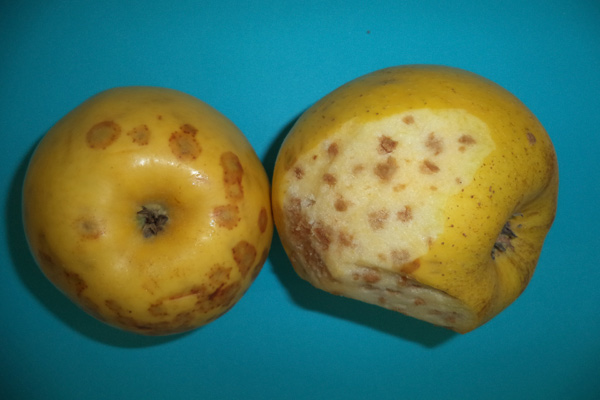
The non-infectious disease bitter pit develops already during the period of fruit ripening and later during their storage. The affected fruits are dotted with numerous dark sunken spots, which are most often concentrated in their lower part. Later, the spots become more intensely colored; in red-colored fruits they acquire a dark red color, while in yellow and green-colored fruits the spots become light green to green. The damaged fruits look as if they have been hit by hail. Sometimes the affected apples have no external symptoms and do not differ from healthy ones, but when cut, brown pits scattered among the healthy fruit flesh are visible. Bitter pits represent dark brown spongy tissue with a bitter taste. The causes that induce the appearance of bitter pit have not yet been precisely established despite numerous studies on the problem in a number of countries where apples are grown.
It has been established that bitter pit appears most often in fruits from orchards with low yields and those from young trees, as well as on fruits that have been harvested before or after their optimum picking maturity. Warm and dry weather during July and August also increases damage from bitter pit. Large fluctuations in water supply as a result of prolonged drought followed by abundant irrigation during fruit enlargement, excessive irrigation before harvest, unbalanced fertilization with N, P2O5 and K2O, application of only high nitrogen rates, and severe pruning increase the occurrence of bitter pit.
Measures to prevent fruit rotting during storage
To prevent damage, it is necessary to:
- Protect the fruit crop well from diseases and pests during the vegetation period;
- Apply balanced fertilization, pruning in accordance with the requirements of the cultivar, and avoid water stress in the trees;
- Carry out harvesting at the most favorable times for each cultivar;
- Leave only healthy and undamaged fruits for storage;
- Store the fruits in cold rooms where the required temperature and humidity are maintained;
- Remove rotten fruits in due time so that they do not serve as a source of infection;
To protect apple fruits from the fungal pathogens causing rot during storage, in our country the fungicides Bellis – 80 g/da and Geox WG – 30–40 g/da are approved for pre-harvest treatments.
To reduce losses from bitter pit, during the vegetation period two to three treatments with CaCl2 – 0.6% should be carried out. The first spraying is conducted about one month before harvest, and the subsequent ones at 10–12-day intervals. In addition to CaCl2, in recent years the chemical industry has introduced to the market foliar fertilizers containing Ca. One of these fertilizers is Foliarel Ca, which is recommended for preventing the occurrence of bitter pit in apple.
To reduce losses from bitter pit during fruit storage, it is recommended to dip the fruits in CaCl2 – 2.5% before placing them in storage.