

According to 2014/2015 data from the European Union’s EUROPHYT Plant Health Interceptions Notification System, out of the 6,680 notifications submitted by the Member States, 2,534 concerned detected pests on plants and plant products. The most frequent interceptions in imports from third countries were of consignments with fresh fruit and vegetables, a total of 1,757. Particularly alarming is the increase in intercepted pests in consignments of pepper (with 149 more notifications than in 2013), eggplant, tomato, leafy vegetables, as well as in consignments of fruit from fruit trees and citrus species.
The economically more important among them are:
Thaumatotibia leucotreta Meyrick
In Europe, the species has been detected in consignments with fruit and vegetables in the United Kingdom, Denmark, Italy, Spain, Sweden, and Finland.
Host plants: The species is polyphagous, attacking 70 plants from 40 families such as citrus (Citrus), soursop (Annona muricata), pineapple (Ananas comosus), avocado (Persea americana), peach (Prunus persica), lychee (Litchi chinensis), species of the genus Capsicum, including sweet pepper (Capsicum annum), maize (Zea mays), olive (Olea europea), castor bean (Ricinus communis), cotton (Gossypium) and others.
Damage: The adult moths are active at night. They lay their eggs singly or in small groups on the fruits or capsules. After hatching, the larvae bore into the fruits. They feed inside them, where they cause the damage, and through the openings fungal and bacterial pathogens can enter secondarily. After completing their development, the larvae leave the fruits and pupate in silken cocoons in the soil or under plant residues. It should be noted that, depending on climatic conditions, the pest develops from 1 to 10 generations per year.
The damage to different hosts is as follows:
- On pepper, the larvae feed on the pods and contaminate the interior of the fruit.
- On citrus, the young larva penetrates the rind and feeds beneath the surface of the fruit.
- On cotton, it initially mines the bolls and later moves on to the seeds.
- On stone fruits, the larvae bore into the fruit and feed around the stone.
Pathways of entry and means of spread: Over short distances, by flight of the moths. Through fruits and vegetables from countries where T. leucotreta is present. It is considered that the likelihood of its introduction into the EPPO region with planting material is negligible, because these plants are without fruits.
Possible risk: T. leucotreta is included in the EPPO A2 List. In northern Europe it may establish in greenhouses, and additional studies are needed for its development in southern Europe.
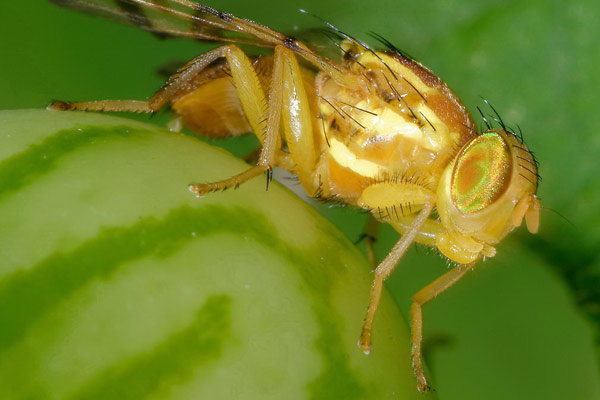
Zonosemata electa (Say), Tephritidae, “Pepper fly”
Host plants: Plants of the family Solanaceae – mainly pepper (Capsicum annum) and varieties such as chili pepper, tomato (Solanum lycopersicon), eggplant (S. melongena) and others.
Biology: The fly has a body length of 6.5 to 7.5 mm. The head, abdomen and legs are light yellow in colour, and the wings are transparent with dark bands. After hatching, the larva is transparent, and later becomes yellow.
The pepper fly has one generation per year. After emergence, the females mate, and oviposition begins from the end of June, July to August. The flies lay their eggs inside the fleshy part of the fruit. After 8–10 days the eggs hatch. The larvae feed inside the fruit for about 18 days, then leave it, fall onto the soil and pupate, usually at a depth of 5–10 cm. The puparium survives from late summer or autumn until the following summer.
Damage: The fly attacks healthy fruits of pepper and eggplant. It also damages tomatoes, but less frequently. Oviposition takes place in still small fruits, usually those with a diameter of 1 to 3 cm. As the fruit grows, a shallow depression forms in the area where the egg was laid. Usually there is one larva per pepper fruit, whereas in eggplant there are several larvae.
Pathways of entry and means of spread: Through fruits and vegetables of host plants from countries where Z. electa occurs. The adult flies can fly and spread over distances, while the larvae and eggs present in the fruits are transported with them.
Possible risk: If introduced into the region, the pest could successfully establish in greenhouses.
Control: In countries where Z. electa is present, the following measures are applied: collection and destruction of rotten and damaged fruits; crop rotation; destruction of alternative hosts such as weeds (S. carolinense); monitoring with yellow sticky traps and, based on observations, application of insecticides.
Leucinodes orbonalis (Lepidoptera: Pyralidae) – Eggplant fruit borer
The species has been intercepted more than 200 times in imports of fruits of Solanum species. Since 2012 it has been included in the EPPO A1 List – pests that are not present in Europe.
In the countries where the eggplant fruit borer is present, significant losses are reported (in Asia, losses of 65% of the eggplant crop are reported). Control is mainly carried out with insecticides, but the development of resistance to those used so far has been reported.
Host plants: The main host of L. orbonalis is eggplant (Solanum melongena), but the species can also attack other plants of the family Solanaceae such as pepper (Capsicum annuum), tomato Lycopersicon esculentum, potato (S. tuberosum), S. aculeatissimum, S. indicum, S. myriacanthum, S. torvum and the weed S. nigrum. It has also been reported on other crops such as beet (Beta vulgaris), sweet potato (Ipomoea batatas), pea (Pisum sativum), Mangifera indica.
Damage: The damage is caused by the larvae, which feed on the fruits.
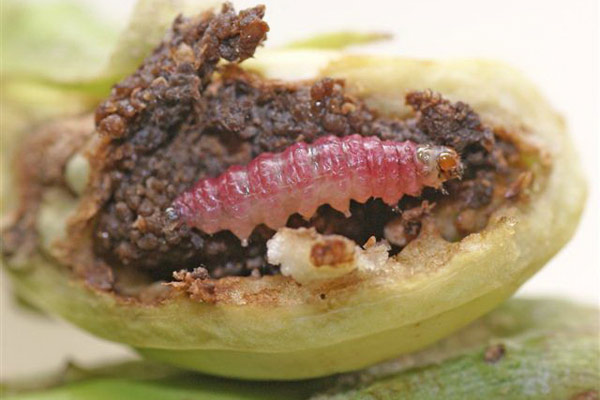
Biology: The moths are active at night. They lay their eggs on the leaves, flower buds and young shoots. The newly hatched larvae crawl to nearby shoots or fruits and bore into them. Early symptoms caused by larval feeding are observed on the stem, branches, flower buds and flowers. The larvae enter the fruits from the side of the calyx. L. orbonalis has 6 larval instars. The last instar larvae bore an exit hole and pupate in plant residues on the soil surface. The adult moths, with wings spread, measure 18–24 mm. Their wings are white, with brown, beige and dark brown to black markings and spots. The larvae are up to 2 cm long, pink in colour, with a brown head.
Pathways of entry and means of spread: With planting material, fruits of the genus Solanum and other host plants – from countries where L. orbonalis occurs. The moths spread over short distances.
Possible risk: It is considered that the pest can develop in greenhouses, but further studies are needed to determine whether L. orbonalis can establish in the field, outdoors, in the southern parts of the EPPO region.