

Aromia bungii (Falderman)
Systematics: Coleoptera, Cerambycidae
Categorization: Included in EPPO A1 List (quarantine pests absent from the territories of the EPPO member countries – May 2012) (EPPO, 2012).
Potential risk:
The import and movement of wood packaging material into the European Community from countries where the species is present increases the risk of its introduction into our country. In addition, Bulgaria has similar climatic characteristics to the countries where it develops, providing suitable conditions for its establishment. It has been established that the larvae feed both on fruit-bearing trees and on young saplings. The larvae develop for 2–3 years in the trunk – a biological characteristic that makes this pest difficult to detect.
According to EPPO, it is highly likely that the species could become established in Macaronesia (Canary Islands, Azores, Madeira and Cape Verde), Portugal, in the Mediterranean region (Morocco, Algeria, Tunisia, Spain, France, Italy, Slovenia, Croatia, Albania, Greece, Türkiye, Cyprus, Malta, Israel), as well as in the countries bordering the Black Sea (Bulgaria, Romania, Moldova, Ukraine, Georgia) and the Caspian Sea (Azerbaijan and Armenia).
Hosts:
The main hosts are species of the genus Prunus, in particular peach (P. persica) and apricot (P. armeniaca), and to a lesser extent plum (P. domestica) and sweet cherry (P. avium). Pomegranate (Punica granatum), white poplar (Populus alba), Chinese white poplar (P. tomentosa), olive (Olea europaea), persimmon (Diospyros virginiana), etc. are also attacked.
Damage:
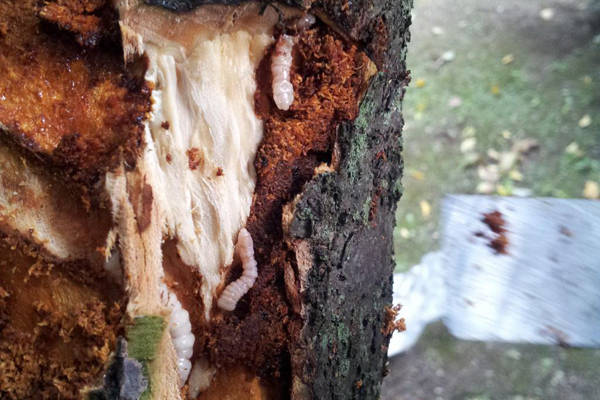
The larvae of A. bungii prefer old trees in poor condition or those with bacterial or fungal diseases, but can also attack healthy or slightly damaged trees. They begin feeding in early or mid-April, with a peak from May to June. They bore galleries (17–22 cm long) in the trunks and larger lateral branches. They prefer to feed under the bark and sapwood of the trees, rarely in the heartwood, which leads to loss of fruit production and weakening of the trees. Very characteristic symptoms indicating the presence of larvae are necroses on the trunk and accumulated frass around the tree, as well as large exit holes.
Morphology:
The eggs are small, whitish, measuring 6–7 mm, and are laid in cracks in the bark of the trees. Females usually oviposit in the trunk of the trees, 30 cm above the soil surface, but eggs have also been found in cracks and wounds on larger and smaller branches. The larvae are white to yellowish. At more advanced developmental stages they reach a size of 38–50 mm. Their body is whitish in colour, the mouthparts are black, the pronotum is irregularly symmetrical with reddish shades – this specific feature makes the species easily recognizable during identification. The pupa is whitish and is found in a “cell” in the heartwood of the tree. Adults are black, 23–40 mm long, with glossy elytra and a red spot (although some forms may be completely black). The beetles emit a specific odour that protects them from predators.
Pathways for entry:
Over long distances the pest can be transported with plants for planting, whole bonsai-type plants, wood and wood packaging material from countries where A. bungii has been detected. The import of plant material from Asia is the main reason for the spread of the species – this is precisely how it was introduced into the USA and the United Kingdom.
It is considered that A. bungii can only fly short distances, in the range of 560–2500 m, similar to Anoplophora glabripennis (Motschulsky 1853). However, since it is polyphagous, it is not excluded that it may fly much greater distances. Nevertheless, spread of the species by flight has not yet been confirmed.
Control:
The pest can hardly be detected during visual inspection of large numbers of plants for planting, although in some of them it is possible to observe laid eggs or cracks in the bark resulting from larval feeding. In addition, these plants are transported in refrigerated trucks, which makes the pest less active and even more difficult to notice.
Management:
Control of Aromia bungii is difficult, as the larvae quickly penetrate under the bark of the tree, where they cannot be affected by contact plant protection products and are protected from potential predators. Systemic insecticides and neonicotinoids can be applied.
Another method is heat treatment of wood at 56 degrees for 30 minutes. However, recent studies indicate that this measure is not 100% effective. Disinfestation of wood using non-ionizing radiation is recommended (EPPO Standard PM 10/8 (1)).
The most reliable measure is to prohibit the introduction of plants and plant products of the genera Prunus and Populus into European Union countries from areas where this pest is present. Annex III of Directive 2000/29/EC contains an import ban, but it applies only to plants of the genus Prunus spp. with foliage, whereas Aromia bungii can also attack plants in vegetative dormancy.
It is advisable that, upon detection of the pest, the trees be destroyed.
Natural enemies and entomopathogens or nematodes such as Steinernema carpocapsae (del Martinez de Altube et al., 2007) may be used.