

In the phenophase “flowering”, fruit species are particularly susceptible to infection, since under favourable conditions the causal agents of diseases penetrate the plant tissues through the stigma and the calyx of the flower. In a wet and cool spring, the flowering period of the trees is prolonged. During this period, the leaf mass also develops, which is not covered with fungicide from the pre-flowering spraying and it also becomes a target of disease attack. Especially in large orchards, where a higher infectious background is concentrated, spraying is necessary in order to prevent the mass development of pathogens.
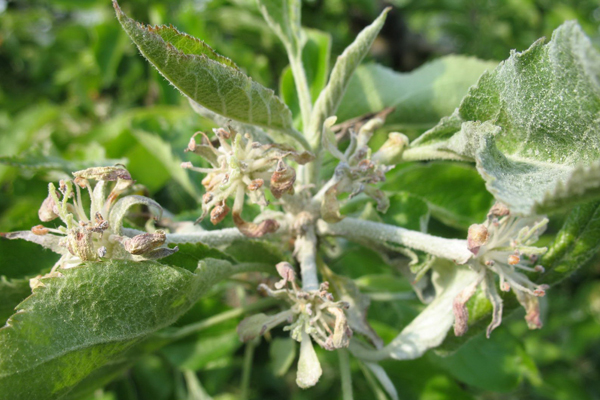
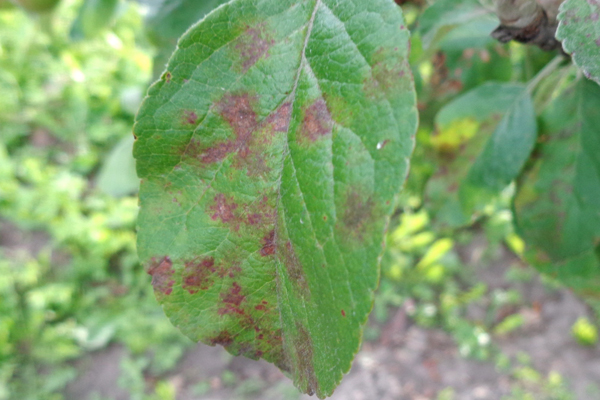
Under suitable meteorological conditions during the flowering period, apple, pear and almond are susceptible to the most dangerous fungal disease – scab, which infects young leaves, petioles, floral parts, fruits, as well as the branches in pear. At the same time, apple, peach and almond are also attacked by powdery mildew.
The first flowering treatment is carried out at 75% faded flowers. In a cool and wet spring, the flowering period is prolonged, a significant leaf mass develops, which is not covered with fungicide and this necessitates a second spraying at the end of flowering.
For the control of scab and powdery mildew, treatments are carried out with registered fungicides for control, listed in the PPP List/2016.
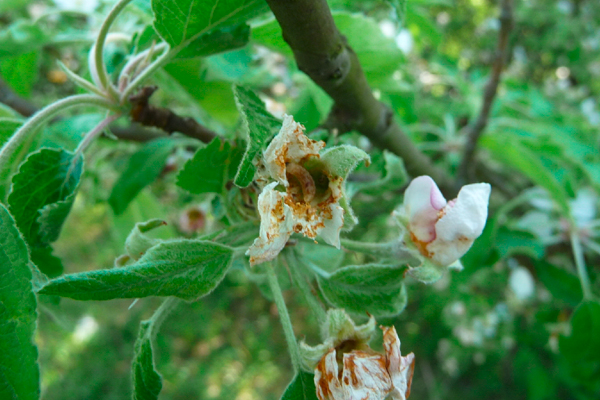
In the period before, during and after flowering, under favourable conditions – high relative air humidity and moderate temperatures – stone fruit species are susceptible to infection by the fungal diseases blossom blight (early brown rot) and shot-hole disease. Control of these diseases is carried out by spraying before or immediately after flowering. Registered fungicides recommended in the PPP List/2016 may be used.
MAIN PESTS FOR THE PERIOD
DISEASES:
Pear scab
Powdery mildew on peach and almond
Gnomonia on apricot
White rust on cherry and sour cherry
Fire blight on fruit species
Bud blight (Didymella) on raspberry
Grey mould on strawberry
Non-infectious damage from low temperatures
PESTS:
During the flowering period, the harmful activity of pests on fruit species also intensifies – leafrollers, leaf-feeding caterpillars, aphids, weevils, Anarsia, etc. To protect fruit species from the listed pests, it is necessary to carry out spraying at the beginning and at the end of flowering with registered insecticides for control, listed in the PPP List/2016.
In addition to these species, the plantations are also attacked by:
Hairy beetle on fruit trees
European red mite
Aphids
The apple blossom weevil feels most comfortable in neglected orchards
The apple blossom weevil prefers old orchards
It causes damage only in apple orchards where plant protection measures are not carried out regularly. It appears in spring first in orchards with southern exposure, in warmer micro-regions, initially on early-flowering, and afterwards on mid- and late-flowering cultivars. An important indicator for this occurrence is when the average daily temperature reaches 6–8°C (the period from 20 February and at the latest until 10 April).
Damage is caused by the adult and the larva, with the larva causing more severe damage. Therefore, it is particularly important to reduce the beetle density before the beginning of egg-laying. It overwinters under the old and cracked bark of fruit and forest trees, in mosses and lichens and in dried fruits. In spring, with the warming of the weather, the beetles leave their winter shelters and move to the swelling flower buds, which they feed on by gnawing them and making holes. They prefer cultivars with a longer flowering period.
Control:
• Registered plant protection products for chemical control – none.
• The only method remains the collection of beetles early in spring, from the end of February and the beginning of March, mechanically, by shaking the trees over a tarpaulin. This will be effective and the largest number of beetles will be collected if it is done during the warm hours of the day, when they are most active.
• Another measure that can be taken is to place sticky bands (a suitable material coated with non-drying adhesive) on the trunk, below the tree crown, which retain the beetles early in spring and prevent their movement towards the branches. The bands are periodically inspected and the beetles are mechanically destroyed.