

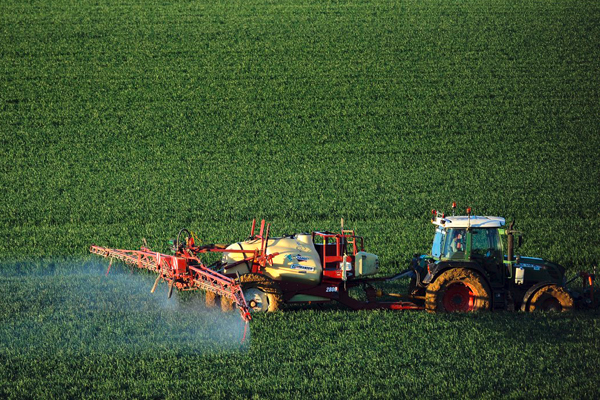
The European Commission’s proposal to extend the authorization of the active substance glyphosate for the next 15 years has provoked sharp criticism in European parliamentary circles and non-governmental environmental organizations, once again drawing attention to the free interpretation of laws and regulations. The latest results from studies on the harmful effects of glyphosate on living organisms and the environment have cast serious doubt on the decision-making process of the European institutions, which blindly follow corporate interests and put at risk the health of their own citizens.
Glyphosate is one of the most commonly used chemical substances on which a large part of the authorized and widely used broad-spectrum herbicides in the world are based. According to European legislation, every 10 years the authorizations of plant protection products must be thoroughly reviewed by independent experts with regard to their quality and impact on the environment and only thereafter be allowed back on the market for a specific period of time.
The World Health Organization versus the European Food Safety Authority
In practice, as early as 2012 the old authorization for glyphosate, which in 1970 was patented under the trade name Roundup by the company Monsanto, expired. In order to obtain subsequent European approval in May 2012, the American company submitted to the Federal Institute for Risk Assessment in Berlin five scientific reports in which laboratory mice were treated with glyphosate. Monsanto’s preliminary conclusions were that the substance is safe and has no carcinogenic effect.
The battle for or against glyphosate, which in recent years has evolved into a struggle against the American agro-cartel, was postponed to mid-2015, when Europe, in the person of the European Commission, finally had to come out with a final decision on this controversial herbicide. Especially after the scandalous evidence from the International Agency for Research on Cancer and the World Health Organization, where glyphosate is identified as genotoxic, the general mood tended towards its unconditional ban. Or at least the logic of events suggested a different development, until at the end of 2015 the reports of the European Food Safety Authority (EFSA) and the Federal Institute for Risk Assessment (BfR) appeared, which categorically rejected the possibility that glyphosate has a direct or indirect impact on human health. The scientific assessment of 96 international independent experts in the field of cancer research was declared “unacceptable, fundamentally flawed and intended to mislead the public”.
Brussels – 7–8 March 2016
At the meeting of national experts held on 7 and 8 March in the Belgian capital, once again no concrete decision was reached. The fate of glyphosate will remain unclear at least until the end of May, when the experts will “finally” pronounce their verdict. Despite the lack of results, the European Green Party, which supported various “anti-glyphosate” citizens’ initiatives in recent weeks, believes that postponing the decision is the only path to victory, because over the next two months new studies of the active substance will be initiated. They will probably prove that glyphosate is not innocent. Will they? One thing is clear: a large percentage of European countries definitely prefer to sit in their comfortable Brussels armchairs and not commit themselves to a concrete position, contenting themselves with the status of “abstained”.
Lack of transparency
“The European Commission wants to extend the authorization of glyphosate for another 15 years. With this action, the Commission will violate not only the principle of safety laid down in the Rio de Janeiro Declaration on Environment and Development, but will also completely disregard the studies of international supervisory bodies, which proved at the end of last year that the use of glyphosate leads to potential genetic mutations and an increased risk of cancer,” stated Martin Häusling, the Green Party’s spokesperson in the European Parliament in Brussels, in his address last week.
This calls into question the decision-making process of the European institutions, which follow corporate interests and put at risk the health of their own citizens. The lack of a unified position not only in the joint research reports, but also in the concrete actions of the European Commission, highlights the unsuccessful model of decision-making in the Community. Because today it is one herbicide, tomorrow the battle over genetically modified plants is forthcoming, and in 10 years’ time our imagination will probably not be sufficient to grasp what the supranational organizations will be arguing about.
To be continued...