

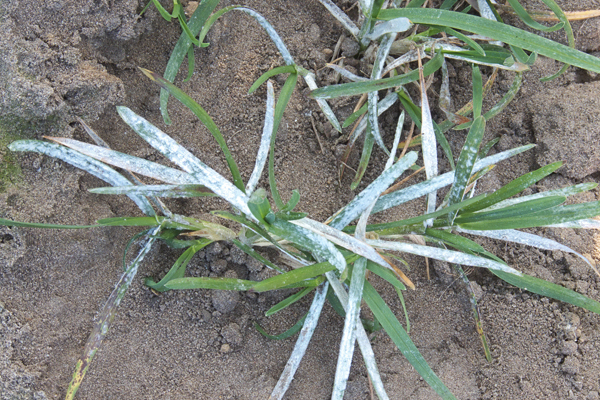
Among the causal agents of diseases, powdery mildew of wheat occupies one of the leading positions. The disease attacks all cereal crops with the exception of maize, rice and millet. This disease is widespread and occupies the same range as wheat and barley. In recent years its importance has increased due to its direct impact on yield, as well as its indirect effect, expressed in reducing the resistance of wheat to other diseases. Losses caused by powdery mildew amount worldwide to an average of 10% annually, and in Bulgaria to 10–30%. The disease causes severe damage to wheat and barley in countries with a cool and humid climate.
Symptoms: Powdery mildew can develop throughout the entire vegetation period if meteorological conditions are favourable for the development and spread of the pathogen. Symptoms of the disease can be found on the leaves, leaf sheaths and stems in the form of a white powdery coating, which initially appears as separate pustules. As the mycelium ages, it becomes denser, acquires a yellowish-grey colour and completely covers the affected plant parts.
Chlorosis is very often observed between individual infected spots on the leaves, while under the fungal mycelium the green colour of the leaves is retained for a longer time. Early infections and severe attacks lead to yellowing of the tissues and leaf scorch. In highly susceptible wheat and barley varieties, symptoms can also be observed on the glumes and the ear of cereal crops. In some relatively resistant barley varieties, the disease may appear in the form of brown necrosis on the leaves. The disease is particularly harmful when it affects the flag leaf and the ear. Under such development, the grain remains smaller, poorly filled and with reduced quality.
Causal agent: The disease is caused by the fungus Erysiphe (Blumeria) graminis De Candolle. There are over 30 specialized forms, most of which parasitize on wild grasses of the tribe Triticeae. In cereal crops, the most important are the specialized forms (f.sp. tritici – on wheat, f.sp. hordei – on barley, f.sp. secalis – on rye and f.sp. avenae – on oats). They attack specific species or genera of cereal plants and consist of numerous physiological races with different virulence towards individual host varieties.
Life cycle: The fungus forms an ectophytic (surface) mycelium and can develop only on living plants. In winter cereal species – wheat, barley, oats – from the third leaf growth stage to wax maturity, the conidial form of the disease develops. After heading, the formation of cleistothecia begins, which in our conditions ripen only in the autumn. By forming these fruiting bodies, the pathogen survives the unfavourable summer conditions. Under suitable meteorological conditions (temperature from 2–30C to 27–300C and moisture) the ascospores are discharged and cause primary infections of volunteers and young autumn crops. In our country the fungus overwinters as mycelium, while in northern countries – as cleistothecia, from which early spring infections of cereal crops occur. Maintenance of the life cycle during the summer is ensured at the expense of volunteers.
Conditions for development: Powdery mildew develops under cool and humid weather, in dense and overgrown stands, and under unbalanced and excessive nitrogen fertilization. In addition to meteorological conditions, the increased biological activity of the pathogen is also due to monoculture cultivation, as well as the choice of immunologically uniform varieties. Depending on the requirements for atmospheric humidity, the conidia of Erysiphe graminis can germinate over the entire range from almost 0% to 100%. This fungus possesses high genetic and ecological plasticity, thanks to which it easily adapts to new hosts and to environmental conditions.
Control: The most reliable means of controlling diseases in cereal crops is the use of resistant varieties. The development of resistant varieties is associated with certain difficulties, since it is necessary to study the genetic systems of two organisms – the host and the pathogen – as well as their interactions. In Bulgaria, as in many other countries worldwide, research work is focused on studying the resistance of wheat and barley varieties and lines to the causal agent of powdery mildew. The aim of these studies is to identify donors of resistance that can be successfully included in breeding programmes for the development of genotypes resistant to the pathogen.
In the infection field of the Institute of Plant Genetic Resources in Sadovo, the resistance of newly bred wheat varieties and lines to economically important phytopathogens for the crop is studied annually. Among wheat, barley, rye and oat varieties, large differences are observed in their reaction to the causal agent of powdery mildew. Among them there are both highly susceptible and highly resistant to immune genotypes. Under field conditions, in the period 2011–2014, the reaction of 243 wheat lines and varieties to the causal agents of powdery mildew and brown (leaf) rust was monitored. The assessment of the tested materials was carried out twice during the wheat vegetation period – at the beginning of stem elongation and at the beginning of wax maturity. The field assessment of the immunity reactions of the studied wheat varieties included evaluation by type of infection (I – immune; R – resistant; MR – moderately resistant; MS – moderately susceptible; S – highly susceptible) and degree of attack from 0% to 100% infected leaf area. Of all materials included in the study, a total of 146 wheat lines and varieties possessing combined resistance to both tested pathogens were selected. These are maintained in the Breeding and Genetic Department and can successfully be included in immunoselection as donors of resistance to the causal agents of powdery mildew and brown leaf rust.
The Institute of Plant Genetic Resources in Sadovo also has wheat genotypes for breeding purposes that are highly resistant to yellow rust and resistant to moderately resistant to Fusarium head blight.
In regions with a more humid and cool climate, in order to limit losses from powdery mildew, it is necessary to observe crop rotation; to avoid early sowing; to carry out sowing at optimal dates and to ensure optimal stand density; to destroy volunteers and cereal weeds that serve to maintain the life cycle of the pathogen; to apply balanced fertilization with nitrogen, phosphorus and potassium. When unbalanced nitrogen fertilization is allowed, more luxuriant and more tender plants with increased content of water, amino acids and peptides are obtained, which leads to a decrease in sugars, lower osmotic pressure of the cell sap and formation of a thinner cuticle. When such plants are infected with the causal agent of powdery mildew, the incubation period is very short, sporulation is intensive, and this leads to strong development of powdery mildew on cereal crops.
Chemical control: The use of fungicides to control the causal agent of powdery mildew in cereal crops – Erysiphe (Blumeria) graminis DC – is necessary when, after field inspection, a general attack from the first to the third leaf in the range of 10%–15% is established. Under such infection and favourable meteorological conditions for the development of the pathogen, the disease can very quickly spread over large areas. Chemical control is successfully carried out with some of the fungicides: Falcon 460 EC, Zantara, Soligor, Sfera Max, Amistar Extra, Artea 330, Credo, Talius 25 SC, Impact 25, Komugin 5, Diamant Max, Alegro, Kapalo, Fezan.