

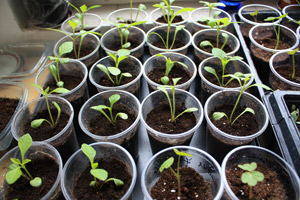
The seedlings are lying on the soil surface
The base of the stems is neither gnawed nor broken – trampling by domestic animals – dogs, cats, or the seeds have been sown too close to the surface.
The base of the stem is thinned and darkened, the plants have “fallen” onto the soil surface as if cut down – “damping-off of seedlings” – most often affects seedlings in greenhouses; it develops under improper temperature and moisture regime – high or low temperatures; excessive irrigation; dense sowing or pricking out; use of untreated seeds and manure-soil mixtures. Recommendation: Diseased plants are pulled out and destroyed together with the surrounding healthy ones. The patch beneath them is watered with a 2% solution of copper sulfate or ammonium nitrate, and the remaining plants are watered with solutions of registered fungicides.
The base of the stem is gnawed – cutworms, wireworms, crane fly larvae.
The base of the stem is softened, the plants have “fallen” onto the soil – “leakage” – occurs when grown in waterlogged substrate and at low temperatures.
Poor emergence and uneven stand establishment
No visible changes in the soil – the soil is not well aerated or the seeds are sown in cold and wet soil, or are sown too deep, or are very old and with low germination capacity.
There are changes in the soil, seeds and sprouts are pulled out and even destroyed – birds, especially early in spring – use of protective nets or repellents; mice – scattering of baits; mole crickets – scattering of baits; ants – dusting their “paths” with borax, use of repellents.
The seedlings are weak and twisted
The seeds are sown too densely. Transplanting and thinning have been carried out at an inappropriate time. Insufficient light for the pots or other containers with seedlings.
The seedlings do not develop
The soil is too cold or dry. The seedlings are not hardened.
The roots, stem bases and/or leaves are eaten
Birds, mice, slugs, springtails, sciarid flies, crickets, crane fly larvae, caterpillars of cutworms and other moths.
The leaves are perforated, gnawed, skeletonized and/or destroyed
Caterpillars of cutworms and other moths, flea beetles – in brassica crops.
The leaves are mined
Leaf-mining flies, tomato leafminer.
The leaves are mottled and/or spotted
Mosaics, yellows, powdery mildew, downy mildews, leaf mold – in tomatoes, black leaf spots. Spider mites, thrips, leafhoppers.
The leaves are preserved, but sometimes discolored and/or curled
Aphids, greenhouse whitefly.
General recommendations
Application of the principles of good plant protection practice: prevention; compliance with technological requirements; optimal agrotechnics of cultivation; ensuring an optimal temperature and moisture regime of the air and substrate in seedling facilities; sowing and pricking out in disinfected substrate; use of high-quality and authentic seeds, with high germination capacity, pre-disinfected; disinfection of equipment; cultivation of resistant varieties; removal and destruction of diseased plants; treatment with products for plant protection registered for the respective pests; in seedling facilities placing colored sticky traps – yellow for greenhouse whitefly and aphids, yellow-orange for leaf-mining flies, sky blue for thrips; application of biological control agents.