

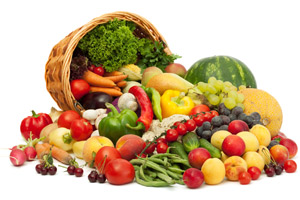
In Bulgaria, the favourable natural, climatic and soil conditions determine the great diversity of cultivated agricultural crops. Our country is renowned for its traditions in the production of fruits and vegetables with an unforgettable taste and aroma, as well as for the high-quality and abundant output derived from them.
Fruit production
The areas with orchards and soft fruit crops in our country cover about 47,000 ha*. Young plantations that have not yet come into bearing account for 12,000 ha. The country produces an average of 169,000 tonnes of fruits from fruit species. The following have the largest relative share of the total production of fruits from fruit species:
- apples – 54,502 tonnes – 32.0%;
- sweet cherries – 33,294 tonnes – 20.0%;
- peaches and nectarines – 30,483 tonnes – 18.0%;
- plums and mirabelle plums – 24,640 tonnes – 15.0%;
- strawberries and raspberries – 8,771 tonnes – 5.0%;
- table grapes – 7,079 tonnes – 4.0%.
Of the fruit produced, 65.0% is directed to the commercial network, 27.0% to the processing industry, and 4.0% is for own consumption.
Annually, about 78,000 tonnes of fresh fruit are processed, with the processed quantities increasing compared to previous years.
Sweet cherries, apples, peaches and plums have the largest share of processed fruits.
The production of finished products from processed fruits amounts to 63,000 tonnes. The share of processed products is as follows:
- 14.0% – fruit concentrates and juices;
- 37.0% – canned products (incl. jams and compotes);
- 17.0% – frozen fruits.
These three main products account for 68.0% of the fruit products manufactured.
Grape production
The total area under vineyards in Bulgaria is 63,000 ha, including 53,000 ha of vineyard areas in farms, of which 32,000 ha are harvested.
The grapes processed for the production of wine and grape must, declared by registered wine producers to the Executive Agency on Vine and Wine, amount to 104,000 tonnes.
According to provisional data for 2015, fruit crops show an increase in harvested area as well as in production, with the exception of apples and sour cherries, for which a slight decrease is reported.
The areas with newly planted and young plantations that have not yet come into bearing show a positive trend in recent years.
A lower average yield is reported for almost all fruit crops in the last year compared to the previous one, due to adverse climatic conditions.
Vegetable production
The areas used for vegetable production in agricultural holdings amount to about 34,000 ha, of which 33,000 ha are open-field areas and 900 ha are greenhouse areas.
The most significant crops in terms of national production are tomatoes, cucumbers, peppers, potatoes, watermelons, head cabbage and aubergines.
The total production of vegetables from open-field and greenhouse areas is 520,000 tonnes.
The following have the largest share of total production:
- potatoes – 132,561 tonnes – 26.0%;
- tomatoes – 120,489 tonnes – 23.0%;
- cucumbers (total) – 51,297 tonnes – 10.0%;
- peppers – 49,909 tonnes – 10.0%;
- head cabbage – 42,347 tonnes – 8.0%.
The production of vegetables from open-field areas only is 427,000 tonnes, representing 82% of total production.
The production of vegetables from greenhouse areas is 93,000 tonnes, accounting for 18% of total production.
The production of cultivated mushrooms is 2,200 tonnes.
The following crops have the largest relative share of greenhouse production – cucumbers, tomatoes, lettuce and leaf lettuce, and peppers.
In recent years, there has been a trend of increasing quantities of products produced from greenhouse areas (mainly cucumbers, lettuce and leaf lettuce).
Greenhouse production allows yield planning when appropriate vegetable growing technologies are applied and observed. This type of production ensures stability of the quantities of vegetables produced, as well as their year-round supply to the market or for export.
The higher average yield of some of the main vegetable crops is the result of applying appropriate cultivation technologies and the use of high-quality, certified seeds by agricultural producers.
Of the vegetables produced and intended for the commercial network, 69.0% are marketed fresh. Vegetables delivered for industrial processing to enterprises account for 18%, and those for own consumption – 13.0%.
The processing of fresh vegetables averages 17–19.0% of the total vegetable production in the country, or about 88,000–97,000 tonnes. Tomatoes have the largest share in vegetable processing (of the total quantity of vegetables for processing) with 42.0%, followed by peppers – 20.0%; aubergines, peas and gherkins – a total of 12.0%. The share of all other vegetable crops for processing is 26.0%.
According to provisional data for 2015, most of the main vegetable crops such as tomatoes, potatoes, melons and watermelons show lower production compared to the same period of 2014. The decrease is between 8% and 24%, most pronounced for watermelons. On the other hand, pepper production is 17.4% above the level of one year earlier.
Compared to the previous year, at this stage a lower average yield is reported for tomatoes, watermelons and melons, and a higher average yield for potatoes and peppers.
Support with European funds and state budget funds
Producers of fruits and vegetables (open-field and greenhouse production) are supported in the current programming period in three ways:
- with funds from the European funds;
- under measures of the Rural Development Programme (also European funds);
- with funds from the state budget.
I. The first way of support is with funds from direct payments (European funds) through the following schemes:
- Single Area Payment Scheme (SAPS) – indicative rate BGN 162.00/ha for 2015;
- Coupled support scheme for fruits (indicative rate BGN 1,662.00/ha for 2015);
- Coupled support scheme for vegetables (open-field production) – (indicative rate BGN 2,071.00/ha for 2015);
- Coupled support scheme for vegetables – greenhouse production (indicative rate BGN 8,814/ha for 2015);
- Redistributive payment scheme (indicative rate BGN 148.60/ha for 2015);
- Payment scheme for agricultural practices beneficial for the climate and the environment – green direct payments (indicative rate BGN 125.70/ha for 2015);
- Young farmers scheme (indicative rate BGN 40.50/ha for 2015).
The guaranteed separate budgets for the schemes for coupled direct support for fruits and vegetables will be in addition to the main direct payment schemes – the Single Area Payment Scheme and the green direct payments.
Under direct payments, Bulgaria has notified the European Commission of the implementation of three schemes of coupled support for fruit and vegetable producers for the period 2015–2020, as follows:
1. Coupled support scheme for fruits – eligible for support are farmers with eligible areas of at least 0.5 ha (together or separately) of the following species: apples, pears, apricots and apricots (local varieties), peaches and nectarines, plums (Prunus domestica), sweet cherries, sour cherries, walnuts, table grapes, strawberries and raspberries. The budget for 2015 under this scheme amounts to EUR 20,024,464, and the expected level of support is about EUR 507/ha.
2. Coupled support scheme for vegetables – eligible for support are farmers with eligible areas of at least 0.5 ha (together or separately) of the following vegetables – open-field production: tomatoes, peppers, cucumbers, gherkins, head cabbage, bulb onions – dry, aubergines, carrots, garden peas – green, garden beans – green, garlic – dry, potatoes, watermelons, melons and pumpkins. The budget for 2015 under this scheme amounts to EUR 17,861,580, and the expected level of support is about EUR 470/ha.
3. Coupled support scheme for greenhouse vegetables – eligible for support are farmers with eligible areas of at least 0.5 ha (together or separately) of the following vegetables (greenhouse production): tomatoes, peppers and cucumbers. The budget for 2015 under this scheme amounts to EUR 2,650,000, and the expected level of support is about EUR 2,500/ha.
Given the relatively smaller size of holdings in the sector, fruit and vegetable producers also benefit from the introduction of the redistributive payment in the form of a top-up for the first 30 ha for all holdings (launched in 2014), as well as from the small farmers scheme, providing a payment of EUR 500 to EUR 1,250 per holding (voluntary entry into the scheme only in 2015).
II. The second way of support is through financing under measures of the Rural Development Programme 2014–2020. The “Fruit and vegetables” sector will be a priority for support under the Programme through the setting of project evaluation criteria and targeted calls. Fruit and vegetable producers may apply with projects under the following measures of the RDP 2014–2020 (European funds):
Measure 4 – Investments in physical assets;
- Sub-measure 4.1. Investments in agricultural holdings;
- Sub-measure 4.2. Investments in processing/marketing of agricultural products;
- Sub-measure 6.1. Start-up aid for young farmers under Measure 6 “Farm and business development”;
- Measure 9 – Setting up producer groups and organisations;
- Measure 10 – Agri-environment-climate;
- Measure 11 – Organic farming.
III. The third way is support with funds from the state budget through state aid schemes:
- State aid for investments in agricultural holdings through corporate tax relief