

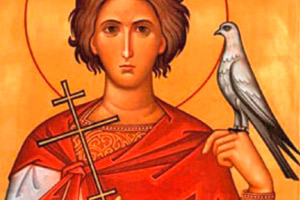
On 1 February (new style) we venerate Saint Trifon Zarezan. Congratulations to those celebrating their name day, to vine-growers, gardeners and falconers! “Let there be abundance! May it overflow across the thresholds!” The National Vine and Wine Programme will be implemented as a financial instrument in Bulgaria until 2018.
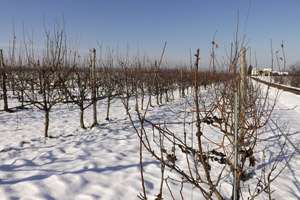
It is believed that Trifuntzi (as Trifon Zarezan and the two days following him are called) originate from the Dionysian feasts, already known in the time of the Thracians. Today Trifon Zarezan is a Bulgarian folk feast in honour of Saint Trifon, born in the Asia Minor province of Phrygia, in the town of Apamea, which is considered one of the ancestral homelands of the vine and wine. Therefore, on this day the ritual “pruning” is performed. The housewife kneads ritual bread and prepares a hen, which by tradition is stuffed with rice or bulgur. In a new woollen bag are placed the loaf, the hen and a wine-flask. With such bags slung over their shoulders, the men go to the vineyard. There they cross themselves, take the pruning knives and from three vine stocks each cuts three canes. Then they cross themselves again and pour the brought wine over the vines.
In Northern Bulgaria (the regions of Ruse, Tarnovo, Pleven, Vratsa) on this day a king of the vineyards is chosen. When they gather, the vine-growers place on the table a sprig of basil wrapped with red thread, and three vine canes, and the oldest says: “Whoever is blessed, let him take the sprig and become Trifon (king).” Whoever wishes, stands up, takes the sprig and offers congratulations to everyone. The king then gives his blessing: “Let it be blessed and bountiful! On every vine a bushel, and from every stump a full measure!” Everyone answers “Amen”. It is customary that the king be more prosperous, because he must treat everyone, and also that he be lucky, i.e. that during his reign (Trifon’s reign) there has been great fertility. When the eating and drinking in the vineyards is over, they set off for the village with bagpipes, fiddles and drums.
It is a little-known fact that Trifon Zarezan is also a feast of falconry, an ancient hunting art dating back 10–12 millennia. In the Ottoman Empire during the 15th–18th centuries, the dogandzhii (falconers, translated from Turkish) were held in high esteem; they were a specific category of population with special duties. They bred and tamed falcons and hawks for hunting for the Sultan’s court. In return, they were exempt from certain taxes and had the right to possess land (ancestral holdings) or chifliks free from specific obligations. At that time the Bulgarian lands were a major supplier of falcons, hawks and eagles to meet the demand for trained birds of prey of the aristocracy in the Ottoman Empire. Thus, falconry in our country became a state-organised livelihood for a considerable part of the population in villages in the semi-mountainous and mountainous regions.
Let us return to our agricultural reality, where modern vine-growers receive state and European support for their vineyards and traditions have been turned into financial instruments for restructuring and conversion of vine plantations.
According to the State Fund Agriculture, by 29 January 2016 a total of 130 applications under 132 projects for financial assistance under measure “Restructuring and Conversion of Vineyards” from the National Support Programme for the Wine Sector 2014–2018 had been submitted. The projects have an implementation period of 2016–2018 and amount to 60,662,483 leva. The measure may be used by owners, tenants or leaseholders of vine plantations, registered as a vine-growing holding and having obtained a certificate of eligibility for participation issued by the Executive Agency on Vine and Wine.
The National Vine and Wine Programme will be implemented as a financial instrument in Bulgaria until 2018. It is financed by the European Agricultural Guarantee Fund (EAGF), and its objective is to increase the competitiveness of Bulgarian vine-growers. The total budget for the intake is 92.809 million leva.