

An international investment worth 55 million euro intends to revitalize the labor market in the municipality of Razgrad by providing approximately 500 new jobs. An economic stimulus in the agricultural sector or small-scale seasonal profit?
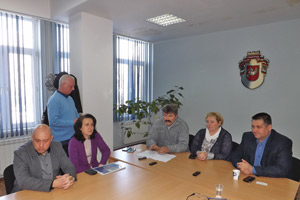
A plant for the production and processing of oyster mushrooms is to be built in the area of the municipality of Razgrad. The pilot project is a joint venture between Bulgarian, Russian and Ukrainian investors, registered in the Commercial Register in Bulgaria. At the meeting held on 22 January in the building of Razgrad Municipality, the managers of the Bulgarian company “Bio-Agro-Resurs plus” Ltd. – Mladen Stanev and Lidiya Rumyantseva – were present; they made a presentation of their investment intentions to the mayor, Dr. Valentin Vasilev, and the media in attendance.
The company’s plan is first to rent the building of the former gendarmerie in the town, with two additional units to be constructed alongside it, where the mushrooms will be cultivated and processed. The total built-up area will be 56 decares, and an additional 25 decares will be used for parking.
Oyster mushrooms will be cultivated on wheat straw with additives, and new technologies and a patent will be used in order to achieve a clean ecological environment.
External markets have been secured for the realization of the production. Part of the mushrooms will be offered fresh, another part – marinated. A third part will be deep frozen with vacuum drying – using the technology applied in the production of space food.
The investors promise 500 new jobs in the area, intended mainly for people with basic education. They believe that, in addition to the initially announced number of jobs, accompanying positions will also emerge. The specialists engaged in mushroom production will be about 30–40 people. The total investment amounts to 55 million euro. It is still not known whether there will be European co-financing of the project and what its amount will be, as well as how the obligations will be divided among the different investors. And this time, will it be business development or small-scale profit?
Measure 112 – Setting up of holdings for young farmers
It was not so long ago that projects for the production of wood-decaying mushrooms in the Rhodopes, two years ago in the previous programming period, were fashionable. Their objective, however, definitely was not the application of the rules and standards of the “Rural Development Programme”, and even less to have any economic effect on the region or to create sustainable employment in the sector. In principle, when constructing mushroom houses there are mandatory steps, which include renovation of buildings (in case the premises where the mushrooms will be grown are not new), installation of special racks, climate control system, ventilation, lighting, as well as technology/technologies for marketing the production. The costs are not small and required a serious initial investment, which most small farmers did not have available. In most cases, logs in the field were inoculated with mycelium, which formally met the requirements of the regulation, but not its objectives. Nevertheless, money was received under Measure 112, with apparent implementation but without any economic value. The production obtained under this type of cultivation turned out to be low, only 1–2 kg of mushrooms per log and not for more than 2 years. “On one decare there are about 3,000 logs and the total yield is as much as from one mushroom house with an area of 300 sq. m for one crop, whose technological growing period is approximately 3 months,” as noted by Dipl. Eng.-Technologist Velichko Spasov, co-owner of “Micel” Ltd. The results were evident: applications for projects for oyster mushrooms, cultivated not under specific conditions but in the field, on a small scale, in order to pocket some money. This led to a number of misunderstandings in the start-up and development of this type of agricultural business such as mushroom production.
Oyster mushroom (Pleurotus ostreatus)
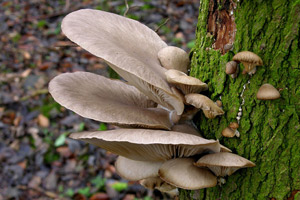
The oyster mushroom is a species of basidiomycete fungus of the genus Pleurotus. What is specific about this mushroom is that it manages to decompose forest wood, reproducing relatively quickly in large, tongue-shaped fruiting bodies. The mushroom is popular in cuisine because it is extremely easy and intensive to cultivate. It is widely distributed both in our country and worldwide. The oyster mushroom fruits in the period September–December (most often between September and October) in deciduous forests. It belongs to the predatory fungi and can paralyze nematodes in order to extract the nitrogen necessary for its development. The flesh of the oyster mushroom is rich in proteins, including all essential amino acids, potassium, phosphorus and iron. Another little-known fact about this mushroom is its ability to purify water from oil waste. During its cultivation, the mycelium (the body of all fungi is composed of mycelium. It can be unicellular or multicellular) forms a mat, which is placed over the contaminated area, absorbing the oil. It is easily distinguished from other wood-decaying forest mushrooms. The pale yellow oyster mushroom (P. cornucopioides) and the king oyster mushroom (P. eryngii) resemble the oyster mushroom, but differ in season and habitat. The pale yellow oyster mushroom fruits in summer and early autumn, while the king oyster mushroom is found around the roots of field eryngo.
Classification
Kingdom: Fungi
Division: Basidiomycota
Class: Homobasidiomycetes
Order: Agaricales
Family: Pleurotaceae
Genus: Pleurotus
Species: P. ostreatus
Cultivation
In recent years the mushroom has been cultivated intensively throughout Europe. The share of cultivated edible mushrooms is growing, and the oyster mushroom, together with other similar species, accounts for approximately 25% of global production. Despite the relatively easy conditions for its cultivation, for example on a suitable substrate or wood, under favorable atmospheric conditions, the mushroom requires specific knowledge and experience that lead to maximum and high-quality yield. There are several varieties for cultivation, called strains, each of which has special qualities related to cultivation for business purposes.
Among them are: Les – 1, INRA 3001, Somycel 3001, 3004, 3025, 3200, 3210 and
NK 35
Each strain determines when during the year fruiting will occur; there are summer and winter strains. Mycelium of each strain is purchased from specialized laboratories. In Bulgaria, one of the large biotechnological laboratories for the production of mushroom mycelium, equipped with modern equipment and technology, is “Micel” Ltd., Plovdiv, where one can learn everything about mushrooms: from consultations on their cultivation to the design of mushroom houses, climate control installations and suitable, certified substrates for the development of high-quality production. www.micel-bg.com
Besides the type of substrate, which is responsible for fruiting, another important condition for high yields is humidity and temperature, which must never fall below zero. Since temperature and humidity must be controlled and regulated, mushroom producers use mushroom houses in unfavorable weather or until the full development of the mushrooms.