

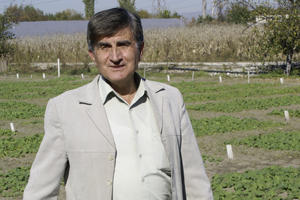
Leading scientist in the field of herbology, Prof. Dr. Tony Tonev, a lecturer at the Agricultural University of Plovdiv, turned 60. From the position of this wise life springboard, he stated: "I thank fate for assigning me such an exciting place for professional realization. For me, the greatest challenge is never to give up, as well as not to forget that I have the privilege of working in what is my true calling and that I love very much!" A two-part interview.
Part 1 - weed behavior in the context of climate anomalies, GMOs, competition in the agrochemical industry, myths and theories about the ideal hybrid.Prof. Tonev, is there a change in weed behavior in the context of climate anomalies, abiotic turbulence, the expansion of invasive species, and the shift in production attitudes and technologies?
Undoubtedly, exceptional dynamics are observed in the behavior of weed associations. The complex of conditions, including the applied agricultural practices and the natural-climatic changes in recent years, have led to serious changes in the composition of weed vegetation both on a global and regional scale.
What is the situation in Bulgaria?
During the long political period of transition in our country, accompanied by economic stagnation, part of the agricultural land was left without any cultivation for a long time. This neglectful attitude became one of the reasons for the changes that occurred in the weed composition. For example, some meadow grasses, harmless until recently – such as oat grass and hair grass, invaded our wheat and rapeseed fields. These small-seeded cereal weeds proved to be much more strongly resistant and less sensitive to both mechanical cultivation and herbicide intervention. On the other hand, the replacement of traditional deep plowing with soil layer inversion with subsoiling, combined with surface cultivation, largely stimulated their multiplication. Due to European restrictions regarding the authorization of plant protection products, the use of highly effective herbicides with a long persistent period was banned. Their replacement with soil herbicides from other groups with a short after-effect period became a prerequisite for the emergence of secondary weed infestation because the agricultural crops remained unprotected for 2-2.5 months.
Another problem is weed resistance to traditional active ingredient bases. The case of the emerging limited efficacy of sulfonylureas against corn poppy is a telling example in this regard. The reason is the emergence of resistance to herbicides with similar active substances. Another major problem in the herbicide control of weeds is the development of compensatory processes. Cases are not uncommon where, despite the massive intervention with the same chemical agents, some weeds remain unaffected and quickly occupy all available living space. In other words, from harmless and weakly competitive, they become significant. Here comes to aid the golden rule in agronomic science and practice: the frequent rotation of herbicides and other plant protection products, as well as the demonstration of a more flexible approach in the choice of agrotechnical means.
Do you think that the mega-competition between leading companies in the global agrochemical industry leads to increased effectiveness and quality characteristics of plant protection?
Undoubtedly, loyal competition among the world's leading manufacturers improves the quality of plant protection. They are committed partners of agricultural producers – they invest colossal financial resources in discovery and implementation activities. This large-scale competition is another reason for the farmer to win. The Bulgarian farmer has the privilege of choosing the best from the world's achievements in the field of plant protection.
Is there a place for GMOs in the fight against weeds?
My personal opinion and the experience I have in a purely agronomic sense is that genetically modified plants are a remarkable achievement in the field of plant breeding with vast possibilities. The application of plant protection technologies with GMO plants has the potential to improve, on a global scale, the phytosanitary condition of agricultural crops, as well as the economic condition of farmers. My limited knowledge of medicine and healthcare does not allow me to express a competent opinion on the qualities and benefits/harms of foods produced from GMO agricultural products.