

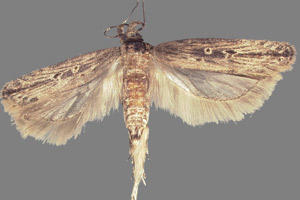
Similar to the potato tuber moth (Phthorimaea operculella), the Guatemalan potato moth (Scrobipalpopsis solanivora) attacks potatoes in the field and in storage. The adult moths fly at night over short distances. In the field, the females lay eggs on the soil or on tubers not covered with soil, and a small number of eggs are laid on the leaves and stems. The newly hatched larvae bore into the tubers and feed inside them. While feeding, they create tunnels and completely destroy the tubers. After completing their development, they leave the tubers through round openings with a diameter of 2–3 mm in order to pupate. In storage, the moths lay their eggs on the tubers. The larvae pupate in the soil, on the walls of the storage facilities, in sacks or, less frequently, accidentally on the tubers.
The damage caused by the Guatemalan potato moth resembles the damage caused by the potato tuber moth. In the tunnels formed by the feeding of the larvae there are food residues, larval skins, and excreta. Stored potatoes can be completely destroyed within 3 months.
Damaged potatoes are not suitable for seed, and those that are more heavily infested are not suitable for human or animal consumption.
In countries where the pest is present, various integrated control measures are applied:
1. Agrotechnical measures:
- Crop rotation;
- Use of healthy planting material;
- When tubers are planted, they are covered with a 10 cm layer of soil to prevent egg laying on them;
- During cultivation and other operations, exposure of the tubers must not be allowed;
- Removal of the harvested potatoes from the field on the day of lifting (the moths are nocturnal insects and at night they lay their eggs on the tubers).
2. Chemical control
- Many insecticides based on organophosphates, carbamates and pyrethroids have been tested. They mainly protect the above-ground parts of the plants. In cases of severe infestation, they cannot solve the problem of protecting the tubers.
3. Biological control – under development in Latin America
- Baculovirus phthorimaea, used for the control of the potato tuber moth, is also effective against the Guatemalan potato moth. A bioinsecticide based on the baculovirus is being developed.
- In Venezuela, the potential of the entomopathogenic nematode Steinernema feltiae is being studied.