

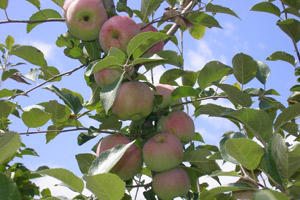
Fruit orchards occupy the same area for an extended period. Their establishment requires significant financial investment and labor, which necessitates that producers comply with the basic requirements of the individual crops. Furthermore, they must also consider modern consumer demands for fruit free of pesticide residues, as well as the protection of soil and water from pollution. Sites for new orchards must meet the biological requirements of the fruit species and variety. Unsuitable for fruit orchards are locations where winter temperatures fall below the critical thresholds for a given fruit species, and summer temperatures rise above 35-37°C.
Soils suitable for fruit orchards must be sufficiently aerated, with good water-holding capacity and permeability. These requirements are met by alluvial-meadow soils, typical leached chernozems, cinnamon forest soils, and gray forest soils.
For up to 4 years, fruit orchards should not be established on sites previously occupied by the same species. It is very important that fruit orchards are established on areas free from infection by crown gall caused by the pathogen Rhizobium radiobacter syn. Agrobacterium tumefaciens.
The most reliable way to reduce pesticide use is the selection of varieties that are resistant or less susceptible to economically important diseases – apple scab and powdery mildew on apple, cylindrosporiosis on cherry, brown rot on cherry and sour cherry, and peach leaf curl.
Before establishing fruit orchards, careful consideration must be given not only to the selection of varieties but also to the planting scheme, especially if the orchard is mixed. When arranging the species and varieties, it is imperative to consider pollination and the protection of the trees and fruit crop from pests. A well-considered orchard planting scheme is a prerequisite for reducing pesticide use throughout the entire cultivation period of the fruit species.
The varying susceptibility of apple, pear, sweet cherry, sour cherry, and plum varieties to the most economically important diseases, the different fruit ripening times, and the phenophases of flowering allow for the application of differentiated plant protection. This avoids unnecessary spraying for individual varieties.