

Green cheese from Cherni Vit village made Bulgaria famous at the "Cheese 2015" World Exhibition
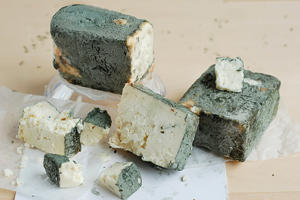
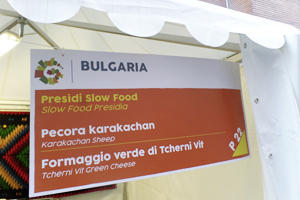
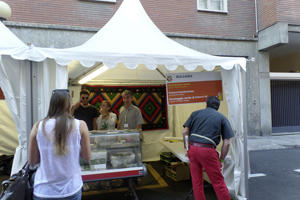
The green mold cheese from the village of Cherni Vit in the Teteven region became one of the most popular exhibits at the "Cheese 2015" World Exhibition in the Italian city of Bra from September 18th to 21st. "Although we participated in this year's edition with twice the quantity, the cheese sold out already on the first day," said the discoverer of the ancient recipe - Tsvetan Dimitrov.
International cheese experts and connoisseurs from countries such as France, the Netherlands, Italy, the United Kingdom, and Spain visited the exhibition to see the unique green cheese from the village of Cherni Vit, specially featured at the Bulgarian stand. "A group of cheese specialists from Trento came to taste it on the spot - they had heard about it during my lecture in Belgrade," recounts Tsvetan. Many visitors to "Cheese 2015" explained they were drawn to the Bulgarian stand after trying the green cheese in the exhibition's tasting tents.
The product is made from first-class white brined cheese, prepared from raw sheep's milk. During maturation, it is covered with a natural green mold, which gives it an aroma of damp earth, a piquant aftertaste, and a creamy consistency. Specialists say this is a cheese unique to the Balkans and one of only three in Europe that develop mold naturally. It has been traditionally prepared for centuries in the village of Cherni Vit, where people kept the white sheep cheese in wooden tubs. The brine drained through the pores of the wood until the cheese dried completely. In summer, it was stored in the mountain pasture sheepfolds, and in autumn, it was brought down to the village cellars. It matured at temperatures of 10-12 degrees Celsius and constant humidity. In spring, when people opened the wooden tubs, upon contact with the cold and damp air, the cheese became covered with green mold.
The people of Cherni Vit believed the mold spoiled the cheese, so in the last decades of the 20th century, they replaced the wooden tubs with plastic containers. Thus, the mold began to disappear, and with it, the green cheese.
Eight years ago, an expedition by the international organization Slow Food, which works to preserve traditional foods, varieties, and breeds, was planned in Bulgaria. "A friend called me and asked me to find dairy products made from ancient recipes in our area," recounts 44-year-old Tsvetan, who was the mayor of his native village of Cherni Vit at the time. "I had about ten days and started touring the Teteven region. I remembered that in my childhood in the village, I had eaten this green cheese. We started searching for it door to door, but it turned out no one produced it anymore because people used plastic containers instead of wooden tubs. A friend suggested we go to the house of Grandma Nenka and Grandpa Kolio - their home is in the Teteven Balkan, at 1200 meters above sea level and a 3-4 hour walk from the village, with no electricity, no running water, and there was a chance the recipe had been preserved with them." Indeed, the elderly couple, who raise about 80 goats and sheep, had not replaced the wooden tubs with containers, and in their cellar, they found a little green cheese - a piece the size of a matchbox, left over from the previous year.
At the tasting with the Slow Food experts, other local traditional dishes were also offered - halva made from fresh cheese, known in this Bulgarian region as "The White Man," *krokmač*, various sweets with milk and cheese. When the hereditary cheese expert - the Italian Piero Sardo, tried the green cheese, he was delighted and said the Bulgarian delicacy had no equivalent in the Balkans.
Tsvetan Dimitrov and three biologists connected with the Teteven region undertook to study the environment in which the green cheese ages and analyzed the sheep's milk produced in the area. It is milked from the Teteven sheep - a breed of which fewer than 10,000 animals remain. According to Tsvetan Dimitrov, the protein composition of the milk in this Bulgarian region is specific. After many attempts, the old technology for producing the traditional product was revived, and small quantities were obtained. Thus, the mold cheese, which the people of Cherni Vit thought was spoiled, went to the "Cheese" World Exhibition in Italy, where it was highly praised by specialists. This spring, it was also presented at a tasting in the European Parliament, and a few days ago, it again caused a sensation at the tenth edition of the exhibition in Bra.
Meanwhile, some of the local people in Cherni Vit have already been trained to make green cheese. "This year, young people from Teteven also showed interest in its production - one raises goats, and the other has a small restaurant and tends a herd of 80 goats," says Tsvetan.
The idea is to attract rural tourism enthusiasts with the unique product and revitalize the village. And Dimitrov succeeds - at the last authentic folklore gathering "From Timok to Vita," the four guesthouses and the small hotel in the village of Cherni Vit were full of tourists.
Mass production of the green cheese is out of the question - although it is part of the national culinary heritage, the authorities refuse to permit its preparation, arguing that hygiene standards are not met. Here, as in other European Union countries, the traditional production of cheese from raw milk is at risk because the control bodies do not recognize the flexibility of the European regulations on food hygiene and safety and apply very strict measures, says the coordinator of Slow Food for Bulgaria, Assoc. Prof. Desislava Dimitrova.
About "Cheese 2015"
"Cheese 2015" is an international cheese exhibition organized by Slow Food. This year it was held in the city of Bra, Italy, from September 18th to 21st. Besides the green cheese, cheese from the milk of the Karakachan sheep, produced in the Pirin region, was also supposed to be presented at the Bulgarian stand, but the participation of one of its masters - Sider Sedefchev, failed at the last moment due to illness.
The "Cheese 2015" exhibition included 144 exhibitors from the Italian market, 25 exhibitors from the international market, 10 food trucks, there were 10 stands on the Street of Food, 33 Italian Presidia, 13 international Presidia, 32 workshops, 7 taste laboratories, 36 breweries on the Beer Square.
The Slow Food movement has millions of followers worldwide who support the preservation of quality local products, seek out and restore traditional production methods, and protect traditional varieties and local animal breeds from extinction.
Slow Food has a built network of members and local structures in over 150 countries.