

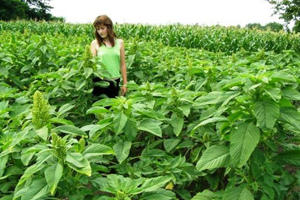
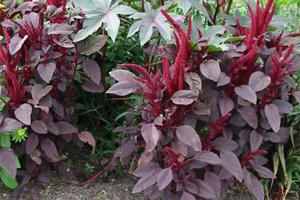
Amaranth is an annual plant from the Amaranthaceae family. This plant is related to the various species of amaranth found in our country, which grow mostly as weeds.
It originates from Central and South America, where over 8000 years ago it was the second most important food (after corn) for the local population – the Incas and Aztecs. After the arrival of the Spanish, the plant was completely banned because it was believed to have been used for pagan rituals and sacrifices. Today, it is cultivated in Mexico, Peru, the USA, Nepal, and India, where it is an important part of local cuisines. There are many species and varieties of amaranth, which are used in different parts of the world for different purposes - as a "grain" substitute, a leafy vegetable, or ornamental plants.
Forage or grain varieties have a long growing season under non-chernozem soil conditions. Throughout the season, they only increase their green mass and hardly flower. Amaranth seeds are small (about 1.4 mm), shiny, and have a black, pink, yellow, or greenish color. This plant is drought-resistant, heat and light-loving, self-pollinating, and surprisingly disease-resistant.
Why is there such interest in the small seeds of amaranth at the moment?
Recently, the Food and Agriculture Organization (FAO) of the UN declared amaranth the crop of the 21st century.
The reason lies in their very high nutritional value. Depending on the variety, the crude protein content in the seeds is between 12.5% and 17.5%, and they are particularly rich in lysine, unlike true cereal grains. The amino acid balance surpasses that of cereal grains. FAO and WHO have a scoring system that determines protein quality (the ratio of amino acids). According to this system, amaranth (depending on the species and variety) scores 67 to 87 points out of 100 possible. For comparison, wheat with an average of 14% protein scores 47 points; soybeans 37% - 68-89 points; rice 7% - 69 points; corn 9% - 35 points. In addition to protein, amaranth seeds are also rich in fats - 6-10%, with 3/4 being unsaturated. They do not contain gluten, which means it is an excellent alternative for people with allergies to common cereal grains (amaranth grain is not actually a grain). Compared to cereal grains, they are richer in fiber, and compared to wheat, they are 2-4 times richer in calcium, iron, and magnesium. Calories are about 400 per 100 grams. Amaranth oil also contains a number of valuable components that significantly contribute to its high biological value – phytosterols, vitamin E, squalene, etc. A distinctive feature of the vitamin E complex in amaranth oil is that it is mainly composed of the more active tocotrienol form of the vitamin, while in most vegetable oils the more passive tocopherol form predominates (mainly alpha-tocopherol). It has been established that the antioxidant properties of the tocotrienol form of the vitamin are 40-50 times higher than those of the tocopherol form, which determines the exceptionally high biological activity of this oil. Squalene is another valuable component of amaranth oil, whose content (about 8%) is incredible for a plant source. It is ten times higher than that in shark liver oil, one of the most valuable vegetable oils.
Grain amaranth has many valuable qualities, but it also has serious drawbacks that hinder its wider cultivation, for example:
- The seeds are very small, which makes sowing difficult.
- They must be sown shallowly to germinate - 0.5 cm. (only in extreme cases at 1 cm.), and in dry weather at this depth there is not enough moisture.
- Under good conditions, most varieties become too tall - 1.5-2.5 m., and the seeds are at the top. This complicates mechanized harvesting.
- In bad years, lodging becomes a serious problem.
- If harvesting is delayed, the seeds begin to fall.
Cultivation
First, seeds are sown for seedling production. This can be done from early April to the end of May (for Southern Bulgaria). Seeds germinate at a soil temperature above 15-18 degrees. Transplanting is done after the danger of frost has passed and the plants have become large enough. The approximate spacing is 40-50 x 20 cm. (for manual harvesting it can be denser). Care includes: weeding, watering (if needed) and hilling up the plants to prevent lodging in strong winds. Several studies show that amaranth needs 50-60% of the water required by corn, i.e., almost half as much. Despite this, irrigation is practically mandatory during drought. Under good conditions, about 200 kg./decare are normal yields. When the seeds begin to ripen - they fall when shaken. Then the tops with the seeds are cut off and left to dry.
Varieties known in Bulgaria
1. Alegria variety – is the most widespread in our country and is grown for its grain. The plants are red, pink, and orange. Its height reaches 1-1.5 m. They are covered along their entire length with green succulent leaves (up to 200 per plant) on numerous branches - passages. The top ends with a complex spicate inflorescence (upright or drooping panicles). The seeds are white-yellowish. Upon careful observation, it can be seen that they are significantly larger than those of amaranth (the weed plants).
2. Kallaloo variety – this variety is of the vegetable type, i.e., only its leaves are used. The plant is fast-growing and easily reaches 2 m. The leaves are much larger than those of amaranth. Under our conditions, it can be used during the summer as a substitute for spinach, which has bolted by that time. The leaves contain as much oxalic acid as spinach, so it is not recommended to consume more than 100 grams per day to avoid calcium deficiency. The nutritional value of the leaves is admirable - in fresh state they contain 2-4% protein, and are also particularly rich in vitamin C - 80-200 mg./100 gr. - for comparison, in lemons, which are often used as a benchmark, it is 50-60 mg./100 gr. They are also particularly rich in carotenoids (sources of vitamin A) - about 3-5 mg./100 gr. The amounts of potassium, iron, calcium, magnesium are also significant. Cultivation is similar to that of the Alegria variety. First, seeds are sown for seedling production, usually from April to the end of May. Transplanting is done after the danger of frost has passed. The approximate spacing is 40-50 cm. x 30 cm. Care includes: weeding, watering (if needed), and regular cutting of the stems at 10-20 cm from the soil - they should not be allowed to form flowers, as this worsens the quality of the leaves and reduces the yield. It should be taken into account that amaranth, as a leafy vegetable, accumulates nitrates and prefers nitrogen-rich soils.