

![MultipartFile resource [file_data]](/assets/img/articles/овощна-градина-декември-2025.jpg)
During the month, the forecasted minimum temperatures will be up to -10°C, in conditions without snow cover, with a more prolonged duration. Expected precipitation in December, close to the monthly norm, will increase soil moisture reserves in the 100 cm soil layer to levels close to the field capacity – FC.
Above-normal temperatures are forecasted for the beginning of December. A decrease in temperatures is expected at the end of the first ten days of December.
During the second and early third ten-day periods, the forecasted average daily temperatures will exceed climatic norms.
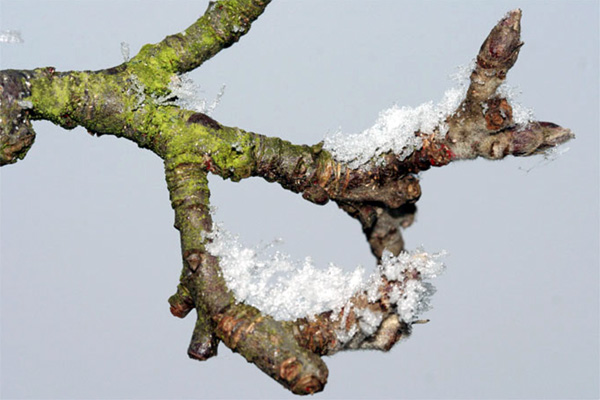
In the eastern regions, maximum values of over 14-15°C are forecasted, with a possibility of inducing undesirable, premature bud swelling in some early-flowering fruit species, which would lead to a reduction in their cold resistance.
Agrotechnical measures
In fruit plantations
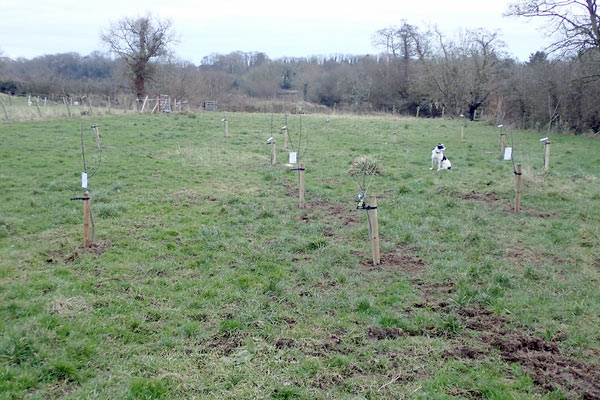
Work on planting new trees and filling in gaps in young plantations can continue until the first more lasting soil freeze.
Work on fencing the plantations with netting continues.
Wire structures are being built for newly established plantations, using concrete posts 2.5 m long and 8/8 cm in cross-section. They are driven to a depth of 50 cm. The end posts are reinforced with supports, and the distance between posts in the row is 15-20 m. Pruning of fruit plantations continues.
Which diseases during fruit storage can worsen their quality
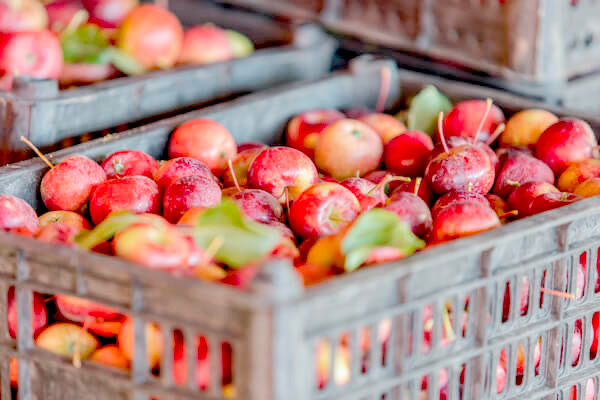
The faster fruits are cooled after harvesting, the longer they will be preserved. Apples are stored at 0 °C, and pears at -1 °C ± 1.5 °C. Large temperature fluctuations adversely affect quality.
In fruit storage facilities, the storage regime is monitored and adhered to.
Seeds are stratified.
In strawberry plantations
If there is a risk of newly planted and young plants being pulled out, the soil around them is tamped down. Strawberry plants are planted in heated greenhouses.
The condition of strawberry seedlings stored in cold chambers for spring-summer planting is checked.
In raspberry plantations
If plants are pulled out, they are tamped down promptly. To prevent stagnant water from freezing, drainage is carried out. New wire structures are installed, and old ones are repaired.
Plant protection measures
In fruit plantations
Given the need for winter spraying, all plantations are inspected to determine the density of economically important diseases and pests. To determine the density of mites, 40 twigs, 8-10 cm long, collected from 10 trees, and 5 cuttings of old bark, measuring ½ cm2 for every 10 decares of plantation, are examined. The collected twigs are inspected under a binocular microscope. Similarly, the overwintering stock of other pests (winter eggs of aphids, larvae of plum and San Jose scale, etc.) is determined.
The eggs of the apple-plantain aphid (Dysaphis plantaginea Pas.) are elongated-oval, black, and shiny. The eggs of the green apple aphid (Aphis pomi De Geer.) are elongated-oval, yellowish-green when laid, turning black and shiny after a few days. They reach about 0.5 mm in length. The eggs of the pear aphid – Dysaphis (Pomaphis) pyri B.d.F. are elongated-oval, black, and shiny. The eggs of the black cherry aphid (Myzus cerasi Fabr.) are elongated-oval, black, and glossy. The eggs of the large peach aphid (Pterochloroides persicae Chol.) are elongated-oval, glossy, reddish-brown when laid, later black. The eggs of the green peach aphid – Myzus (Myzodes) persicae Sulz. are elongated-oval, glossy, and black. The eggs of the mealy peach aphid (Hyalopterus amigdali Blanchard.) are black, glossy, and elongated-oval. Overwintering larvae (second instar) of the common plum scale – Parthenolecanium (Eulecanium) corni Bouche. harden and darken to a rich brown color. They are 1.2-1.6 mm long. Their bodies are roughly grooved on top with a clearly defined keel. Newly hatched larvae of the San Jose scale – Diaspidiotus (Quadraspidiotus, Aspidiotus) perniciosus Comst. are yellow, elongated-oval, and mobile. They have antennae and simple eyes. They reach 0.25 mm in length. The shields they form are about 0.5 mm in size. Initially white, they later darken (grayish-brown).
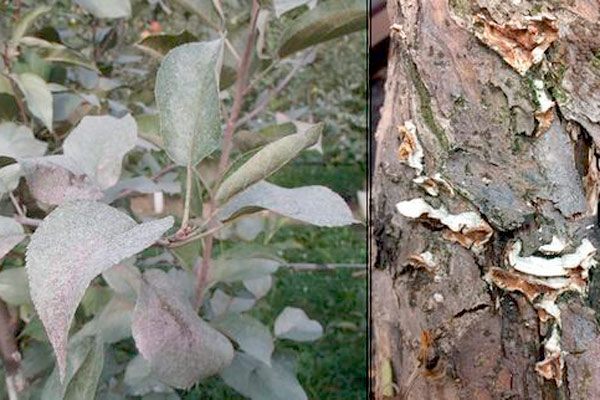
Silver leaf disease (Chondrostereum purpureum) can be caused by a fungus, in which case it is infectious and spreads from tree to tree. The disease has the greatest impact on fruit trees such as apple, pear, and cherry, but can also affect ornamental trees like willow, poplar, maple, oak, and elm. Infectious silver leaf is characteristic of old, neglected trees, and gardens adjacent to woodland areas, especially if they are in shaded, damp places. Through wounds, the fungus enters the tree's tissues and causes wood rot. Toxins are released, which are transported with the sap to the leaves. Under their influence, the epidermal tissue separates from the mesophyll beneath it, and air penetrates between them. This air gives the leaden or silvery hue. On the dead parts of the bark, numerous leathery fungi with a purple underside form. Most often, the disease manifests on individual leaves or branches and gradually affects the entire crown.
The eradication of intermediate hosts for diseases and pests continues, as well as trees heavily infested with bark beetles or infected with viruses (plum pox, rubbery wood of apple) and fungal diseases (silver leaf).
As indicators for Plum pox virus (Sharka virus) during virus identification, the species Chenopodium foetidum, Nicotiana cleverandii, N. bentamiana, and Nicandra physaloides are used. The Plum pox virus is primarily transmitted through rootstocks, scions, and grafting buds, as well as with suckers taken from diseased plants. In the natural environment, it spreads in a non-persistent manner through more than 20 species of aphids - Brachycaudus cardui, B. helichrisi, Myzus persicae, M. varians, Phorodon humuli, and others.
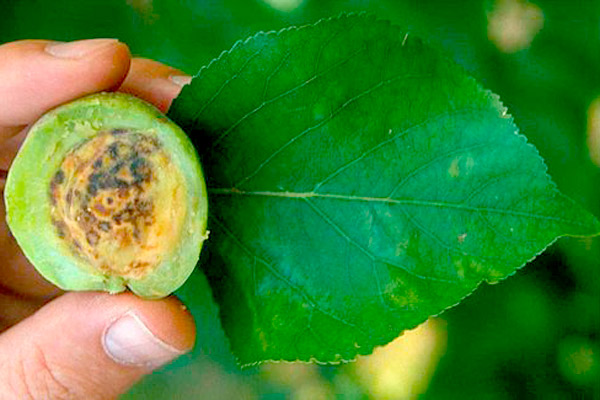
Plum pox virus (Sharka virus) on peach
In most tolerant varieties, symptoms appear intensely on the leaves but are not observed on the fruits at all, or are small and shallow, without affecting the fruit flesh. On plum leaves, light arcs, wavy lines, or other shapes appear. The most typical are ring-shaped chlorotic spots. On apricot leaves, Sharka symptoms appear as light green rings and diffuse linear mottling or as necrotic spots. On peach leaves, chlorotic rings, diffuse light spots, and vein clearing form. The upper half of the leaf blade constricts and acquires a characteristic pointed shape.
In varieties with a higher level of resistance, symptoms on fruits and leaves are absent, but slight imprints on the pit are observed.
Symptoms of rubbery wood in apple manifest as skeletal branches with a horizontal arrangement forming in young trees in nurseries and in the first years after planting. In mature trees, the branches bend at their base and hang downwards, acquiring a broom-like, fairy-like structure, without breaking. The wood in damaged branches is unstructured. No damage to leaves and fruits is observed.
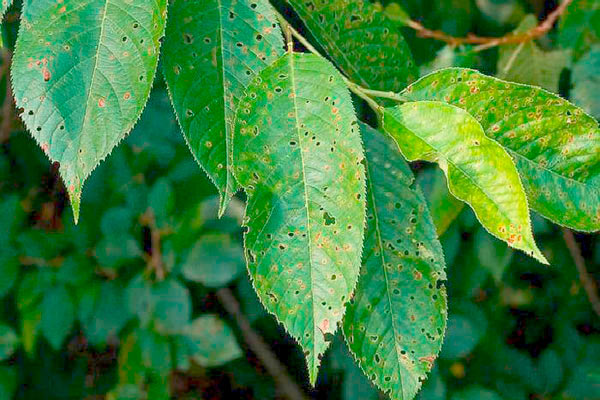
Winter spraying of cherry, peach, apricot, and almond plantations with 2% Bordeaux mixture continues to combat shot-hole disease.
Due to the low temperature threshold of shot-hole disease, it can develop even during mild winters. The dispersal of bacteria and fungal spores usually occurs through raindrops, and less frequently – through wind or insects.
The bacteria Bacillus pumilus and Xanthomonas campestris pv. pruni survive until spring on the affected plant parts – in the intercellular spaces of the cortex, phloem, and xylem at the tips of last year's shoots, in the buds, or in canker damage. The fungus Stigmina carpophila overwinters for at least two seasons in infected twigs and buds, where in spring, with the emergence of leaves and shoots, conidia are formed, causing primary infections.
Preparations, spare parts, spraying and dusting machines, netting, corrugated cardboard, timber, and other materials necessary for plant protection measures are purchased.