

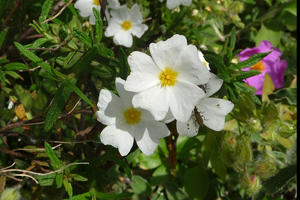
The rockrose is the plant with the highest polyphenol content in Europe.
Rockrose (Cistus incanus), also called grey-haired cistus or rock rose, is a genus of low perennial shrubs, known primarily for their strong, distinctive fragrance reminiscent of amber, which is due to the high content of essential oils in their leaves. The plant is widespread in the Mediterranean region. It thrives on highly infertile soils – dry, sandy and stony, mainly in sun‑exposed hilly and mountainous areas with abundant sunshine. In Bulgaria, rockrose is found mainly in the Strandzha Mountain region. The plant is a perennial evergreen, semi‑evergreen shrub or subshrub, usually growing in groups. Twenty species are known, each with its own specific characteristics. The shrubs are relatively low – in some species they reach up to 1.5 m, while others are no higher than 0.5 m. Their width is about 0.7–0.8 m. The leaves are elongated, arranged opposite one another, 5 to 7.5 cm long and about 2–2.5 cm wide. The plant is abundantly covered with flowers and the flowers have five petals in white, pink, dark pink or scarlet, with the edges towards the stamens sometimes having a darker shade. Because of its strong resemblance to the flower of the dog rose, from the Rosaceae family, rockrose is also sometimes called a “rock rose”. An individual flower lasts up to 8 hours – it opens early in the morning and withers before sunset, but new ones constantly open. It flowers mainly in May and June, and the seeds ripen at the end of July. The fruit is a multi‑seeded capsule about 1 cm long. The seeds themselves are angular, rough and reddish‑brown in colour. The different species of rockrose have different percentages of aromatic substances – in some it is 2–5%, in others it reaches up to 16%, but of lower quality.
Rich source of polyphenols
The most beneficial component in rockrose is the large amount of polyphenols – essential oils and resins. This makes it a valuable raw material for the cosmetics and perfumery industries. Its aromas are also used in the food industry – for flavouring beverages, cigarettes and confectionery products. Recently, it has been increasingly used as a food supplement, due to its proven strong antioxidant and anti‑inflammatory effects. Rockrose plantations can be exploited for at least 25 years. For commercial purposes, one‑year‑old shoots are used, which are harvested at the end of May and the beginning of June. It has been established that the leaves contain the highest concentration of the aromatic component – about 20%, in the upper part of the young twigs – about 9–10%, and in the stem – very little. The shrub is also valued as a melliferous plant, which attracts bees and imparts a specific aroma to the honey.
The plant that ignites itself
The presence of a large amount of aromatic oils has a protective function for the plant. It grows on low‑fertility and almost unforested terrains. To protect itself from grazing animals, the plant produces strong aromas that irritate their noses and repel them from its otherwise succulent leaves.
Some rockrose species go even further. They exhibit rather strange and dramatic behaviour, expressed in self‑ignition.
When the plant becomes too old or when competition for a territory increases greatly, it does not “wait” for its stem to completely dry out and decompose. At the end of summer, when the seeds have already been dispersed and the sun is at its hottest, the plant begins to produce a larger amount of polyphenols. They spread like an invisible mist not only around the emitting plant, but also in the surrounding area. Polyphenols contain easily flammable components. When the temperature rises above 30°C and their concentration increases, they soon ignite, engulfing the already ageing and semi‑dried shrub, setting it on fire, but together with it they also ignite the entire plant cluster that has formed at that site. The plants soon burn out, but the seeds survive. Above all, the seeds of rockrose remain, as they are best protected against high temperature and direct flame. Moreover, the high temperature acts as an irritant, as a stimulant that cracks the protective coat of the seed and allows it to germinate very soon after the short‑term fire. The new young plants grow on completely bare terrain, with almost no competition and on soil well fertilised with wood ash.