

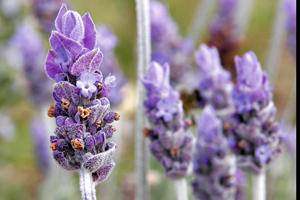
In recent years, lavender has established itself as the main essential oil crop in Bulgaria. The inflorescences contain essential oil, which is widely used in the perfumery and cosmetics industry. Owing to its pleasant specific aroma, it is increasingly entering people’s everyday life.
Bulgaria is one of the places in the world where lavender finds the most favourable conditions for cultivation. Its high productivity is combined with high oil quality. Within the international perfumery industry, it is known as Bulgarian lavender or Bulgarian lavender oil. With its high profitability as a permanent plantation without special pruning requirements and without economically important diseases, lavender quickly attracts the attention of people from various professions who wish to grow it in their spare time in order to improve their standard of living.
The high economic efficiency, generating a profit of 500–600 leva per decare, is the motivation for establishing lavender plantations. Previously ignored among strategic crops and relegated to second place in the foothill regions, today it is grown both in the plains and in Dobrudzha. The fertile soils and high-quality Bulgarian varieties make it possible to fully utilise the productive potential of lavender and have generated considerable interest in its cultivation.
Lavender is a Mediterranean plant. In the wild it occurs in the southern parts of Europe, North Africa and in some regions of the Arabian Peninsula. Its biological characteristics are demonstrated by the fact that it can be cultivated under various soil and climatic conditions and on sites with altitudes from 0 to 1000 m.
Lavender is a thermophilic and at the same time cold-hardy plant. Its affinity for warmth is associated with the budding and flowering phases, when high temperatures of 40–50 degrees in the sun increase oil synthesis, while in a state of dormancy during the cold months the shrubs withstand temperatures down to minus 30 degrees, which makes lavender a unique crop with high yield and high quality under Bulgaria’s unique climate. Lavender is a melliferous plant and the honeybee is its main pollinator, which has an impact on its vegetative propagation, namely through rooting of cuttings from authentic Bulgarian varieties. Anyone who has read or has been told about the opportunities offered by lavender asks themselves what is needed to establish a small lavender plantation of 5, 10 or 15 decares? The answer is that they must own or lease the respective area for about ten years in such dimensions. The plots should be on flat or sloping terrain, should not retain water, should be of the darker soil types, and should not deviate from normal parameters such as salinity, acidity, etc. – for this, consultation with a specialist is required. What everyone can do is clear the land of shrubs, stones, trees and other inert impurities, level the area and plough it twice – first to a depth of 20–25 cm and second to 30–35 cm. After the first ploughing, base fertilisation is carried out with phosphorus and potassium fertilisers at the rate of about 50 and 20 kg/decare. Until planting, the plots are kept weed-free by cultivation or disc harrowing, depending on their moisture content.
Of the seven Bulgarian varieties, most plantations are established with Sevastopolis, Druzhba and Yubileyna due to their plasticity and the high quality of their oil. Planting material must be supplied by a certified producer who guarantees the authenticity of the variety and its purity. For greater assurance, express a wish to inspect the mother plantation of the respective producer and, based on its size and condition, assess their capacity. From one mother shrub, 150 high-quality cuttings can be obtained, and for one decare of plantation 2000 rooted cuttings are needed. In order to trade in planting material, the producer must produce from 300,000 to 400,000 cuttings for areas of 150–200 decares respectively, which means that it is mandatory to have about 3000 pruned mother shrubs with only one-year-old shoots. These are the potential capabilities of medium-sized sole producers.
Standard planting material must meet the following requirements in accordance with BDS (Bulgarian State Standard): height of the aboveground part not less than 10 cm, length of the root system not less than 8 cm, thickness of the notional root collar not less than 4 mm, and number of branches of the aboveground part not less than 2.
Trade in planting material is carried out in October and November in the form of bundles of 50 plants each. Seedlings purchased earlier must be untied and loosely arranged in a deep furrow, which is then covered with soil and lightly compacted. November and December are the most favourable months for planting in the field. Transplanting is most often done manually, using planting tools called “swords”, used in forestry for afforestation. They are sharpened tubes with a diameter of 3/4", equipped with a footstep and a handle. On larger and flat areas, a pepper transplanter can be used. For manual planting, the field is pre-marked with a cultivator at an inter-row spacing of 140 cm, which is the accepted spacing for lavender cultivation and is a multiple of the universal inter-row spacing of 70 cm used for most machines. This allows hoeing during the first and second year to be carried out with sunflower and maize cultivators without repositioning the working elements.
In lavender fields it is also very convenient to use the UNLM – the universal mounted vineyard machine, with which ridging up and ridging down of the plantations can be carried out. The intra-row spacing is 30 cm, providing 2000 plants per decare. The planting depth is most often up to the beginning of the first branching, or the plants are earthed up to that point if they have been planted more shallowly, or two weeks later if the soil settles. The quality of planting is related to the forthcoming cold months, in which, on the one hand, freezing must be prevented and, on the other, the risk of heaving, which has far more negative consequences, must be avoided. Lavender is a plant that does not tolerate replanting, and the care to ensure the specified number of plants is taken during the first and partly during the second year, as later replanting leads to suppression of the younger plants by the roots of the older ones and has no economic effect. The planting material represents plants in dormancy at the time of purchase and after transplanting in the main field, in which state they remain until the beginning of the next spring. The awakening of the plants occurs when temperatures rise from 0 to 2–3°C, but this is most pronounced when 7–8°C is reached, which is a temperature range characteristic of early spring crops. Lavender is a plant that is highly sensitive to temperature; when it falls below zero, it enters forced dormancy, and conversely, it resumes growth when temperatures rise. This phenomenon can occur several times in autumn, in spring, and often in winter, when there is a risk of negative, albeit minor, consequences.
Lavender does not tolerate waterlogging, therefore low-lying areas must be drained. In early spring, the main care for lavender consists in protecting the fields from weeds, to which it is very sensitive.
Studies related to the fertilisation of lavender have established that a single application of 30 kg/decare of ammonium nitrate and 50 kg/decare of triple superphosphate in early spring fully satisfies the plants and guarantees a flower yield of 500 to 650 kilograms per decare. Already during the first vegetation period in the permanent field, lavender begins to bloom. For better formation of the young shrubs, at the beginning of flowering the inflorescences are removed with a scythe or a motorised nylon-string mower. Harvesting the inflorescences in the first year is not profitable, but a small part of them may be distilled in a distillery in order to become acquainted with the process of mowing, transportation and partly with the quality of the oil.
Depending on the variety and the region where lavender is grown, flowering begins in the last ten days of June and continues until the end of July. In warmer regions with lower altitude it starts earlier, and in higher locations – later. Long-term research has established that the essential oil content varies in the different phases of flowering as well as at different times of the day. The studies carried out on the dynamics of flowering and the accumulation of essential oil in the flower give grounds for the following practical conclusions:
- The general trend in the accumulation of essential oil in lavender flowers is an increase in its content as growth progresses. The most favourable time for harvesting is in the flowering phase – at 75 to 100% flowering. Delayed harvesting, carried out after 100% flowering, even slightly after that, does not lead to significant losses. On large areas, harvesting should start as early as 50% flowering and be carried out mainly at 75–80% with a view to completion by full flowering, but should not last more than 20–25 days.
- Linalyl acetate is preserved without significant changes from 50% flowering of the plants until the end of flowering.
- The general trend in essential oil content during the 24-hour period is its increase during the day and decrease at night.
- Harvesting should be carried out in sunny and calm weather. Rain has a sharp effect in reducing the essential oil content by 20 to 40%.
- The harvested raw material must be transported and distilled immediately. The harvested flowers must not be left in sacks, as they easily become overheated and spoiled.
- Storage can be carried out without significant loss up to 24 hours after harvest, when the harvested flowers are left in small heaps on the shrubs.
- Harvesting can be carried out manually with a sickle, semi-mechanised with a brush cutter, and mechanised with lavender harvesters.