

![MultipartFile resource [file_data]](/assets/img/articles/заглавна-пшеница-мана.jpg)
Summary
Winter wheat is one of the most valuable and high-yielding crops in the world and is of primary importance for feeding the population. It is a highly adaptable crop and can be grown under various climatic conditions and on different soil types. Wheat production in our country is accompanied annually by various diseases that have a major impact on yield. Wheat powdery mildew is a widespread disease in all regions where wheat is grown. It appears almost every year, with the frequency and intensity of infection depending on climatic conditions and the susceptibility of the cultivated variety. Moderate temperatures, high relative humidity and dense wheat stands stimulate the development of powdery mildew.
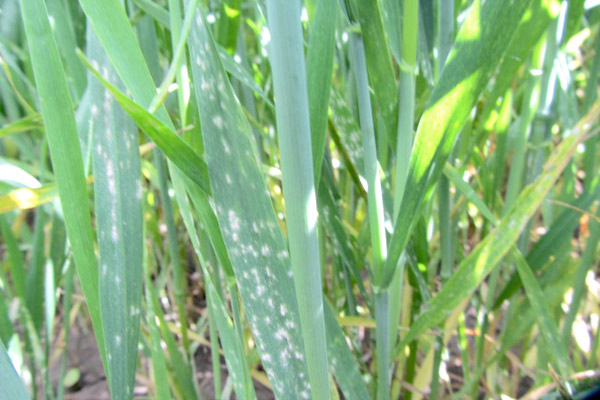
Figure 1. Symptoms of powdery mildew on leaves
The symptoms of powdery mildew affect all aboveground parts of the wheat plant, with the most conspicuous being the symptoms on the leaves (Fig. 1, 2 and 3). The first symptoms can be observed as early as autumn on the leaves of young plants. At a later stage the symptoms may affect the leaf sheaths, the stem and the ears. On the infected organs, white to off-white powdery fungal growths (pustules) are observed, which expand and may cover the entire leaf. Over time, the growths acquire a pale brown colour and small black bodies appear in them – the cleistothecia of the fungus.
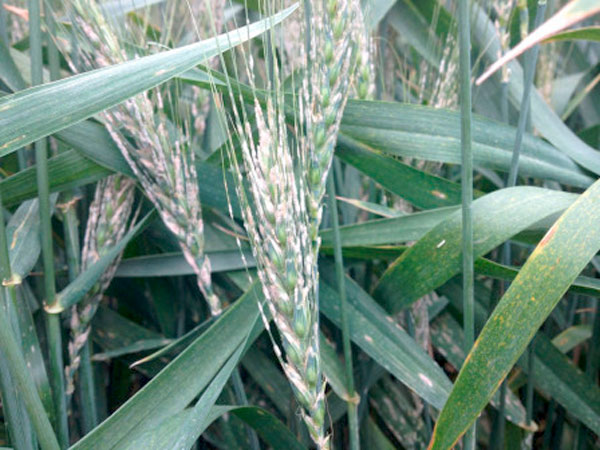
Figure 2. Symptoms of powdery mildew on the ear
https://cropprotectionnetwork.org/encyclopedia/powdery-mildew-of-wheat
In cases of severe disease expression, respiration and transpiration are greatly increased, resulting in a shortage of water and sugars in the plant. The root system is less developed, the aboveground parts grow less, and yields are lower and of poorer quality. Early development of the pathogen in spring and favourable conditions for its spread up to the flowering growth stage can lead to significant losses in productivity. The greatest yield losses are observed in cases of severe infection of the flag leaf during flowering.
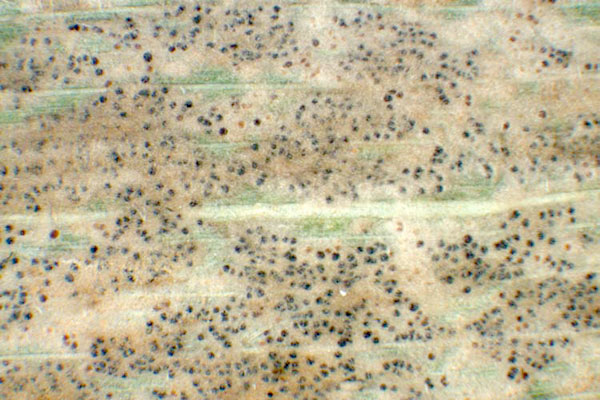
Figure 3. Mycelium and cleistothecia of Blumeria graminis f.sp. tritici
The causal agent of powdery mildew in wheat is the ascomycete fungus Blumeria graminis (DC Speer) f.sp. tritici with conidial form Oidium monillioides Link. The fungus overwinters as mycelium and conidia in the crops infected in autumn. Cleistothecia are of lesser importance for overwintering and as a source of infection in spring. The fungus develops on the surface of the infected organs, attaching to them by means of appressoria and obtaining nutrients from the epidermal cells with the help of haustoria. Conidiospores are unicellular, colourless, ellipsoidal and are arranged in a chain at the tip of erect, unbranched, short conidiophores. Conidia are formed in large quantities and together with the hyphae appear as powdery growths on the infected parts of the plant. The pathogen is dispersed by conidiospores throughout the entire growing season. Under optimal conditions, new conidia are formed every 7 to 10 days. An important feature of their biology is that a high air humidity close to 100% is required for their germination. In a drop of water they lose their germination capacity. They germinate over a wide temperature range – from 3 to 31°C, with an optimum temperature of 17°C. Low humidity favours the formation and spread of conidiospores, while high humidity favours the infection process and the viability of conidia. Ascospores are formed towards the end of the growing season in cleistothecia. Under our conditions they serve for the preservation of the fungus during the summer. Ascospores are unicellular, colourless, ellipsoidal, measuring 20-30 x 10-13 µm. In autumn, when the cleistothecia are heavily moistened, the ascospores are ejected and, carried by the wind, infect volunteer plants or young autumn crops. Infection occurs at temperatures from 0 to 25°C (optimum from 15 to 21°C), and the incubation period is from 3 to 11 days.
The development of powdery mildew is favoured by cool and humid weather, but with light and infrequent precipitation. Dense stands and unbalanced fertilization with high rates of nitrogen fertilizers favour the development of the pathogen. The diversity in the pathogen population and its corresponding development is closely related to temperature fluctuations and the amount of precipitation. In some cases, climatic conditions stimulate the development of the pathogen, while in others they greatly reduce the multiplication and spread of the disease. A substantial increase in the pathogen population is observed when maximum daytime temperatures exceed 10°C. At temperatures above 25°C, the development of powdery mildew is restricted and the formation of conidiospores ceases. The optimum temperature for the development of powdery mildew ranges from 15 to 20°C. High relative humidity (above 85%) favours infection, whereas heavy rainfall contributes to washing off the formed conidiospores and greatly reduces their dispersal. The effect of rainfall on powdery mildew varies in different regions depending on the amount of precipitation (Cao et al., 2012, Stanoeva, 2019).
The cultivation of resistant varieties is the most economically efficient and most environmentally safe method for disease control. Unfortunately, resistance to the pathogen is not constant due to the considerable virulence diversity observed in populations of Bl. graminis f.sp. tritici, expressed in a large number of physiological races (grouping of isolates based on their ability to overcome genes controlling resistance). Studies on the virulence diversity of the fungus in our country show that each year at least 3–4 physiological races are observed in pathogen populations. From the research carried out in the last five years in the country, 73 races have been identified, six of which are new for Bulgaria. The resistance of varieties is determined by the effectiveness of the genes that control it, i.e. prevent infection by a particular physiological race. At present, more than 68 genes for resistance to powdery mildew have been reported (Li et al., 2019; He et al., 2021; Zhang et al., 2022). Of the 20 race-specific genes studied over the last five years in Bulgaria, the genes Pm 1, Pm 3c and Pm 17 show the highest effectiveness (Iliev and Stanoeva, 2013, Stanoeva, 2017). The genes Pm 5 and Pm 6, as well as the gene combinations Pm 2+6 and Pm 1+2+9, are characterized by low effectiveness (Stanoeva, 2023a,b).
Phytosanitary and agronomic measures are of substantial importance for preventing the development of powdery mildew. The destruction of plant residues and volunteer plants limits the sources of primary infection at the beginning of the growing season. Early sowing, especially in years with a warm and humid autumn, creates conditions for severe infection of the crops at the very beginning of their development. High seeding rates lead to dense stands and thus to maintaining high humidity within the crops. Unbalanced nitrogen fertilization at high rates favours vigorous plant growth and reduces their tolerance.
Chemical control is the most commonly used approach for the control of powdery mildew.
The critical period in wheat development with regard to powdery mildew infection is from tillering to ear emergence (growth stages 21-59) and especially from the appearance of the first awn to full ear emergence (growth stages 49-59). Treatment against powdery mildew in wheat is required when the economic injury level is reached, which is 10% infection at growth stages first–second node and flag leaf emergence–flowering. Suitable for use are authorized fungicides from the DIM, SDHI, strobilurin and other groups. If powdery mildew occurs together with other diseases, good plant protection practice is to use fungicides active against the entire disease complex.
References
1. Iliev I., Stanoeva Y., 2013. Virulence diversity in populations of the causal agent of wheat powdery mildew in Bulgaria during the period 2010-2012. Scientific Works, Institute of Agriculture – Karnobat, vol. 2 (1): 219-228.
2. Stanoeva Y., 2023 a. Race composition of Blumeria graminis f.sp. tritici in Bulgaria and effectiveness of some Pm genes. Plant Science, 60(2), p. 3-11.
3. Cao, X.R., Luo,Y., Zhou,Y.L., Duan,X.Y., andCheng,D.F.2013.Detectionof powdery mildew in two winter wheat cultivars using canopy hyperspectral reflectance. Crop Prot. 45:124-131.
4. He H, Liu R, Ma P, Du H, Zhang H, Wu Q, Yang L, Gong S, Liu T, Huo N, et al. 2021. Characterization of Pm68, a new powdery mildew resistance gene on chromosome 2BS of Greek durum wheat TRI 1796. Theor Appl Genet. 134:53–62.
5. Li G, Cowger C, Wang X, Carver BF, Xu X. 2019. Characterization of Pm65, a new powdery mildew resistance gene on chromosome 2AL of a facultative wheat cultivar. Theor Appl Genet. 132:2625–2632.
6. Stanoeva Y., 2023 b. Virulence diversity in a population of Blumeria graminis f.sp. tritici in Bulgaria during 2020-2021. Journal of Mountain Agriculture on the Balkans, 26 (5):96-108
7. Stanoeva Y.,2017. Investigation of the race variability in the populations of Blumeria graminis tritici in Bulgaria during 2013-2015. Congres book 2 nd international Balkan agriculture congress 16-18 MAY 2017, 44-49.
8. Stanoeva, Y. (2019). Dynamics of distribution of the powdery mildew on wheat in the Dobrudzha agricultural institute during 2016 - 2017. Field Crops Studies, XII(4), 63-72. Bg.
9. Zhang Y., X. Wu, Wang, Y. Xu, H. Sun, Y. Cao, T. Li and M. Karimi-Jashni, 2022. Virulence characteristics of Blumeria graminis f. sp. tritici and its genetic diversity by EST-SSR analyses. PeerJ 10:e14118 DOI 10.7717/peerj.14118