

![MultipartFile resource [file_data]](/assets/img/articles/бактериални-заглавна-1.jpg)
Bacterial diseases are ubiquitously distributed in our country. Every year fruit producers lose on average about 30% of the fruit yield as a result of the development and spread of diseases in orchards.
Intensive plantings and the frequent monoculture cultivation of identical crops and cultivars lead to an accumulation of pathogenic microorganisms that compromise fruit production. The productivity of trees is directly dependent on abiotic and biotic factors, among which are bacteria as causal agents of diseases. In recent years, the free exchange of planting material or material of unclear origin has led to the emergence and spread of new virulent races.
On the other hand, dynamic climate changes and the lack of sub-zero temperatures during the winter period enable the development of bacterial pathogens throughout the year.
A number of measures underpin the limitation and spread of diseases, the most important of which is the correct diagnosis of pathogens. The identification of diseases and their pathogens will allow the development of methods for limiting the disease, which will reduce the degree of damage and the economic losses.
The main symptoms for identifying diseases of bacterial origin are the local type of development; on the leaves, oily spots are observed, usually with a chlorotic halo. Rot in the woody tissues, cankerous lesions that vary in depth, often accompanied by an unpleasant odour. Dieback of scaffold branches as a result of necrosis of the conductive tissue. On the roots, tumours with a granular structure.
Fire blight/Erwinia amylovora (Winslow)
Hosts of economic importance for the country are quince, pear and apple, but the pathogen can attack about 200 representatives of the family Rosaceae, including ornamental species.
Symptoms
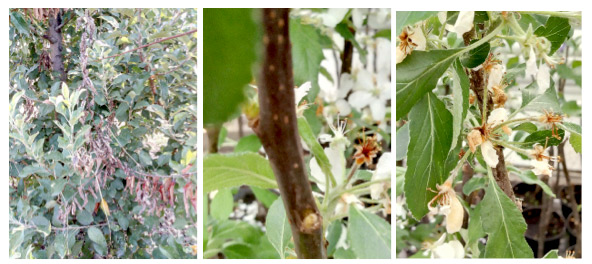
In fruit-bearing orchards, the characteristic symptoms of the disease are observed during flowering, which is also the most critical phenological phase of tree development. On the attacked flowers, necrotic areas appear, which enlarge and encompass the entire flower. The necrosis progresses and continues to develop along the flower pedicels, encompassing the leaves and the bearing shoot. The leaves and flowers turn dark brown to black. In infected, more susceptible cultivars, a faster development of the disease is observed, reaching the scaffold branches of the trees. Cankerous lesions can be seen when the infection passes from the scaffold branches to the trunk or when infection occurs as a result of mechanical injuries. Characteristic features of the disease are: the tips of young shoots acquire the shape of a “shepherd’s crook”, and the leaves on the affected shoots do not fall even after autumn leaf fall, which gives the trees a scorched appearance.
Causal agent
The phytopathogenic bacterium Erwinia amylovora is peritrichous, strictly aerobic, Gram-negative. The bacterium overwinters in cankers formed on twigs, branches and trunks of trees. In spring, a bacterial exudate is formed on the cankers, which is spread by rain, insects and by pruning tools. Once it lands on plant organs, the bacterium enters them through natural openings in the leaves and flowers (stomata, lenticels, nectaries). The bacterium can also enter through wounds caused by insects, hail, as well as through mechanical damage during orchard cultivation and pruning.
Bacterial blight/Pseudomonas sp. (Migula)
Hosts of the pathogenic bacterium are all stone fruit species, almond, hazelnut, apple and pear.
Symptoms
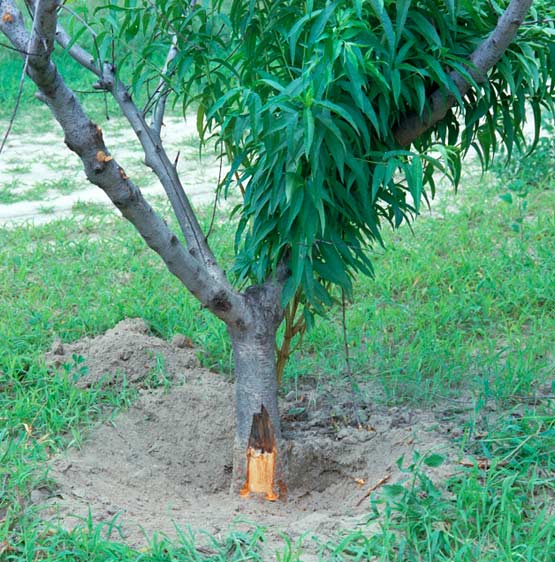
The bacterium can cause blossom blight similar to that caused by the fungal pathogen Monilinia laxa. On leaves, pale green diffuse spots appear, varying in size and shape, which later become necrotic in the centre. A characteristic symptom is that the spots are surrounded by a yellow halo. On the trunk and scaffold branches, the bacterium can cause cankerous lesions; around the damaged area a depression of the tissues is observed, the bark is darker in colour, shiny and oily, cracking may occur and there is a sharp boundary between diseased and healthy tissue. Gum exudation around infected parts is also a manifestation of the bacterial disease. When the bark is peeled off at the site of infection, it is clearly visible that the cambium and pith have necrotized. Damage can also be seen on the one-year-old growth of the previous year, where leaf and flower buds do not develop in spring but remain dry and often covered with gum.
Causal agent
Pseudomonas sp. is heterogeneous and the species is divided into more than 50 pathovars. The bacteria persist in infected parts from the previous season – trunks, twigs, branches, buds. In spring, with the onset of favourable conditions, which usually coincide with the flowering period of stone fruits, the bacterial cells spread and infect the flowers and young leaves. During the summer season and with a sustained rise in temperatures, the bacterium passes into an epiphytic phase and remains so until climatic conditions change; this period coincides with leaf fall. Young trees are more susceptible to the disease; in them the infected tissue acquires a reddish-brown colour, cracks form accompanied by gum exudation. The infection quickly expands and reaches the older shoots and scaffold branches.
Bacterial shot hole/Xanthomonas campestris pv.pruni (Smith) /Bacillus pumilus (Meyer & Gottheil)
Hosts of the pathogens can be all stone fruit species.

Symptoms
On the leaves, small necrotic spots with a light yellow-green halo and a clearly defined boundary of the affected tissue are formed. The affected areas on young leaves become perforated. On the fruits, during their growth period, a separating cork layer remains at the site of the detached spots. The spots are 1–2 mm in diameter, often covered with exudate that resembles gum and quickly turns brown. Usually the necrosis is superficial. In addition to shot hole type damage, the bacteria also cause bud death, cankers, lesions and gum exudation on one-year-old shoots. At positive temperatures during winter, the bacteria develop, and olive-green spots appear which quickly enlarge and become brown.
Causal agent
The causal agents of bacterial shot hole can be two bacteria – Xanthomonas campestris pv.pruni and Bacillus pumilus. They overwinter in the attacked plant parts. In spring, before sap flow of the host begins, the bacteria multiply in the intercellular spaces and cause rupture of the epidermis, which leads to a visible lesion; during the vegetation period the lesion turns into a canker. The inoculum from the lesions and cankers is spread by rain and wind and infects new leaves through the stomata. The developing pathogens on leaves and shoots release inoculum through which secondary infections are caused. Spring pruning favours the spread of the bacteria to neighbouring branches. The bacteria can also be transmitted by insects.
Bacterial crown gall/Agrobacterium tumefaciens (Smith and Townsend)
Bacterial crown gall can attack all fruit species; the disease is widespread throughout our country. The bacterial disease is a major problem in the production of fruit planting material.
Symptoms
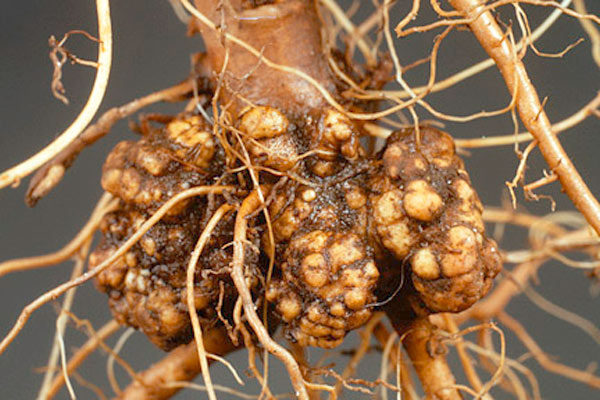
A characteristic symptom of the disease is a disturbance in sap flow in the plant organism, resulting in delayed development and drying of the aerial parts. The tumours usually have a granular structure. The bacterium stimulates the growth of plant cells (hyperplasia) in the root zone and the root collar. Initially, the tumours are pale yellow and soft, later they darken and harden.
Causal agent
Bacterial crown gall of fruit trees is caused by the bacterium Agrobacterium tumefacies. The pathogen persists in the soil and in the tumours of attacked plants. A large number of herbaceous plants that are attacked by the bacterium are also sources of infection. The pathogen penetrates plants through wounds. The infection can be spread by humans using cutting tools during tree planting and soil cultivation operations.
Control
Observance of basic agrotechnical practices is of essential importance. The correct choice of suitable cultivars and rootstocks, in accordance with the specific conditions of the region, allows cultivars to develop their maximum productive potential. Planting cultivars with proven resistance or tolerance to bacterial diseases provides an opportunity to limit the use of pesticides from an environmental perspective.
The control strategy starts already in nurseries: when lifting the planting material, trees with tumours on the main root and root collar must be destroyed. If the tumours are on lateral roots, they can be limited by pruning. Before planting, the roots can be dipped in a copper-based solution. Planting material on which cankerous lesions are visible is cut back to healthy wood.
During the annual pruning for training and fruiting, sanitary pruning of infected parts is also carried out by cutting back to healthy tissue. Disinfection of pruning shears is a mandatory practice, and after pruning a copper-based fungicide is applied. In recent years, pruning of stone fruit species is recommended to be done in the summer season, after fruiting, in order to use sunlight as a limiting factor for reducing infections.
Balanced fertilization has a direct effect on the health status of orchards; unilateral nitrogen fertilization, which favours easier attack of plants, is avoided.
Key points of the strategy against bacterial diseases include the application of copper products or approved bactericides. Copper products are used as a preventive measure, covering the phenophases from mass leaf fall to bud swelling in spring. From the phenophase of first open flowers until fruits reach 90% of their size, biological bactericides are recommended. From the end of flowering until the fruit set reaches a size of up to 10 mm, registered products based on fosetyl-aluminium can be used.