

![MultipartFile resource [file_data]](/assets/img/articles/заглавна-пръскания-1.jpg)
In February, the agrometeorological conditions will be characterized by increased dynamics, with alternating periods of above-normal temperatures and values up to and below the climatic norms for the month.
During most days of the second ten-day period, the agrometeorological conditions will be determined by higher-than-usual temperatures for the season. After the second ten-day period, a cold spell will set in – with forecast minimum temperatures down to minus 12 oC, and this will prevent premature, undesirable development of the fruit trees.
Precipitation is expected during the month, around and above the norm.
Conditions during the first and second half of the second ten-day period will be favorable for carrying out seasonal agrotechnical activities – pruning and winter spraying.
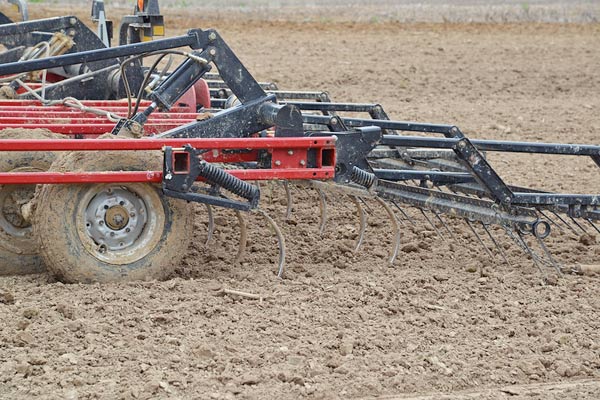
Agrotechnical activities
In fruit tree nurseries, the planting of rootstocks in the nursery block begins.
Rootstocks budded in the previous year are inspected. The bindings are removed if this has not been done in autumn. Rootstocks whose buds have died during the winter are grafted with scions.
The wild part of the rootstock above the bud is cut off. This is done before the start of sap flow, otherwise the young plant is weakened. The rootstocks are cut 2–3 cm above the grafted bud with the cut sloping away from the side of the bud. Cutting the rootstock to a stub 12–15 cm above the grafted bud is practiced in nurseries exposed to strong winds.
When soil moisture is adequate, the first inter-row cultivations are carried out with a cultivator or disc harrow, and in the rows – with a rotary tiller with an offset section, in order to prepare the soil surface for treatment with soil herbicides.
Scions are collected for top-working trees of low-value cultivars and for replacing buds that have failed during the winter in fruit tree nurseries.
Care is taken of the stratified seeds. When the weather warms up, sowing in the seedbed may begin.
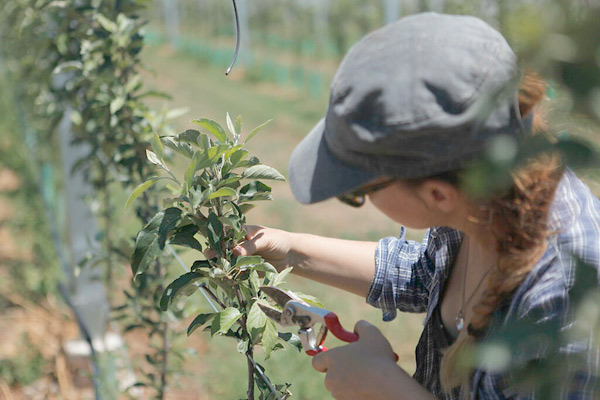
In fruit orchards
The uprooting of diseased, old, and dried trees that no longer bear fruit is completed.
Repairs of old and construction of new trellis systems continue.
Winter pruning for production and rejuvenation of pome fruit species continues.
Up to the second ten-day period, young trees may be planted in new fruit orchards.
If conditions allow – up to the second ten-day period it is advisable to continue deep application of phosphorus and potassium fertilizers.
In favorable weather – conditions up to the second ten-day period are suitable – winter pruning for production in stone fruit species begins.
Monitoring continues in vegetative facilities for further cultivation of kiwifruit (Actinidia).
Care continues for the cultivation of rootstocks for citrus and pistachio in warm greenhouses.
Plant protection activities
In fruit orchards
Caterpillar nests, egg clusters and egg rings, shoots and branches infected by diseases and attacked by pests, mummified fruits, etc., are cut out, collected and burned, if this has not been done in autumn.
Packaging materials are disinfected by fumigation in closed premises or by spraying with a solution of a fungicide and an insecticide.
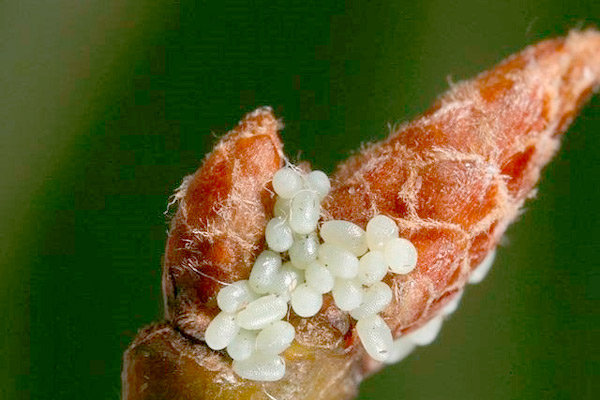
Eggs of small winter moth
Winter spraying is carried out
The results of winter spraying are good when the solutions are applied as coarse droplets and all parts of the trees are covered with the solution. This is achieved by applying 100–150 dm3 per decare with powerful sprayers in calm weather. Spraying is carried out with a 3% solution of Para Zomer or Acarzin against scale insects and aphids, psyllids, woolly apple aphid, winter moth eggs, mites, pupae of the leaf-mining moth, and others that overwinter on the trunks and in the crowns of the trees. Spraying is carried out only when the population density of some pests is above the economic threshold of harmfulness.
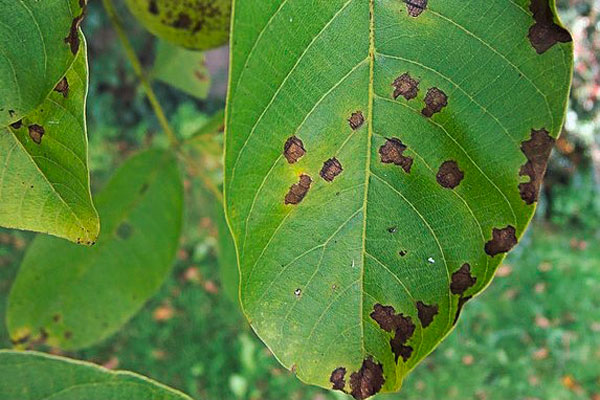
Spraying is carried out with a 2% Bordeaux mixture or other copper products against plum pocket disease in plum trees, fire blight in pome fruit species, peach leaf curl, shot hole disease in stone fruits, brown rot, bacterial blight, fallen leaves to destroy the overwintering inoculum of apple and pear scab, red leaf spot in plum, anthracnose in walnut, cercospora leaf spot and scab in almond.
Soil herbicides in fruit orchards
If weed emergence has begun and the soil is sufficiently moist, soil herbicides are applied in the southern regions of the country. Only the tree row strip of the plantations is treated. Before application of the herbicides, the soil is loosened and leveled. Herbicides are sprayed with sprayers that are not used for application of other pesticides. When this is not possible, after spraying, the tanks, pipelines and nozzles of the sprayers are thoroughly washed with water containing 2% washing soda or quicklime.
Stomp-Aqua or another suitable herbicide is used in pome and stone fruit species at a rate of 250–300 ml/da.
In strawberry plantations
Soil herbicides are applied, if weather permits. Stomp-Aqua is used at a rate of 250–300 ml/da or another suitable herbicide, incorporating it into the soil.
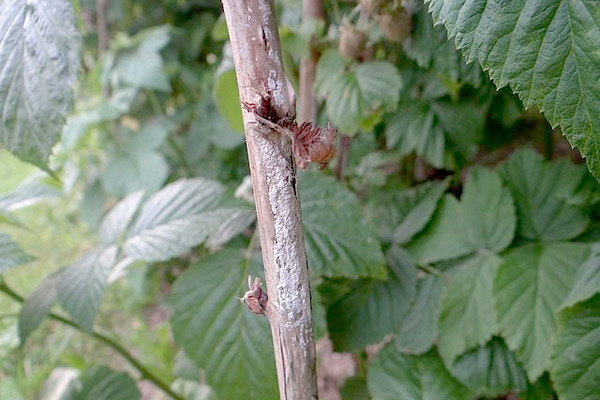
Didymella on raspberry
In raspberry plantations
Winter spraying is carried out. Against Didymella, Coniothyrium, anthracnose, and leaf spots, treatment is done with a 2% Bordeaux mixture, also spraying the fallen leaves.
Against California red scale, treatment is carried out with a 3% solution of Para Zomer or Acarzin.
Soil herbicides are applied, if weather permits. Stomp-Aqua is used at a rate of 250–300 ml/da or another suitable herbicide.
In blackcurrant plantations
Soil herbicides are applied, if weather permits. Stomp-Aqua is used at a rate of 250–300 ml/da or another suitable herb