

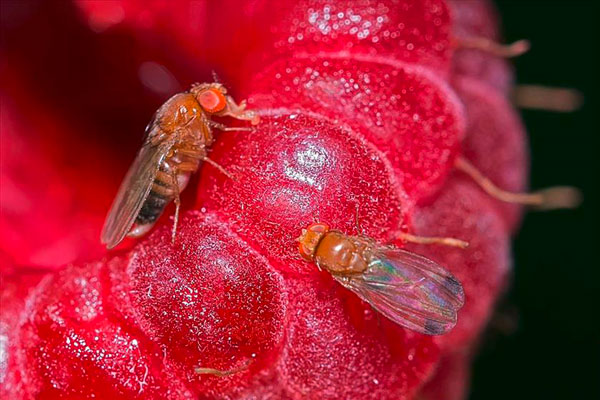
Under the conditions of the US Pacific Coast, 6 types of traps with different shapes—colorless, white, and red—were tested in berry plantations, cherry orchards, and vineyards. Counts were conducted from July to October, with the first flight peak observed in early September, the second in early October, and the third after mid-October. In 2010, between 15 and 30 drosophilids were found in one trap per count, while in 2011—from 0 to 5 insects weekly, which can be explained by the low temperatures that fell during the winter of 2010—down to minus 20°C (in the eastern part of Washington State). Control measures included collecting and destroying infested fruits in white or black polyethylene bags through solarization—left in the sun.
After establishing the presence of D. suzukii in the Trentino province, Northern Italy, from the monitoring conducted in 2010, they found eggs and larvae in the fruits of cherries, blackberries, raspberries, strawberries, blueberries, figs, and wine grape varieties, as well as in wild-growing shrubs around these plantations.
In Switzerland, after the presence of D. suzukii was established in 2011, a national monitoring was conducted from April to September 2012 in all administrative districts and particularly carefully in the cantons where it was first discovered—in the eastern, southern, and western regions of the country, with the participation of researchers and local specialists. An informational bulletin is published to train farmers, which is regularly updated with new data obtained domestically and abroad. The exchange of information with specialists from neighboring countries—France, Italy, Austria—as well as the transfer of knowledge through the mentioned bulletin and other publications, is considered particularly important. For this monitoring, traps from a Swiss company were tested. There, it is considered that as preventive measures, it is important not to use diseased fruits for compost, nor to bury them in the soil, but to solarize them in polyethylene bags to destroy the larvae in the fruits. These measures also include chemical treatments of wild hosts around fruit plantations and vineyards.
Sanitary measures include mass trapping using traps placed at short distances from each other within the plantation itself. Chemical control is difficult because the fruits are attacked when they are ripe, which leads to their contamination and violates legislation on pesticide residue limits on fruits, as well as disrupts the environmental balance. Furthermore, the fly develops many generations per year, which is an indication that resistance to pesticides will quickly appear, and the cultivated hosts are too numerous, both wild and ornamental. So far, there is no precise information on how many plants are its hosts. At this stage, it is considered that insecticides are not very effective, and neonicotinoids have proven unsuccessful in controlling D. suzukii. Similar results have been obtained from the USA, Italy, and other countries.
In Austria, the drosophila was discovered in September 2011 in three regions—Styria, Carinthia, and Tyrol. Similar to neighboring Switzerland, a mass monitoring was conducted here in 2012 throughout the country, with main efforts focused primarily in the regions where its presence was established. Traps from a Belgian company were placed at 90 locations across the country in plantations of strawberries, raspberries, and cherries. Observations conducted from July to October established that the flight peak was during August-September. Within one year, this dangerous pest had moved within the boundaries of the mentioned three regions, as well as about 200 km to the west into a new fourth region—Vorarlberg, i.e., around the city of Innsbruck.
Guidelines for research work in the coming years. In each agro-ecological region, it is urgently necessary to organize monitoring to establish the distribution boundaries of this new dangerous quarantine pest. Subsequently, restrictive and sanitary measures should be applied, as well as measures against re-infestation of the area. In parallel, the study of the developmental biology of Drosophila suzukii together with the phenological development of individual host plants should begin.
The next step should be a strategy for initiating integrated pest management, including studying possibilities for searching for its natural enemies and parasites of its eggs and larvae. The approach should be directed towards integrated control with the aim of transitioning to biological control against D. suzukii, considering its particular specificity as a pest and information on results obtained in other countries. Pesticide treatments at the initial control stage could only be targeted against flying adult insects before they lay their eggs on ripening fruits, as well as after fruit harvest. For this purpose, it is necessary to test insecticides approved for use in the country with different chemical bases, as well as in combination with biological ones, without excluding mass trapping as a method and other similar control methods.