

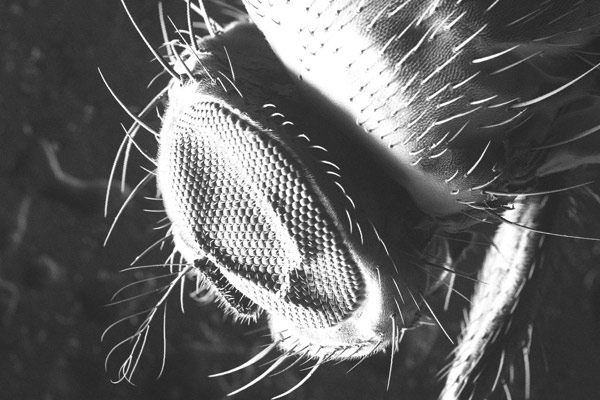
At the 8th International Conference on Integrated Fruit Production, held in early October 2012 in Turkey under the auspices of the International Organization for Biological Plant Protection, several alarming reports were presented by colleagues from the USA, Switzerland, Austria, Italy, and other countries about a new dangerous pest for fruit crops and vineyards - Drosophila suzukii (Matsumura).
Distribution. This species was first recorded in the USA in the autumn of 2008 in the state of California, where losses for 2010 in the states along the Pacific coast (California, Oregon, and Washington) were about $500 million, primarily from attacks on strawberry, raspberry, blackberry, blueberry, and cherry plantings. These losses reached $3 million in 2011. Currently, this highly dangerous pest has spread from the Pacific coast in the west to the states of the Atlantic coast in the east, to the state of Florida in the south, and the province of British Columbia in Canada in the north, i.e., up to the 49th parallel.
In Europe, the pest was first discovered in Spain in 2008., after which it was detected in other European countries in the period up to 2011 - Italy, France, Austria, Switzerland, Slovenia, Germany, Croatia, and in 2012 - in the United Kingdom and Portugal, meaning that during the specified period, it spread from the 40th to the 47th parallel in Western Europe. Losses in Southern France reached up to 80% for attacked crops, and in Northern Italy in the Trentino region between 30-40% for berry fruits and cherries. It has not yet been clarified how this drosophila arrived from America to Europe - likely with fruits or planting material.
The fly D. suzukii in 2010 moved from Spain and Southern France in Europe about 1400 km to the north and east, which speaks to its high mobility and adaptability, i.e., from the Mediterranean region in the south to the cold mountainous areas of the Alps, and over the next two years - throughout Western Europe. It has been established that one generation can move up to 45 km, with migration also aided by winds.
D. suzukii was first described in 1916 in Japan, discovered on cherries, where Matsumura (1931) worked on its study, who also noted its synonym – Leucophenga suzukii (Matsumura, 1931). The species belongs to the phylum Arthropoda, class Insecta, order Diptera, suborder Brachycera, family Drosophilidae, Drosophila suzukii (Matsumura). Over 1500 species in the genus Drosophila have been described worldwide. Besides Japan, D. suzukii is found in North and South Korea, China, in the easternmost part of Russia - the Primorsky Krai, India, Burma, Pakistan, Mexico, and Costa Rica. It has been known in the Hawaiian Islands since 1980. It is believed that D. suzukii was either naturally distributed in Japan or introduced from outside, when and how is unknown to this day.
Host Plants. Among berry species, it prefers - strawberries, raspberries, blackberries, blueberries; among stone fruit species - cherries, peaches, apricots, plums; grapevines - table and wine grapes. It also attacks crabapples, figs, blueberries, cornelian cherries, as well as a large number of wild and ornamental plants such as Lonicera spp., Sambucus nigra, Rosa spp. and others. In traps in France, it was found on tomatoes. All this shows that this drosophila is polyphagous and will be a very dangerous pest for our fruit production in the coming years.
Morphology and Life Cycle. Research conducted so far in Japan, the USA, Italy, France, Austria, Switzerland, and others has established that Drosophila suzukii is a small fly with a length of 2-3 mm, with a wingspan reaching 6-8 mm, and red eyes. Male individuals have a dark spot at the tip of their wings, which is the origin of its name in the USA - spotted wing drosophila (SWD). Female specimens possess a well-developed telescopic ovipositor.
The larva is milky white. The pupa is brownish.
D. suzukii overwinters as an adult insect. Under suitable conditions, it can develop year-round. In one season, this species develops from 7 to 15 generations depending on the climatic conditions of the area - in Japan there are about 13 generations, and in California - up to 10. For its normal development, temperatures between 10-32°C are necessary, with their optimal activity between 20-25°C, and below 5°C they enter winter dormancy. Considering that this drosophila has reached the northern island of Hokkaido in Japan, as well as the Russian Far East, and from the warm regions of Spain has established itself in countries of the Alpine region, we can understand its great adaptability to the climatic conditions of a given region. Female individuals lay their eggs on the ripe fruits of host plants. One female can lay up to 400 eggs or an average of about 300. The eggs hatch within up to 72 hours depending on climatic conditions. Several larvae can be found in one fruit. They should only be sought within the fruits, as they never develop outside of it. The pupa can develop inside the fruit pulp or outside of it. Attacked fruits soften, and secondary pathogens can invade at the site of attack, leading to the development of diseases caused by fungi and bacteria, causing the fruits to rot and drop, i.e., such fruits completely lose their commercial value.