

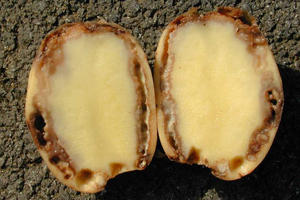
On Potatoes
The plants exhibit wilting of leaves and stems during the day and recovery at night until the point where the plants can no longer recover and die, but retain their green color for some time. At a height of 2.5 cm above the soil, a longitudinal cut of the stem reveals browning of the vascular bundles and the formation of cavities. When the vascular bundles are severed, a milky-white sticky exudate oozes from them.Symptoms on tubers can be clearly expressed or completely absent. From infected tubers with a high degree of infection, a white exudate oozes in the area of the "eyes". After cutting them lengthwise, from eye to eye, necrosis and browning of the vascular ring are observed. From the vascular bundles on the cut surface, a creamy-white, greasy bacterial exudate oozes spontaneously (without pressure). With early infection of plants, tubers are not always formed or they are very small.
On Tomatoes
Under conditions optimal for the bacterium's development, young leaves wilt, and then the entire plant. Adventitious roots form at the base of the plants. The bacterium develops in the vascular bundles of the stem, completely destroying them. In a cross-section, a white or light-yellow bacterial exudate oozes from the brown plant tissues.The symptoms of brown rot on tubers closely resemble those caused by ring rot (Clavibacter michiganensis subsp. sepedonicus). Distinguishing between the two quarantine bacteria on potatoes and the precise identification of the bacterium Ralstonia solanacearum is performed only in the Central Plant Quarantine Laboratory, under sterile laboratory conditions using biological, biochemical, serological (IF, ELISA) and molecular (PCR, real-time PCR) analytical methods.
In Bulgaria, brown rot is subject to systematic survey and control within the framework of a national monitoring program "Phytosanitary Control of Potatoes".
The bacterium was first discovered in the CPLQ in Sofia in 2007 in ware potatoes imported from Egypt. The infected lot was destroyed and the exporting country was notified.
In 2010, a new infection of Ralstonia solanacearum was established in a lot of ware potatoes imported from Turkey and destined for Germany.
The infected lot (21.5 tons) was destroyed, and both countries were notified.
In September 2014, the disease bacterial brown rot on potatoes was discovered for the first time within the country's territory in the Burgas region. Immediate measures were taken to eradicate the infection and limit its spread.
CONTROL MEASURES are regulated by Ordinance No. 11 of April 10, 2001, for the control of bacterial brown rot and include:
- Infected tubers, plants, and plant waste are destroyed. They may be used for industrial processing or as animal feed after heat treatment, under the control of inspectors, if there is no risk of spreading the infection.
- Infected areas are placed under quarantine and buffer zones are determined to protect adjacent areas free of the disease.
- The cultivation of potatoes and other host plants on areas with established infection is prohibited for five consecutive years.
- Crop rotation is carried out under the control of plant protection inspectors.
To prevent the transfer and spread of the infection, it is important to apply the following measures:
- planting certified seed;
- disinfection of storage facilities and potato warehouses before and after the end of the harvest year, as well as of machinery and equipment before processing each area;
Disinfectants with proven effectiveness are: 3-5% solution of Sodium hydroxide (caustic soda), 1% solution of Verikal (aldehyde base), 24% ammonium solution, Menno Florades (a disinfectant against phytopathogenic bacteria, fungi, and viruses) as well as a 1.5% solution of Persteril (a disinfectant with bactericidal action).
- removal of plant residues, which are potential carriers of Ralstonia solanacearum;
- crop rotation.
If you suspect the presence of the disease, immediately contact the plant protection inspectors at the Regional Food Safety Directorates for assistance.