

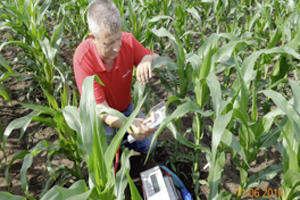
Leaf Gas Exchange
Leaf gas exchange in intact (undetached) leaves can be measured with portable systems developed based on an infrared gas analyzer, for example, the LCpro+ (ADC, England) (Fig. 1). The principle of the method is based on the fact that molecules of heteroatomic gases, such as CO2 and H2O, absorb infrared light at a specific wavelength.
The main indicators of leaf gas exchange are:
- net photosynthetic rate;
- transpiration intensity;
- stomatal conductance;
- intercellular CO2 concentration.
The determination of leaf gas exchange indicators under field conditions is carried out on the uppermost, fully developed leaves of the plants, on sunny days, and at the optimal time for photosynthesis - usually between 10:00 AM and 12:00 PM. The analysis of leaf gas exchange provides information about the instantaneous state of the plant's carbon nutrition and water exchange, which are fundamental physiological processes related to growth and productivity. The dry mass of plants contains 45% carbon, which they obtain from the air during the assimilation of CO2 in the process of photosynthesis. Plants transpire (evaporate) water to transport mineral elements and organic substances absorbed by the roots to the above-ground organs and to cool themselves under high temperatures. The parallel determination of the photosynthetic rate (A) and transpiration intensity (E), along with a number of other accompanying indicators, makes it possible to track how plants from different variants (cultivars or products) respond to stress impacts. It is considered that they have a good physiological status when the ratio of assimilated CO2 to transpired water (A/E) is high.
When comparing leaf gas exchange indicators across different variants, it can be established to what extent differences in photosynthetic rate are due to stomatal limitations or mesophyll factors. If the photosynthetic rate decreases together with transpiration, stomatal conductance, and intercellular CO2 concentration, it can be assumed that the damaging effect is largely due to stomatal limitations (low conductance of CO2 as a result of impaired water exchange). If under the same conditions, the intercellular CO2 concentration increases, and the transpiration intensity does not change, the effect is more likely related to mesophyll factors (disruptions in pigment complexes, light or biochemical processes of photosynthesis).