

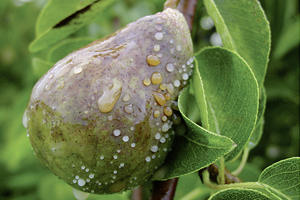
To ensure the production of healthy fruit produce, care for fruit plantations must continue during the winter months when the plants are dormant. With the onset of the relative dormancy of fruit species, the harmful activity of pests and disease pathogens weakens, but most of them remain in the plantations - in the soil, on the fallen leaves and fruits. This allows the fight against them to continue during the autumn-winter period.
Chemical Activities
The next very important activity during the dormancy period is carrying out winter spraying against the overwintering stages of a number of pests on fruit crops. It affects a large number of pests on fruit plants and is particularly useful for older trees, where there is an accumulation of infection from brown rot - early and late, scale insects, red fruit mite, leaf aphids, leaf fleas, leafrollers, winter moths.
For pome fruit species, winter spraying limits the infection from apple scab on apple and pear, fire blight, black rot, codling moth, etc. For stone fruit species, the attack from shot hole disease, peach leaf curl, bacterial canker, plum curculio, etc. is reduced. For raspberries, bud blight and cane dieback are limited.
When 70% of the leaf mass has fallen, stone fruit species should be sprayed with copper-containing fungicides: Bordeaux mixture - 2%, Funguran OH 50 WP - 0.15%, Champion WP - 0.3%.
Apple and pear trees are sprayed with a 5% urea solution. The fallen leaf mass around the trees is also sprayed well. With urea, besides fertilizing the orchard, favorable conditions are also created for the development of some microorganisms that destroy the scab infection in the leaves.
Fire Blight on Pome Fruit Species
This is a bacterial disease that affects all above-ground parts of pome fruit species - pear, apple, quince, medlar. Infected trees are recognized by the characteristic shepherd's crook-like curved from the top down and dried young shoots, branches with dried blackened leaves and fruits that remain on the trees and do not fall. The bacterium causing the disease overwinters in the infected branches, so the affected plant parts must be cut out 50-70 cm below the boundary between diseased and healthy tissue and must be burned outside the orchard. When an infection is detected, it is necessary:
- Cutting out the affected parts of the trees 50-70 cm below the boundary between diseased and healthy tissue and burning them outside the orchard;
- Severely infected trees are uprooted and also burned;
- After each cut, the cutting tools should be disinfected with a 10% solution of bleach or formalin;
- After finishing pruning, treatment with a copper-containing fungicide should be carried out.
Peach Leaf Curl
The causative agent of the disease is a fungus that overwinters between the bud scales or on the bark of infected shoots. The symptoms are single or numerous, pale green, pale yellow, or crimson swellings on the upper side of the leaves, which are sunken on the lower side. The damage can cover entire leaves, causing them to necrotize and fall off.
For better control of the disease, when 70-80% of the leaf mass has fallen, it is necessary to spray peach trees with contact or systemic fungicides: DITHANE M 45-0.03%, DITHANE DG-0.3%, SANCOZEB 80 WP-0.3%, SCORE 250 EC-0.02%, THIRAM 80 WG-0.15%, SHAVIT F 72 WDG-0.2%, CHAMPION/MACC 50 WP/CHAMP WP-0.3%
Conditions for Carrying Out Winter Spraying
To ensure effective spraying, it must be carried out on calm, sunny days, with an air temperature above 5 degrees Celsius. The nozzles of the sprayers should have a size of 2 mm to achieve optimal drenching of the tree canopy, from the top to the base of the trunk. Use from 50 to 120 liters of working solution per decare, depending on the age of the trees and the shape of the canopy.