

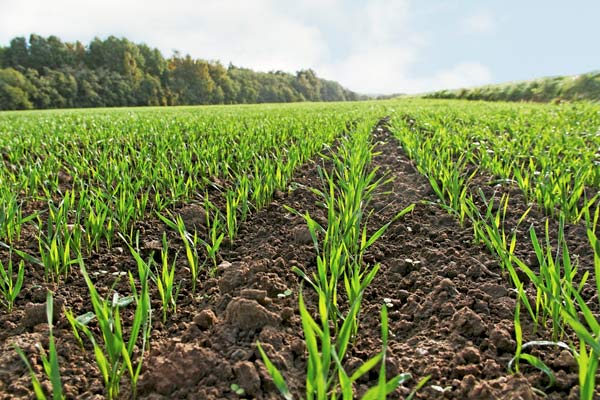
Cereals and grain crops are of significant economic importance and are fundamental for crop rotation. The correct choice of variety depending on geographical conditions, fertilization, and the implementation of adequate plant protection measures is extremely important for realizing the biological yield potential of these crops.
Preparation for autumn sowing includes one of the most important activities – seed treatment with fungicides. Through it, the development of economically harmful seed-borne diseases is reduced and limited: smuts, fusarium, barley stripe disease and others.
Smuts are among the most widespread and harmful diseases of cereal crops. They attack various organs of the host plants, including vegetative and flower buds, leaves, stems, petals, sepals, stamens, pistil, fruits, seeds. They more rarely attack the roots. The affected organs appear charred and covered with soot, from which the name of the disease – smut – is derived. The formed sooty mass consists of teliospores (chlamydospores). Smuts are strictly specialized parasites – the different species attack a specific plant species. If the seeds are not treated with fungicides, losses can range from 5 to 40%.
Depending on their development cycle, smuts are divided into three groups:
The first group includes smuts whose infection is transmitted as teliospores on the surface of the seeds, and infection occurs during seedling emergence. This group includes:
Common bunt (stinking smut) of wheat – Tilletia foetida (Tilletia levis) and Tilletia caries (Tilletia tritici);
Covered smut of oats – Ustilago levis;
Covered smut of barley – Ustilago hordei;
Loose smut of barley (black smut) – Ustilago nigra;
Stem smut of wheat – Urocystis tritici;
Stem smut of rye – Urocystis occulta
The second group includes smuts whose infection is transmitted as mycelium inside the seeds. When such seeds are sown, the fungus mycelium is activated during germination. It reaches the growing point and, during ear formation, transforms all its parts (except for the rachis) into a smutty powdery mass. This group includes:
Loose smut of wheat – Ustilago tritici;
Loose smut of barley – Ustilago nuda
In the third group of smuts, the infection is not transmitted by seeds; infection occurs during the vegetation period of the plants. The pathogens survive unfavorable conditions as chlamydospores on the soil surface and in plant residues. Under favorable conditions, the chlamydospores germinate, forming a basidium and basidiospores, which are sexually differentiated. Carried by the wind, they land on the host tissue, germinate and form weakly growing haploid hyphae. When two sexually different hyphae come into contact, the contents of their cells fuse and a parasitic dikaryotic mycelium is formed, which develops between the cells and causes local damage. Later, the mycelium disintegrates into chlamydospores. A typical representative of the third group is common smut of maize – Ustilago zeae.