

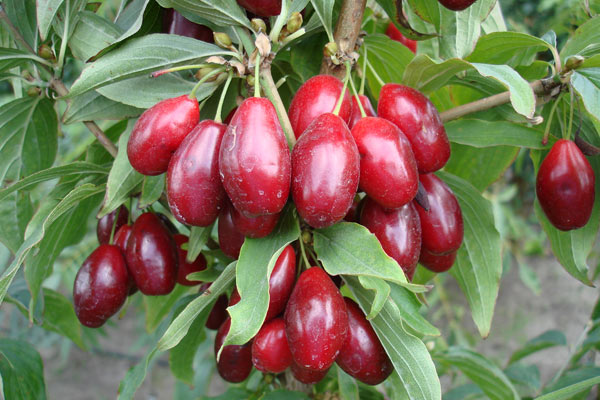
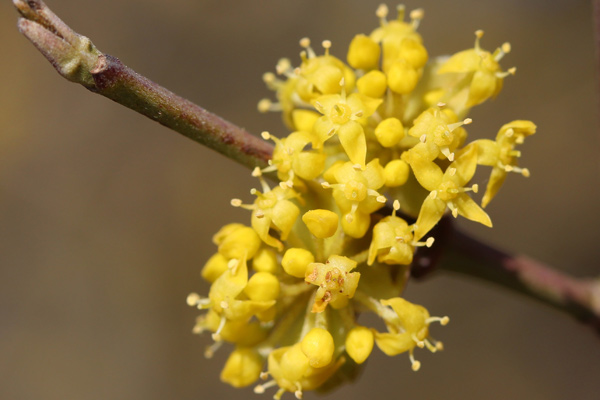
The common dogwood (Cornus mas L.) belongs to the genus Dogwood (Cornus L.) and is the most popular species of the dogwood family (Cornaceae). In the wild and in cultivation, several varieties and forms are better known:
- according to the crown shape – pyramidal (forma piramidalis Dipp.) and dwarf dogwood (f. nana Carr.);
- according to the leaves – with strongly pubescent margin (f. crispa Dipp.), with yellow or anthocyanin-coloured margin (f. elegantissima Nichols), with yellow leaves for a long period after leafing (f. aurea Schneid.), with white margin (f. argenteo-marginata);
- according to the fruit colour – with light yellow (white) fruits (f. alba (West.) Rehd), with yellow fruits (f. flava Vest.);
- according to the fruit size – large-fruited (f. macrocarpa Dipp) and small-fruited (f. microcarpa Dipp.).
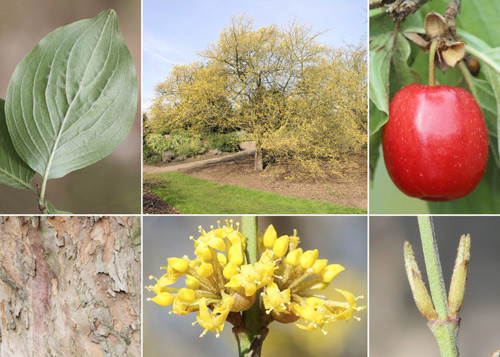
The common dogwood grows relatively slowly. It develops as a shrub with usual dimensions of 3-4 m or as a tree reaching a height of up to 8-10 m. The crown width reaches the same dimensions, as its shape is most often globular. In young trees, the bark of the trunk is smooth, thin, brown with a grey hue. In 20-30-year-old trees it is shallowly cracked, chestnut-coloured, with scales that periodically fall off. In older trees it is dark grey.
The wood has a pink-yellow and brown-red heartwood – extremely strong and valuable. One-year shoots are angular and their cross section is triangular. On the sun-exposed side they are reddish-brown, and on the opposite side – greenish, with pronounced lenticels, pubescent. The leaves are simple, entire, arranged in opposite pairs, lanceolate, pubescent. The leaf buds are small, appressed or slightly detached from the shoot, elongated-conical, pointed, narrow, light green. The flower buds are larger, globular, with a small tip, light yellow-green, finely pubescent. The flowers are bisexual, small, yellow, gathered in inflorescences of a transitional form between umbel and head, most often 16-24 in number. The fruit is a drupe, juicy, sweet-sour, astringent when not softened, red or yellow, with cylindrical, pear-shaped, bottle-shaped, barrel-shaped and other transitional forms, weighing 2-8 g. The fruit stalk is thin, elongated, light green. The stone is extremely hard, with an oval to spindle-shaped form, almost smooth, light brown.
In our country, in addition to the widely known and distributed common dogwood, three more species are known. The second most popular is the bloody dogwood (Cornus sanguinea L.), widespread throughout the country and invading arable land as a weed vegetation. The white dogwood (Cornus alba L) is a shrub with strikingly coloured red and yellow twigs, for which reason it is grown as an ornamental plant. The flowering dogwood (Cornus florida L) is a beautifully flowering species, grown in Europe as an ornamental plant with late flowering.
The common dogwood is a very valuable forest, fruit, medicinal, ornamental, technical, melliferous and ritual plant. It is known primarily as a forest fruit tree or shrub whose fruits have been used by humans for millennia as a source of vitamin-rich food supplement. The fruits are suitable for consumption fresh and processed. Well-ripened fruits are most suitable for consumption 2-3 days after harvesting, when they begin to soften.
Dogwood fruits (cornelian cherries) have an exceptionally rich chemical composition, which determines their high medicinal and nutritional value. In our studies we found that the content of vitamin C in fresh fruits of Bulgarian cultivars varies from 70.18 to 82.37 mg per 100 g fresh weight. After four days of storage, in order to become suitable for consumption, the vitamin C content decreases by 4-9 mg per 100 g. The dry matter content ranges from 12.34% in the cultivar Shumenski Prodalgovat to 14.37% in Kazanlashki Krushovidен. The content of total sugars varies within relatively small limits from 7.10% in Shumenski Prodalgovat to 7.68% in Zhalt Hadzhiyski. Acids, determined as malic acid, range from 2.094% to 2.995% in fresh fruits and decrease to 1.880% after four days of storage. Tannins range from 0.225% to 0.337% and decrease slightly on the fourth day. Cornelian cherries are extremely rich in antioxidants, vitamins, fibres and mineral salts. All of these have important functions for the normal course of physiological processes in the human body. The content of chemical components is largely preserved in processed fruits as well.
The kernels in the fruit stones also have a very rich chemical composition. They serve as raw material for the production of soap and oil. The latter has a fresh yellow colour and a high content of linoleic, linolenic and oleic acids. It can also be used in culinary applications.
The economic importance of the common dogwood is still determined mainly by the fruit production obtained from forest stands. The largest producer is Ukraine, where artificially established forest stands and large orchards of cultivars are grown over extensive areas. Dogwood production is also obtained in Moldova, Türkiye, Greece, North Macedonia, Serbia, Croatia, Romania, Russia, Slovenia, the countries of the Middle East, Italy, France, Spain, Portugal, Germany, the USA, and others. From all regions of the Caucasus and Crimea, the annual production used to be between 30,000 and 40,000 t, and today it has increased many times over.
From the natural habitats in our country, in an average crop year, during the 1970s and 1980s of the last century, more than 6,000 t of cornelian cherries were collected from the regions of Blagoevgrad, Kardzhali, Sliven, Stara Zagora, Pazardzhik, Targovishte, Yambol, Montana, Plovdiv, Vidin, Lovech and Dobrich.
The exceptional strength of dogwood timber has been known since ancient times. In addition to old weapons and clock mechanisms, it was used to make musical instruments, parts for old looms, walking sticks, crutches, door handles, tools, hammers, garden tools, wooden ploughs, cart wheels, icons and various souvenirs. The leaves of dogwood are used for leather processing and dyeing.
The common dogwood is highly valued as an ornamental plant. With its numerous, beautiful inflorescences and early flowering, it is one of the heralds of spring. It is increasingly present in the landscape design of public and private park spaces. It can easily be used to create unique flowering hedges with various profiles.
The important role of dogwood as a medicinal plant has also been recognised since ancient times. Its fruits, leaves, bark, stones, buds and roots are an important source for obtaining medicines. Folk medicine, as well as modern medicine, is well acquainted with many disorders in the human body that are effectively treatable with dogwood-based products.
The significance of dogwood as a melliferous plant is very important. With its very early, abundant and prolonged flowering, it provides one of the first pastures for bee colonies. It supports bees after an exhausting winter and creates preconditions for the laying of the first brood for the new season.
The deep integration of dogwood into people’s everyday life has given names to many settlements, localities, streets and even family names. Accepted as a symbol of health, longevity, fertility, success and freshness, dogwood has shaped old but still preserved traditions in the life of our people. Everyone eagerly awaits to see their fortune from the Christmas and New Year banitsi and breads, decorated with short dogwood twigs with buds, to which small slips of paper with fortunes are attached. People who honour this colourful tradition believe that the more richly adorned a dogwood survachka is, the healthier and more fertile the coming year will be. The survakari have been welcome guests in the Bulgarian home from ancient times to the present day, coming in to recite the well-known folk verses “Surva, surva vesela godina…..”.
The economic importance of the common dogwood as a stone fruit crop is continuously increasing. This is due to its high ecological plasticity, drought tolerance and very low susceptibility to diseases and pests. It is suitable for organic fruit production and is known for its longevity. It is adaptable to climate change and can be successfully grown on less fertile soils where other fruit crops do not develop well. All this defines the common dogwood as a crop of the future. This is further supported by the availability of a diversity of natural large-fruited cultivars and forms, as well as by the intensified targeted breeding of new cultivars over the past two decades. The leading country in this respect is Ukraine, where more than 50 new large-fruited dogwood cultivars have been developed.
As a cultivated fruit plant in our country, the common dogwood is represented by a not very large diversity of local cultivars and large-fruited forms. It is grown mainly in home orchards by amateur fruit growers. It is still little represented in specialised plantations, but there is a growing interest in this direction, driven by the potential of dogwood for high and regular yields.
Readers can find full and comprehensive information about the common dogwood in the new monograph by Prof. Dr. Argir Zhivondov, published this year. The monograph covers historical data, botanical description, the importance of dogwood, biological requirements, methods of propagation, production of planting material, establishment and cultivation of dogwood plantations, yields, new and promising cultivars, medicinal properties and the use of cornelian cherries in culinary practice.
The monograph is useful for a wide range of readers – agronomists, foresters, biologists, lecturers, students and the numerous dogwood enthusiasts.
For contact, tel. 0888 229006 and email: a.zhivondov@abv.bg