

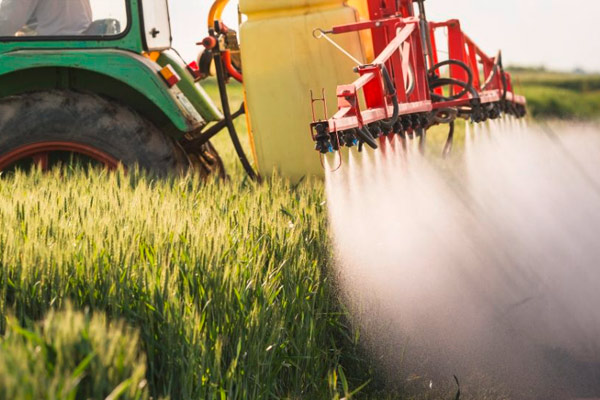
Pesticides (from the Latin words pest – harm, and cide – to kill), also called plant protection preparations and products, are organic and inorganic substances applied against insects and other pests of plants and of stored products and materials; against insects, parasites and other organisms, vectors of causal agents of diseases in plants, animals and humans, as well as against undesirable plant species (weeds, poisonous, woody-shrub and other vegetation) in agrocenoses and other cultivated areas.
Pesticides are divided into groups depending on several main indicators:
According to the origin of the toxic substance into:
- of mineral origin (inorganic compounds of sulfur, copper, iron, arsenic, sodium, aluminum, etc.);
- of plant origin (pyrethrins, cyperins, nicotinoids, etc.);
- of synthetic origin – the toxic substances are compounds obtained by synthetic means (organophosphorus compounds, synthetic pyrethroids, neonicotinoids, dithiocarbamates, triazoles, derivatives of pyrimidine, of glyphosate, metalaxyl, etc.);
- derivatives of microorganisms (actinomycetes, fungi, bacteria, etc., called bioinsecticides – Dipel H2, Ranax, Naturalis, various antibiotics).
According to the pests against which they are applied into:
- insecticides (insectum – insect) – against insects;
- acaricides (acarus – mite) – against mites;
- insecto-acaricides – against insects and mites simultaneously;
- nematicides (nematodes – nematodes) – against plant-parasitic nematodes;
- limacides – against slugs;
- rodenticides = raticides – against harmful rodents.
All these pesticides are grouped under the common name zoocides (zoon – animal);
– fungicides (fungus – fungus) – against fungi causing diseases in plants and their production;
– bactericides – against bacterial diseases of plants and their production;
– virocides (virus – poison) – against viral diseases of plants.
These pesticides are grouped under the common name fungicides.
– antibiotics – pesticides formulated from products of the vital activity of microorganisms – actinomycetes, bacteria, fungi, etc.;
– herbicides (herbum – herbi – grass, weed) – against undesirable weed or poisonous vegetation;
– algicides – against algae;
– arboricides – against undesirable woody-shrub vegetation;
– chemosterilants – preparations for sexual sterilization of insects.
According to the mode of penetration of the active substance and toxicity, pesticides are divided into:
– contact – they poison organisms upon contact with them, penetrating through the body surface (in insects, mites, nematodes, causal agents of fungal and bacterial diseases, etc.);
– stomach (ingestion) – through food (in insects, mites, rodents, etc.);
– fumigants – they penetrate the organism via the respiratory tract (in insects, mites, nematodes, causal agents of fungal and bacterial diseases, etc.) and poison the organism through the gases and vapours they release.
This division is relative, since many pesticides possess all three modes of penetration.
All pesticides are divided into two large groups – contact and systemic.
Contact pesticides cause death or impair basic vital processes in the organism upon direct or indirect contact with it (deposition of the pesticide on the organism, movement of the organism over a surface with pesticide, by asphyxia or otherwise), without entering plants and being transported by the conducting system.
Systemic pesticides penetrate into plant tissues – leaves, young shoots, roots and other parts and, together with water, nutrients and nutritional substances, are transported through the plants by the conducting system – xylem and phloem, from the roots to the above-ground part and from the above-ground part to the roots of the plants. The products accumulate mainly in the cell sap of the individual organs. These pesticides poison insects, mites and other pests mainly via the stomach-nutritional route, although they also possess significant contact toxicity, and contact pesticides – significant stomach toxicity. Systemic pesticides are applied mainly against insects with piercing-sucking mouthparts, mites, causal agents of diseases and other pests.
Some pesticides also have the so-called penetrating action – they penetrate into plant tissues (leaves, fruits, young shoots, floral parts and other organs) to a certain depth, but are not taken up by the conducting system. Their toxicity is contact and stomach. The movement of the products in this case is from cell to cell, also called “translaminar” – most characteristic of the penetration of pesticides into the leaf parenchyma and into young fruits.
Herbicides, according to their toxicity, are divided into two main groups – total (they poison all types of plants) and selective (they poison only certain plant species).
There is also a hygienic-health classification of pesticides, based on a large number of indicators – lethal dose in mg/kg live body weight in rats; oral, dermal and inhalation toxicity; accumulation, embryotoxicity, teratogenicity, blastomogenicity, carcinogenicity, mutagenicity, allergenicity, irritation of skin and eyes, etc. On the basis of these indicators, pesticides are divided into 3 categories for use – first, second and third, determining the qualification of the persons allowed to work with a pesticide belonging to the respective group.
In plant protection, the so-called “biologically active substances” are also used – sex pheromones, kairomones, analogues of major hormones in insects and mites, attractants, repellents, antifeedants, immunizers, etc.
Toxicity of pesticides, poisons, poisoning, dose
The toxicity of pesticides to pests and plants manifests itself in different directions depending on the toxic substance (t.s.), its structure, size of molecules, solubility, resistance to abiotic factors, degradation, etc., and often on additionally added substances to the product – solvents, emulsifiers, fillers, etc.; on the treated organisms – taxonomic group, species, age, stage, sex, physiological state, season, etc.; on environmental factors – temperature, moisture, precipitation, solar radiation, wind, etc.; on the plant on which the pest develops – species, age, growth vigour, etc. The toxicity (from toxicon – poisonous) of pesticides to pests and plants is generally expressed in: inhibition of enzymes, coenzymes and hormones, removal of oxygen from the cells of the treated organisms; oxidative and chlorinating action; disturbance of gas exchange; reduction of osmotic pressure in the tissues of organisms and plants, followed by coagulation of protoplasm, proteins and peroxidation of lipids in cell organelles; damage to chloroplasts in plant leaves, as well as reduction of life span and fecundity; effects on the rate of reproduction, movement, feeding, metamorphosis; effects on the life of symbiotic microorganisms in the stomach of insects, mites and other pests, etc. The mechanism of toxicity in the main groups of pesticides is described in separate articles.
Poisons are substances which, when interacting with an organism in insignificant quantities, cause disturbance of vital processes and, under certain conditions, a morbid state or death occurs. Toxic are natural compounds, products of the vital activity of plants, macro- and microorganisms, and substances obtained by synthetic means. There are external (exogenous) and internal (endogenous) poisons formed in the organism. Toxicity = poisoning is understood as the interaction between an organism and a toxic substance – poison, which is always a toxic substance, and poisoning – a pathological process arising from the interaction of the poison with a living organism (human, animal, insect, mite, nematode, causal agent of disease, plant, etc.). Toxicity is of two types – acute, arising from a single action of the poison (pesticide) on the living organism and manifested by disturbance of basic vital processes, with the possibility of a lethal outcome, and chronic, arising as a result of repeated actions of the poison on the organism in small quantities. It is manifested by slowly developing disturbances of vital processes in the organism.
According to the place of penetration of the poison into the animal organism, toxicity is divided into:
– oral – penetrating through the mouth (per os);
– dermal – penetrating through the body surface (skin);
– inhalation – entering the organism via the respiratory tract.
Toxicity is expressed through the dose – toxic dose, “The dose makes the poison” (Paracelsus). The dose represents the quantity of pesticide (a.s. of the pesticide) that produces a biological effect on the treated organisms and is expressed as a unit of weight of the pesticide (a.s.) per unit area, volume or mass of the organism – most often in mg/kg live body weight for rats. The biological effect of pesticides, manifested on studied objects – organisms, called biotests, is determined by the mortality caused or by signs of poisoning – change in basic vital processes, in the duration of life and in the degree of fecundity; reduction of mobility, feeding rate, respectively of damage, etc. Mortality and biological effect of pesticides are expressed as percentages compared to other organisms of the same species, age and stage, not treated with pesticides, called “controls”. Toxicity indicators are expressed with letter symbols LD – lethal dose; CD – fatal dose; LC – lethal concentration; ED – effective dose – used when it is possible to establish the biological effect of the applied pesticide.
The letter symbols are arbitrarily adopted by the authors. The efficacy of pesticides is always lower than mortality, and the difference between them is greater the longer the period of time over which the results of pesticide toxicity are recorded.
Depending on the degree of toxicity, the dose may be: threshold – the minimum quantity of pesticide (a.s.) that causes a change in basic vital functions in the organism(s); upper threshold – the minimum quantity of pesticide that causes death of the organism(s). This dose is called lethal – fatal and is divided into an absolute threshold dose causing 100% mortality of organisms – denoted LD 100, and a median threshold dose causing death of 50% of organisms – denoted LD 50. The quantity of pesticide applied against pests on a certain area, volume of air space, soil, soil-fertilizer mixture, etc. is called the application rate (dose) of the pesticide, and the quantity of working substance (solution, emulsion, suspension, poisoned bait, etc.) – application rate of the working substance. Observance of these categories when applying pesticides against pests is a basic prerequisite for high efficacy. It is accepted that against pests of crops with a continuous surface, row crops, on grassed and bare areas, pesticides (doses) are calculated in units of weight or volume – mg, g, ml, cm2, l, kg, and against pests of fruit crops, vineyards, hops, rose plantations, tall-growing vegetable crops, etc. – as a percentage of the working substance. The dose of pesticides for pests and crops on which they will be applied is proposed by the manufacturing (importing) company, but it is often specified through the so-called “Biological testing” for compliance with the local climatic factors of the country. A pesticide authorized for application in an EU (European Union) Member State with climatic factors close to those of the Republic of Bulgaria may be authorized for use without biological testing. Biological testing in the Republic of Bulgaria is carried out under an ordinance of the Ministry of Agriculture, Forestry and Food, and the results obtained from it are discussed and adopted by specialized commissions and by a Products Council appointed by the Minister of Agriculture, Forestry and Food. The Products Council proposes, and the Minister approves, a list of pesticides authorized for marketing and use in the Republic of Bulgaria.
For pesticides, the so-called “Maximum permissible concentrations” – MPC and “maximum permissible quantities” – MPQ have been adopted, respectively in percentages and in mg/kg fruits, vegetables, grapes, foodstuffs of plant and animal origin, feed, etc. For each pesticide and crop on which it is applied, a pre-harvest interval (quarantine period) in days has been established – the period from its application on plants, food products and materials, soil and air space by spraying, dusting, fumigation, soil baits, etc., until its degradation (breakdown) into substances safe for the health of humans, domestic and wild animals, for pollinators of plants and for other beneficial organisms. The pre-harvest interval is often equated with the duration of toxicity of the pesticide. These two categories differ significantly from each other in duration and in the objects to which they refer: the pre-harvest interval for humans, wild and domestic animals, beneficial organisms, etc., and toxicity – for pests. The pre-harvest interval depends on the pesticide, the dose, the crop on which it is applied and its age, as well as on abiotic factors – temperature, moisture, precipitation, solar radiation, wind and others.