

Fire blight is a bacterial disease that is widespread throughout the country. The pathogen attacks and develops mainly on species from the family Rosaceae, and among the most susceptible hosts of the bacterium is the pear. The disease can develop on all parts of the trees, destroying flowers, shoots and scaffold branches. The infection may reach the trunk and develop also on the rootstock. In years with favourable conditions for the development of the bacterium, which usually coincide with pear flowering, the pathogen causes significant damage in orchards, which is reflected in the yield and quality of the produce.
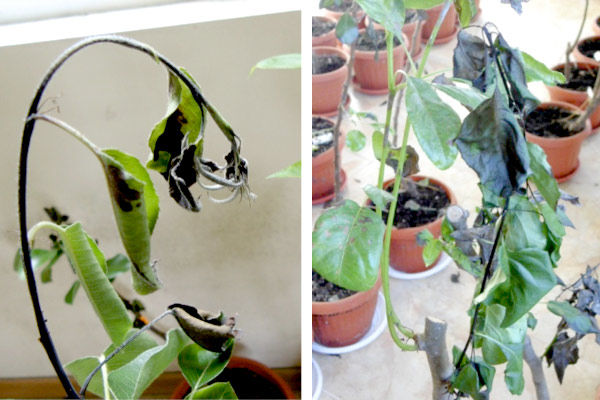
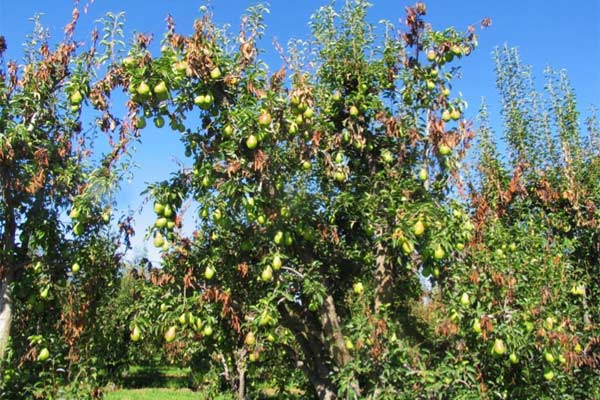
Symptoms: The first symptoms are observed during flowering, which is also the most critical phenophase in the development of the trees. Necrotic areas appear on the affected flowers, which enlarge and cover the entire flower. The necrosis progresses and continues to develop along the flower pedicels, passing onto the leaves and the bearing shoot. In pear, the leaves and flowers acquire a dark brown to black colour. In infected, more susceptible cultivars, a more rapid development of the pathogen is observed, reaching the scaffold branches of the trees. Canker damage can be seen when the infection passes from the scaffold branches to the trunk or in cases of infection resulting from mechanical injuries.
Characteristic features of the disease are: the tips of young shoots acquire the shape of a “shepherd’s crook”; the leaves on the affected shoots do not fall even after autumn leaf fall, which gives the trees a scorched appearance.
Pathogen
The phytopathogenic bacterium Erwinia amylovora is peritrichous, strictly aerobic and Gram‑negative. It overwinters in cankers formed on the twigs, branches and trunks of the trees. In spring, bacterial exudate is observed on the cankers, which is spread by rain, insects and pruning tools. Once deposited on the plant organs, the bacterium penetrates them through natural openings of the leaves and flowers (stomata, lenticels, nectaries). It can also enter through wounds caused by insects, hail, as well as through mechanical injuries during orchard cultivation and pruning.
Control
Establishment of orchards only with healthy planting material. Pruning of infected parts from the previous season is recommended. Disinfection of tools during phytosanitary pruning. Uprooting of heavily infested trees in the orchards. Preventive treatments are recommended, from 4 to 8 applications, carried out during periods when conditions for disease development (temperature and moisture) are favourable. Particularly important are protective treatments during flowering and after hail, when the bacterium most easily penetrates plant tissues. The approved plant protection products are: Bordeaux Mix 20 WP (0.375–0.5 g/ha); Vitra 50 WP (150 g/ha); Cuprochlor 50 WP (150 g/ha); Kocide 2000 (0.155–0.680 g/ha); Regalis Plus (150 g/ha).