

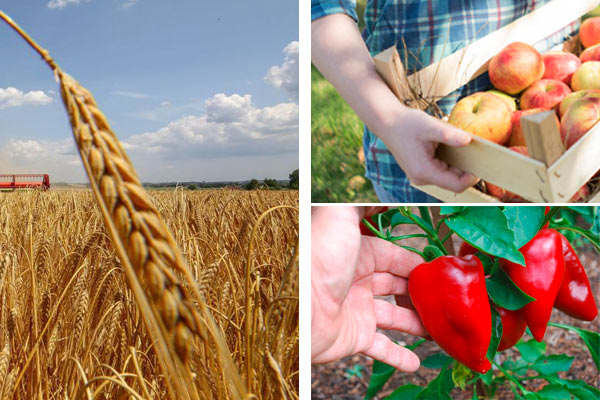
Historically, Bulgarian agriculture has provided numerous examples of resilience under force majeure circumstances – wars, plague, economic and natural disasters...
Today, when Covid-19 has struck us, when the economy is gasping for breath, agriculture is once again the sector with an unexpectedly large-scale capacity and potential, capable of carrying the sinking ship on its back to the safe shore. In short: our agriculture is in a condition to maintain the food chain at a high level – the circulatory system for the nation’s survival against the insidious scourge.
It is an indisputable fact that, in the current explosive epidemiological situation, agriculture is in a privileged position. Production takes place in the open air, spatial isolation and distancing are not a problem. Before I continue to present my thesis on the state and possibilities of our agriculture, I would like to clarify that in this case I have in mind a specific subsector, more precisely the production of cereal crops – wheat, barley, sunflower, maize and rapeseed. In this production – thanks to the protectionist policy of the Ministry of Agriculture and of all governments after 2007 – a huge energy charge was generated – generous European subsidies and a host of other economic and investment mechanisms and privileges.
The result of this “intervention” is evident – a broad-format basic, technological and structural transformation has been carried out, an avant-garde project has been implemented. Today it can be stated calmly and without a shadow of doubt – grain production in Bulgaria holds leading positions in the European Union.
Having outlined the profile of grain production, an important item in Bulgaria’s exports, I must note yet another remarkable fact: today, when the whole of Bulgaria is under siege by the coronavirus, the mobilisation of the so-called grain producers (as Prime Minister Borissov affectionately calls them) is at an exceptionally high level, work is progressing at unsuspected rates, regardless of the unfavourable climatic and phytosanitary environment, to which we must add the purely psychological pressure exerted by the invasion of the insidious viral calamity.
This is the place to emphasise that the rear of our farming army is at its advanced post. I am referring to the companies that supply seeds, fertilisers and plant protection products. The management of all these companies, representatives in our country of the leading global agrochemical and seed industries, have mapped out perfect corridors for timely supply. This means that the business partners of Bulgarian farmers are working day and night to organise the planning and logistics of their products to every field in Bulgaria. And something more. The expert teams of this responsible business are in the field, because in their view today Bulgarian agricultural producers need high-level professional assistance and competent expertise more than ever. This will help farmers to define informed decisions and strategies, to eliminate risks and to form sustainable production.
The trading companies for seeds, fertilisers and plant protection products have positioned a working model for strategic partnership – an investment capital resource including energy, time, top-class products, creativity and dedication! And most importantly: shared responsibility for the future harvest!
Against the background of this highly intensive format of our national agricultural production, the disproportionate development of another part of our agriculture – fruit growing and vegetable production – clearly stands out. The well “kept secret” came to full light during the dispute in April between the Minister of Agriculture Desislava Taneva and the heads of the retail chains in connection with the rescue operation for Bulgarian agricultural products – fruit, vegetables, meat, fish, dairy products – planned by the Ministry of Agriculture, Food and Forestry. This loud quarrel ultimately ended (at first glance) peacefully. A Council of Ministers Decree ordered that 50% of the retail space in supermarkets in the country be allocated to domestic production.
I do not have sufficient competence to comment from a legal point of view on this administrative regulatory act in a free market that is part of the European commercial space, even if it is during a pandemic.
I would like to make the reservation that the continuation of this publication will cover only part of the issue, more precisely fruit and vegetables. Minister Taneva, whether intentionally or not, informed the traders present at the “negotiation” table that out of 100,000 agricultural producers in Bulgaria, 16,000 grow fruit and vegetable crops – 75% of these 16,000 are non-viable.
What does this fact mean? It is an indication, a confirmation, that the Bulgarian administrative and political authorities have neglected for years the two key sectors – fruit growing and vegetable production. First and foremost, as Ms Taneva herself admits, 75% of the farms are non-viable and need protection, support and assistance. Fruit growers and vegetable producers are the poor relatives of grain producers. So far, subsidies and state aid for them have been symbolic, in most cases poorly regulated, chaotic, non-objective and ineffective. The problem of permanent and seasonal employment in these labour-intensive productions with high capital expenditures has remained unresolved and there is no concept for its solution. On the other hand, the lack of producer organisations for the marketing of produce, whose absence is justified by the notorious Bulgarian dualism that has haunted us from time immemorial, is not a serious argument. There are more than enough economic instruments capable of debunking this mythologem. For example – a pilot project for a cooperative of this type, financed by the Agriculture Fund, would certainly prove to be a demonstrative and effective example. We come to the wholesale markets where the main part of the already very modest production of fruit and vegetables, which remembers better times, is marketed. The organisation of these trading centres does not meet a single modern requirement. The sad picture is complemented by the deplorable condition of the sanitary facilities...
In what state is the scientific support for these productions with irreplaceable participation and central role in the food chain? The Institutes of Fruit Growing in Plovdiv and Kyustendil and of Vegetable Crops in Plovdiv, within the structure of the Agricultural Academy, have long since ceased to shape visions of the present and future of modern fruit growing and vegetable production. They have ceased to be centres of knowledge and competence, they have ceased to chart tracks for transfer and innovation. Their scientific, experimental and applied activity has been seriously compromised by the underfunding imposed on them by law. These once indispensable factors of sustainable, modern and profitable production today appear to be a peculiar social experiment, a provocation, created at a high institutional level with the sole purpose of their slow, quiet and imperceptible to the untrained eye oblivion. Which proves once again that we are top of the class in making wrong decisions!
By way of conclusion: Bulgarian fruit growing and vegetable production are small-scale, seasonal, extensive, low-tech productions. They are not export-oriented, the share of exports is negligibly small. Their comprehensive, fundamental transformation and modernisation requires a financially secured strategic perspective.
From numerous media platforms, with a trained, theatrical voice, although I strongly doubt her dramatic talent, Minister Taneva has deafened us by repeating that Bulgarian fruit growing and vegetable production need support. This is the very TRUTH! Only, from the abundant eloquence of Ms Taneva it did not become clear whether she herself realises that the first address of this support is the Ministry of Agriculture, Food and Forestry headed by her?
If we assume that all this noise and crackle is not a PR campaign and an imitation of hyperactivity in a delicate situation, then it follows that Desislava Taneva already has a concept for the revival of the vital sectors of our agro-industry. This assertion, we would like to believe, is indirectly supported by the fact that Minister Taneva has publicly announced that she is personally taking over the management of these super important productions, a sign that she is formalising her new project. If she really commits herself to putting an end to the well-known “doing nothing”, we will applaud her. We wish Minister Taneva every success in carrying out this responsible mission! Because, in order for her personal, ambitious cause to succeed, she will have to wage many more wars, not only against the retail chains...