

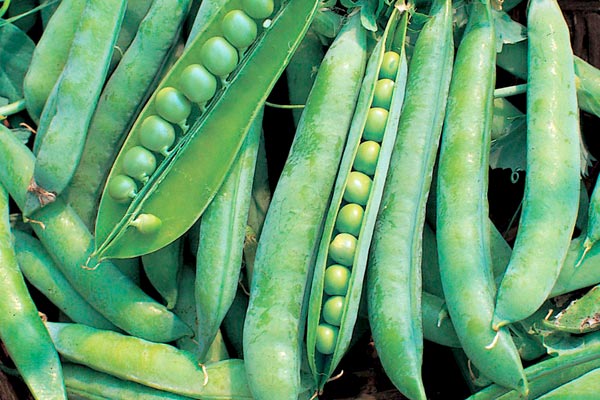
The family Fabaceae is the third largest family of angiosperms. Its representatives are herbaceous plants, subshrubs, shrubs and trees, represented by about 730 genera and 19,400 species. Legumes are distributed all over the world and thrive under diverse conditions. A large number of agricultural crops of significant economic importance are among the representatives of this family.
In Bulgaria, about 275 species from 38 genera of the family Fabaceae are naturally distributed. Among them are the familiar common bean, pea, soybean, peanut, clover, chickpea, sainfoin, broad bean, vetch, lentil.
A small part of the legumes – green (garden) bean (Phaseolus vulgaris (L.) Savi.), garden pea (Piasum sativum L.) and broad bean (Vicia faba L.), belong to the main legume vegetable crops in Bulgaria. They are excellent sources of dietary fibre and nutrients such as folate and potassium, substances that are also found in other vegetables. At the same time, legume vegetable crops are excellent sources of plant protein, iron and zinc, which also assigns them to the group of protein foods.
Legume vegetable crops are used as staple foods with high biological value. They provide in an easily assimilable form proteins, carbohydrates, vitamins, mineral salts and other physiologically active substances. A cup of green beans or 100 g of green peas covers the recommended daily intake of vitamin C. Rich in mineral salts, mainly potassium salts, in B-group vitamins, fibre, proteins and others, legume vegetables are extremely suitable for inclusion in healthy dietary regimes for varied, wholesome and balanced nutrition.
Legume vegetable crops have a short vegetation period, which makes them very suitable as fillers in vegetable crop rotations. They improve soil fertility through symbiotic relationships with bacteria of the genus Rizobium and are good predecessors for all other crops, except those from their own family. In addition to grain, 1–2 t per hectare of green forage are obtained from garden peas, and mechanically harvested green beans are a very good green manure, whose effect is equivalent to fertilization with 3 tonnes of farmyard manure per hectare.
Over 95% of the production of garden peas and green beans is intended mainly for the manufacture of sterilized and frozen canned products, baby and diet foods. In different regions of the world and in our country, a great variety of cultivars and local forms of green bean, garden pea and broad bean are used for consumption in unprocessed form and are suitable for hand harvesting. The garden pea “mange-tout” (mange-tout peas) and the sweet tender “sugar snap” (sugar snap peas) are little known to our consumers and are grown only by amateur gardeners. In the countries of Western Europe and the USA they are cultivated on larger areas and are of considerable interest.
Cultivars of beans for consumption in unprocessed form are divided into stringless cultivars and “filet” type, which form strings at a later stage of pod development, with preference given to cultivars with flat, broad, easily cooked pods with a typical bean flavour. In our country broad beans are used mainly for human consumption, both their green pods and their mature seeds. Broad bean seeds are consumed dry, fresh, frozen or canned.
Green beans are grown in many places around the world due to their broad naturalization. Among the countries with the largest production of green beans in the world are China, India, Turkey and Egypt. In Europe they are most widely grown in France, Belgium, Spain, the Netherlands, Italy and Greece.
Garden peas are grown in more than 87 countries worldwide, with half of the world production concentrated in Canada, China, India and Russia. In recent years, the pea-growing areas in the European Union have exceeded 800,000 ha. France is one of the largest producers (60% of EU production), followed by Germany and England.
Broad bean is the fourth most important legume crop in the world after common bean, pea and chickpea. It is grown in about 50 countries, and total production exceeds 4.4 million tonnes. The largest producer is China, followed by Ethiopia, Egypt, West Germany, Italy, Morocco and France.
In Bulgaria, according to data from the Ministry of Agriculture, Food and Forestry, the harvested open-field areas in 2018 amounted to 479 ha for garden (green) peas and 188 ha for garden (green) beans, or a total of 667 ha. The average yields from open-field areas are 3,564 kg/ha for peas and 9,367 kg/ha for beans. Production from open-field areas is 1,707 and 1,761 tonnes respectively, and there are also 5 tonnes of greenhouse production of green beans, or a total of 3,473 tonnes. Broad beans are grown throughout the country on small areas, mainly in home gardens, and serve to meet the needs for fresh vegetables in early spring, before green beans appear on the market.
The increase in the areas under these vegetable crops in recent years is the result of: the introduction of a coupled support scheme for protein crops; the early delivery of pea production for processing before other vegetable and fruit species; the use of green beans as an intermediate and second crop; the established processing capacities; the developed technologies for fully mechanized cultivation and harvesting of legume crops; the accumulated experience in this respect, as well as the growing demand on the domestic and foreign markets.
Targeted research and breeding activities with legume vegetable crops in Bulgaria are carried out at the Maritsa Vegetable Crops Research Institute in Plovdiv. The main objective of the breeding work is the collection, identification, study and maintenance of gene sources with valuable economic traits and the creation, through classical breeding and modern methods, of new cultivars with greater adaptive capacity to the specific combination of temperature and photoperiod in our country, resistant to diseases and pests of economic importance for the country, possessing high yield potential, high quality and suitability for mechanized harvesting, intended for different branches of the processing industry.
The garden pea cultivars developed at the Maritsa VCRI are of the wrinkled-seed type and best meet the requirements for high sugar content (about 5%), slow dynamics of carbohydrate metabolism, uniform ripening of the grains and suitability for mechanized harvesting. They have different lengths of the vegetation period: early – Musala, Pulpudeva, Iskar (55–58 days); medium-early (60–70 days) – Hemus, Concord, Hebar, Marsi, Puldin; and late – Plovdivska Perla, Uspeh 72, Vyatovo, Mira (over 72 days).
The developed bean cultivars combine the requirements for mechanized harvesting (Plovdiv) with high pod quality (Zarya), resistance/tolerance to halo blight (Oreol, Perun, Fiesta, Veritsa), bacterial blight, anthracnose, viruses and bean weevil (Tangra, Pagane, Evros).
Broad beans are represented only by local forms. Research work on them is related to the collection of such forms, their study and preservation. Of interest are only cultivars and breeding lines with specific traits that can serve as source material for breeding programmes or for inclusion in the national variety list.
The search for alternative solutions for these crops, adapted to the climate and the changes that have occurred at regional and global level, continues to be a main task in the legume breeding programmes of the Maritsa VCRI in Plovdiv, in support of policy both at national level and specifically for each farm, association and agricultural producer.