

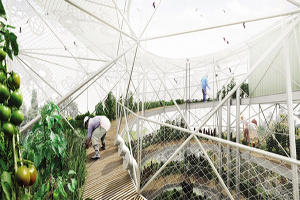
Sustainable solutions for larger investments and secure yields The future is in skyscraper greenhouses
Potential for future development
Modern urbanized society requires a constant flow of food raw materials, which travel thousands of kilometers from rural areas or from countries whose exports are concentrated on agricultural production. The environmentally friendly products, so highly valued lately, become just a label at the end of the long journey from field to table. In fact, the export of agricultural goods leads to the use of refrigerated trucks and warehouses, thereby increasing carbon emissions and causing about 15% waste. Food waste, on the other hand, is a criminal act against the backdrop of rapidly rising charts of hungry or malnourished populations worldwide. The volatile and often high oil prices directly affect product prices, which have doubled their cost in recent years. The "food route" is doomed because the losses in ecological terms are many times greater than the gains in economic statistics.
According to the core principle of current agriculture - intensification, combined with forecasts of an 80% increase in the world population by 2050, the only way to overcome the crisis is to cultivate more agricultural land. The problem is that land, soil, and water (about 70-90% of water resources go to irrigation) are finite resources.
As it seems at the moment, the two main ways to enrich and expand the world's food reserves are genetic engineering and the use of chemicals. A third alternative with potential for future development is also appearing on the horizon.
Vertical plant farms
Growing agricultural crops in glass skyscrapers in the city center seems like a scenario from a science fiction movie, but the truth is that the idea has been discussed in scientific circles for the last 50 years. Currently, there is beginning to be talk of vertical farms, not only because the need for more food is threatening, but also because a large market niche with prospects for successful business is opening up. "Vertical vegetable fields" aim to avoid the problems associated with growing crops in areas with severe droughts and plant disease infestations. It is also significant that they are grown "under the nose" of the consumer.
Their principle involves irrigating several floors of plant crops at once. The greenhouse type of farms ensures production regardless of the seasons, maintaining a constant temperature needed for the life cycle of the respective crop. The serious problems with carbon emissions and the rising cost of products due to transport are eliminated, as there is no need for "complex" logistics - the farms are usually in close proximity to the buyer, and with their modern architecture, they are part of the exterior of large cities.
The buildings use solar panels and wind turbines placed on the roofs to generate electricity sufficient for the operation of the closed system in the vertical farms. Usually, plants are grown not in soil, but on volcanic rock - perlite, irrigated with a nutrient water solution.
The full text can be read in the magazine "Plant Protection & Varieties and Seeds and Fertilizers" No.10, 2014