

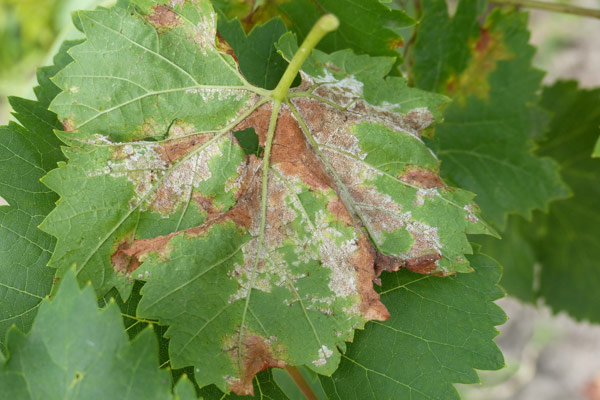
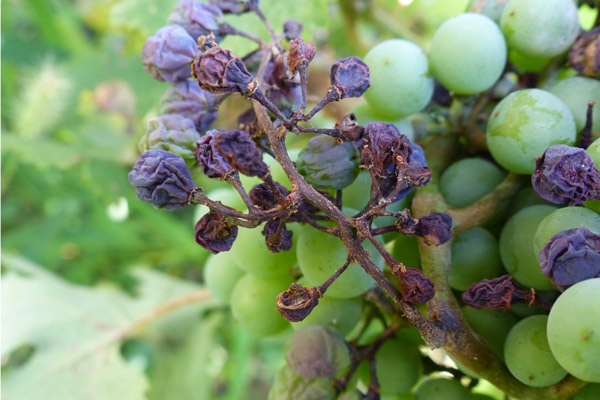
The causal agent of grapevine downy mildew is a positive example of a phytopathogen whose development is highly dependent on specific climatic conditions and can be successfully forecast. Modern forecasting models, in combination with appropriate agronomic practices and knowledge of the age-related resistance of the vine, can serve to create an integrated strategy for controlling the disease. The benefits of such an approach can be realized in various directions – ecology, control of pesticide residues, economic efficiency. Over the last seven years, a model for grapevine downy mildew caused by Plasmopara viticola was validated at the Center for Integrated Management of Plant Diseases (CIMPD) at the Agricultural University – Plovdiv and in private farms.
Forecasting model RIMpro-Plasmopara.
RIMpro-Plasmopara is a new forecasting model for the control of grapevine downy mildew and was developed by the company Biofruitadvies (Netherlands). Since 2014 it has been offered in a package together with other already established models for diseases and insects in apple and pear. The model is dynamic and reproduces the overall development of the disease during the season; it is not limited to considering infectious events separately and thus can determine their significance. RIMpro-Plasmopara forecasts primary and secondary (summer) infections. The structure and parameters of its sub-models describe in detail important biological stages in the development of the fungus.
The program uses microclimate data, which start to be monitored from February with the help of a weather station located in maximum proximity to the vineyard. The model also processes information on climatic events expected in the following days. In this way, a forecast is prepared for the development of the disease not only in the past but also in the near future, thus expanding the possibility for preventive treatments.
The main details of the model are:
- Determining the first infection of the season and issuing a spray alert even before the appearance of spots (sometimes the onset is in April, and other times in June)
- The infection pressure and the amount of rainfall may require more frequent spraying and the choice of a more reliable product
- Weak infections – conversely, may extend the interval between sprays or cancel them if there is protection from previous interventions
- The moment of infection determines the need for a product with a specific mode of action.
In 2019, the monitoring of the microclimate was of decisive importance. In Plovdiv, the first significant infections occurred relatively late – at the beginning of June, followed by another prolonged risk-free period and medium-strength infections at the very end of the month and the beginning of July. These infections actually occurred after the “pea-size berry” stage, without substantial importance according to the strategy established in the country. However, our experience showed that they should not be underestimated, because the amount and intensity of rainfall in recent years have been high, which eliminates the efficacy of contact products (copper and others) and results in severe infection on the youngest leaves and weak infection on the older ones. Preserving the leaf area of the vine from downy mildew infection is important until the end of the season, because overwintering and the formation of fruit buds are impaired. Systemic or penetrating fungicides are preferable in such cases.
In some regions of Northern Bulgaria, the difficulties in controlling downy mildew were considerable. They were expressed in evenly distributed strong infections from April to August. An additional aggravating factor was the large number of torrential rains and the impossibility of working in the vineyards. Despite everything, the crop was successfully preserved with the help of data from the model and their correct agronomic interpretation.
Given the trend of increasing demand for organic and pesticide-free products, cultivation of new, more downy-mildew-tolerant varieties is of particular interest. At CIMPD there are 6 such German varieties which show interesting quality parameters for wine production. Our experience proves that in their case it is possible to apply measures for downy mildew control only in the phenological phases important for the fruit and under conditions of a high forecast infection risk. Copper-based products, which are permitted for organic production, provide sufficiently good economic results. Observing the total quantity of copper products used is of important legal and environmental significance. A reduction of copper use in viticulture is also possible through targeted spraying.
The highest level of expertise in grapevine disease control is expressed in the ability to combine protection against several diseases in a single spray. All this is achievable through more information from models for powdery mildew and black rot of grapevine, which are now also available. Equally important are thorough knowledge of plant protection products, of the varieties, and the ability to carry out precise treatments according to leaf area volume, wind, and the product’s mode of action.