

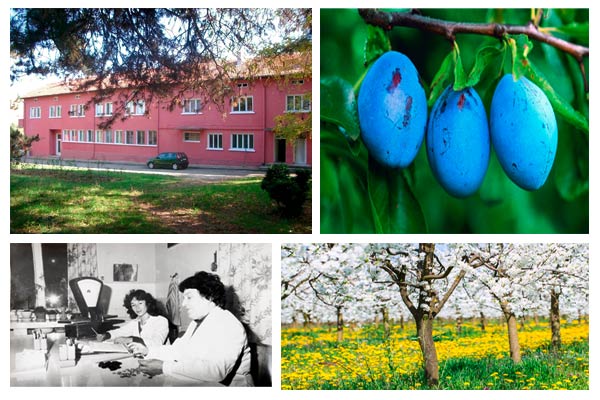
In 1929 two horticultural experimental stations were established in Bulgaria in the two most distinct fruit-growing regions in the country – Kyustendil and Gabrovo. The founder of the Fruit-Growing Experimental Station in Dryanovo is Petar Lilov. He was born in Vidin in 1886 and worked as a horticultural agronomist in the mobile agricultural departments in Vidin, Kyustendil and Sofia, and as an inspector at the Ministry of Agriculture. From 1924 to 1926 he was sent on a long-term specialization in fruit-growing experimental work at Cornell University in New York. After his return from America, he succeeded in convincing the then governing authorities of the need to establish a scientific institution for fruit growing and on 1 August 1929 he became director and founder of the Fruit-Growing Experimental Station in Dryanovo, whereby he is regarded as the founder of fruit-growing experimental work in our country.
In the first years at the Fruit-Growing Experimental Station in Dryanovo, studies were carried out on almost all fruit species. During this period the station achieved significant results, many of which were adopted in agricultural practice. Foremost are the studies of the fruit assortment with a view to introducing into production the most suitable cultivars. For this purpose, large collection plantations were established, comprising 575 cultivars, many of which were introduced from Italy, France, Germany, Serbia and other countries.
Conditions for profiling and specialization were created later, and in 1965 the scientific team of the station was assigned to work mainly on improving plum production in the country. Studies on sweet and sour cherry continued on a more limited scale. The main tasks facing the station’s team were: collection and evaluation of local and introduced cultivars, development of new cultivars, conducting ecological studies in the region, identification of suitable rootstocks and methods of propagation, and development of appropriate agronomic practices.
Over the long period of its existence, many research associates and specialists have worked at the Plum Experimental Station in Dryanovo, leaving a lasting mark on fruit-growing science and practice. Particularly great are the merits of Petar Lilov, Aleksandar Daskalov, Dimitar Boykov, Gancho Katrandzhiev, Ivan Iliev, Petko Marinov, Marko Vitanov, Georgi Prodanov, Yordanka Shtarkova, Maria Yoncheva, Valentina Bozhkova, Pencho Iliev, Ivanka Vitanova.
Professor, D.Sc. Marko Vitanov has great merits for the development of the Plum Experimental Station in Dryanovo. His entire working and creative career passed at the station, where he was director for 20 years. In the 1960s and 1970s one of the main tasks of the station was the introduction and breeding of new plum cultivars. Under the guidance of Prof. Vitanov a large amount of hybrid material was created, as a result of which new cultivars were selected and approved by the State Variety Commission: Dryanovska, Sinya Yubileyna (Blue Jubilee), Gulyaeva, Gabrovska, Strinava, Vitanova, Burya and Pop Khariton, and later the cultivars Nevena and Balvanska Slava as well.
In addition to breeding activities, good results were achieved in plum cultivation technology. The first experiments to study the influence of different rootstocks on the growth and fruiting of trees were laid as early as 1942. The greatest merits in this field belong to Senior Research Associate Maria Yoncheva who, in the 1960s and 1970s, thanks to the rich initial material collected by her from local plum and blackthorn-plum forms and some myrobalan cultivars, managed to select a rich rootstock material. Of greatest interest to practice are the moderately vigorous seedling rootstocks. For their time, suitable rootstocks were identified for the plum cultivars Kyustendilska Blue Plum, Stanley and Strinava.
For many years, suitable systems for training and pruning of plum trees have been studied in accordance with the requirements of modern industrial technologies. The greatest merits in this field belong to Senior Research Associate Maria Yoncheva and Assoc. Prof. Dr. Stella Dimkova. Possibilities were established for training trees of different cultivars and for pruning regimes consistent with the technology of plum orchard management. In the 1970s, contour mechanized pruning of plum cultivars was studied, which for its time was a revolution in plum cultivation technology.
A significant place in the research activities of the Plum Experimental Station in Dryanovo is devoted to issues related to fertilization of orchards. The first results showed the need to apply the three main nutrient elements – nitrogen, phosphorus and potassium. The possibility of applying the method of leaf diagnosis to determine fertilization requirements was studied. Prof. D.Sc. Ivanka Vitanova has great merits in the field of fertilization. Prof. Vitanova’s entire creative career passed at the Experimental Station in Dryanovo. She started work as a research associate in 1968. In 1979 she defended her doctoral dissertation and obtained the educational and scientific degree “Doctor”, and in 1982 she acquired the academic title “Associate Professor”. In 1996 she defended a dissertation and was awarded the scientific degree “Doctor of Agricultural Sciences”, and in 2000 she was promoted to “Professor”.
Prof. Ivanka Vitanova was Director of the Plum Experimental Station in Dryanovo from 1987 to 1993 and from 1995 to 2012, and during her tenure this institution achieved some of its greatest accomplishments in the field of agricultural science. Prof. Vitanova’s main contributions are in the field of organic fruit production and systems for maintaining the soil surface in plum orchards. She is an innovator in the application of green manuring, replacing farmyard manure with green manure crops – rye, rapeseed and barley.
The research work at the station on the biology, ecology and control measures against the economically most important diseases and pests of plum in Bulgaria has been long-standing and productive. The first studies on the disease red leaf spots of plum were carried out as early as 1945 by Prof. Marko Vitanov. The biology of the causal agent was clarified and it was established that mass infection occurs during flowering. Blossom-time spraying against red leaf spots was applied for the first time in 1960, with very good effect.
Today, although with a considerably reduced staff, the team of the Experimental Station in Dryanovo strives to preserve and further develop the scientific achievements of our predecessors. Since 2003 the station has been a division of the Institute of Mountain Stockbreeding and Agriculture in Troyan. At present there are three research associates and one doctoral student working here. The projects on which the associates are working are in several directions. One of the main tasks of the team is to preserve the gene pool of plum and myrobalan. At present the station has a rich collection of local, introduced and domestically bred cultivars of the genus Prunus.
The collection plantation consists of 41 introduced, 5 cultivars bred at the experimental station, and 16 local plum cultivars. The station has 19 introduced and 13 local myrobalan cultivars. The collection also contains several local forms of pear and cherry. Breeding activities are continuing, with two plum elites and 75 selected hybrid plants under study.
Another main area in which the team is working is technology for organic production of plum fruits, including the choice of suitable training systems and pruning; organic fertilization; and environmentally sound plant protection technology for plums and myrobalan. The species composition of economically important pests of plum and myrobalan has been studied. Their phenology and the factors affecting the density and species composition of these pests have been monitored. In parallel, the phenology of the economically most important diseases of plum is being observed, and the susceptibility of individual cultivars to these diseases is being studied. A number of pesticides are being tested for the control of diseases and pests of plum, as well as their phytotoxic effects on the different cultivars.
In line with new trends in the production of environmentally clean products, in recent years scientific research has been conducted on the use of organic biofertilizers, monitoring their effect on yield and fruit quality. As a result of these studies, the main task facing the team is the development of an integrated technology for the production of environmentally clean fruit products, which should include an appropriate assortment of cultivars, selection of suitable sites, systems for maintaining the soil surface, fertilization and an environmentally sound plant protection system.