

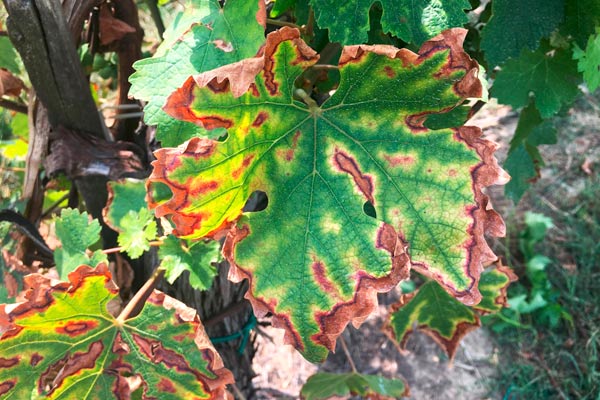
Until the 1980s of the 20th century, the phytosanitary status of vine plantations was determined mainly by the spread of downy mildew, powdery mildew, grey mould and anthracnose, and in years with hail by white rot. In the period after 1970–1980, new highly harmful pathogens were introduced with planting material, causing excoriose (Phomopsis viticola) and eutypiosis (Eutypa armeniacae). In vineyards with reduced agrotechnical care, damage is also caused by agents of wood rot – esca (Stereum hirsutum), root rot (Armilariella mellea) and white root rot (Rosellinia necatrix).
Eutypiosis – Eutypa armeniacaea (Eutypa lata)
From diseased vines, shoots grow with severely shortened internodes, small chlorotic leaves with scorch marks on them. Fully developed leaves acquire a red colour. Symptoms are found on individual, and not on all, shoots of a plant. Young inflorescences shed. Typical symptoms are on the wood: on longitudinal section of diseased shoots, necrosis of the tissues with a brown to dark violet colour is observed in the wood. The damage starts from the point of injury to the trunk. Diseased and healthy tissue are separated by a dark stripe.
The entry point for the pathogen into the tissues are wounds caused by pruning. Dominant factors for the spread of the disease are precipitation above 1.25 mm and light wind. The fungus develops within a temperature range from 1 to 45oC.
Control. Preventive measures play a key role: removal of diseased shoots and vines and burning of the wood outside the plantations; pruning should be carried out in dry and calm weather. Preparations based on methyl thiophanate have a fungicidal effect. Treatments should be carried out from bud swelling at 10–12 day intervals.
Excoriose – Phomopsis viticola.
Some of the buds on diseased shoots do not develop, and from the remaining ones shoots grow with severely shortened internodes, small and deformed leaves. On the basal internodes, dark, watery, elongated spots are observed, which stand out sharply against the tender bark of the green shoots. By the end of the vegetation period, the damage appears as dark brown necroses, spindle-shaped, isolated or fused. On 2–3-year-old wood the bark turns whitish (mainly on the first 2–4 nodes) and is speckled with black dots (pycnidia of the pathogen). Symptoms are also observed on clusters, petioles, the main vein of the leaves, around which small light brown spots form.
The fungus overwinters as mycelium in the buds and as pycnidia and perithecia on diseased/infected shoots. It develops at temperatures from 5 to 35oC in the presence of water or relative humidity of 98–100%. At 8.5oC infection occurs within 13 hours, and at 25oC – in only 5 hours. In its life cycle, the causal agent of excoriose, Phomopsis viticola, coexists with fungi of the genus Phoma.
Control. The best results are obtained when chemical control is carried out in the phenophases from bud swelling to the 3–4 leaf stage, with fungicides based on: mancozeb (Dithane DG – 0.3%, Dithane M 45 – 0.3%); fosetyl-aluminium and folpet (Mikal Flash – 0.3%; Momentum Extra WG – 300 g/ha); fosetyl-aluminium and fenamidone (Verita WG – 0.2%); fluopicolide and propineb (Pasoble 70 WG – 200 g/ha); captan (Captan 50 WP – 0.3%); folpet (Folder 80 WG – 187.4 g/ha; Follow 80 WP – 187.5 g/ha), etc. Diseased shoots and vines should be cut out and burned outside the plantations.
Esca /“red leaf” disease/
Symptoms of esca appear during the summer months, with rising temperatures, initially on the leaves of basal shoots. Later they spread to all leaves of diseased plants, affecting individual arms or cordons. In red-berried varieties, the leaves of individual shoots turn red, and in white varieties they become yellowish brown. The damage expands between the main veins, the tissues become necrotic and scorched. Typical symptoms are revealed on cross-section of the trunk. Light brown rot of the wood is observed, which becomes friable. This is the “chronic form” of the disease.
An “acute form” also develops, in which sudden death of individual shoots or entire plants is observed. Leaves and grape clusters suddenly wilt within only a few days. The dried shoots acquire a bluish colour and become brittle. The most typical manifestations are on the wood. On cross-section, light-coloured zones with destroyed wood, surrounded by darker stripes, are outlined.
Later, leathery fruiting bodies, arranged like “fish scales”, form on the affected vines. They are sessile on the bark.
Control. Control includes a complex of measures: uprooting and burning of diseased vines; protecting plants from injury; pruning should be carried out to healthy tissue and the wounds should be coated with oil-based paint or with a 2% copper sulfate solution in combination with thiophanate-methyl – 0.2%; preventive spraying with copper-containing products and drenching of diseased plants with preparations based on thiophanate-methyl should be carried out.
White root rot (white root disease) – Rosellinia necatrix.
The disease occurs in plantations established on sites of uprooted orchards, vineyards, forests, on heavy and moist soils with low content of carbonate compounds. It appears on individual plants or in patches. Infected vines have depressed growth, smaller, dissected and light green leaves. Shoots are weak, thin, with shortened internodes and chlorotic appearance. These manifestations intensify progressively and end with the death of the plants. When uprooted, the roots are found to be rotten, with black bark that peels off easily. The wood is brown and spongy. On the affected parts, white to brown mycelium can be seen, which may be fine and cobweb-like or in the form of rhizomorphs.
On the affected parts, the fungus develops white mycelium, from which chlamydospores, rhizomorphs and black sclerotia are formed. The fungus also develops saprophytically in the soil, from where it attacks young roots, which it kills, and then penetrates into the thicker roots. It destroys all elements of the bark and wood, as a result of which the dead parts are brittle and friable.
Favourable conditions are created on heavy, moist soils poor in carbonates and at temperatures of 22–33°C.
Control. New plantations should not be established on sites of uprooted forests, orchards and other crops where white root rot has been established. Diseased vines should be destroyed and the site disinfected with 2% formalin or with calcium cyanamide. The soil can also be disinfected with fungicidal combinations of thiram-, methyl-thiophanate-based products and other thiabendazole-derivative preparations.
Root rot – Armillariella mellea.
The disease develops in patches. Diseased vines have depressed growth and smaller, light green leaves. In some cases, plants suddenly wilt and dry out. Typical symptoms are revealed after peeling off the dead bark. At the base of the trunks, on the inner side of the bark, white mycelium with a fan-shaped structure and black, thick rhizomorphs, 1 to 3 mm in diameter, are observed. An important diagnostic feature are the clusters of fruiting bodies of the fungus, called “honey fungus”, which form at the base of the trunk.
Control. The measures indicated for white root rot should be observed. A promising approach is the biological method using antagonistic fungi Trichoderma viridae.