

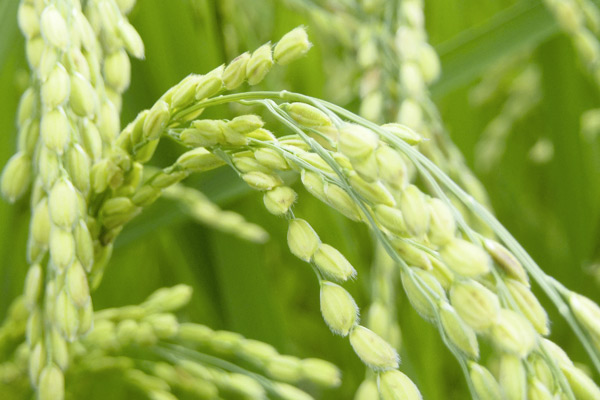
Rice is one of the main and most valuable cereal crops. It has been cultivated since ancient times and today is widespread on a vast scale in tropical and subtropical countries, where it has primary food security importance. For more than half of the world’s population it is the main source of dietary calories, providing 35–80% of total caloric intake. The growing global population requires rice production to increase by at least 50% above its current level. Over the last 7 years a trend of increasing rice consumption worldwide has been observed, while at the same time global rice production has remained at around 500 million t. As a result, a tendency towards a reduction in global rice stocks has been recorded. Nevertheless, according to statistics, rice provides 20% of the world’s food supply, while wheat – 19%, and maize – 5%.
Trends in rice production worldwide and in Bulgaria
At present, about half of the Earth’s population depends on rice for its survival. The crop is grown in 113 countries and provides 19.62% of global grain production. It is the second cereal crop in terms of production after maize, and together with wheat is a staple food in the world (Faostat) – according to FAO data, 745 710 t of paddy rice, 713 183 t of wheat and 1 016 740 t of maize are produced.
Rice is grown everywhere in the world, with the exception of Antarctica. The highest per capita rice availability is in Guyana (over 800 kg), Cambodia (over 600 kg), Thailand, Myanmar, Laos and Vietnam (500–600 kg).
More than 3 billion people consume over 100 kg of rice per year. This crop is cultivated on 155.5 million ha, with the area having increased by 0.39% annually over the last 30 years. At the same time, the rate of increase in production has declined significantly. The average annual increase in production was 3.68% in 1980–1985, 2.28% in 1986–1990, 0.91% in 1991–1995 and only 0.74% in 1996–2000 (FOASTAT). Several key factors contribute to this situation:
- Exhaustion of the potential of high-yielding varieties.
- The quality characteristics preferred in different regions of the world vary. For example, in Europe there is a gradual increase in preference for long-grain genotypes („indica“).
- Concerns regarding human health and the environment, etc.
In Bulgaria today, due to a number of objective (climate, limited suitable soils) and subjective reasons (continuous reorganisations, restructuring, changes in ownership, etc.), temporary declines and subsequent recoveries in the cultivated area have been observed over the past two decades. Analysis of the harvested area, average yield and total production in the country shows that fluctuations are present, but average yields are steadily increasing. For example, in 2015 the harvested area amounted to 124 000 dka and production up to that period increased nearly 2.9 times – from 20 thousand t to 67 thousand t. At the end of 2017, however, a slight decline to around 111 000 dka was again observed. Average yields are relatively stable – from 448.0 kg/dka in 2005 to 545.4 kg/dka in 2015, reaching 571 kg/dka in 2017. The dynamics depend mainly on the biological potential of the varieties and on the agrometeorological conditions of the year.
The total established irrigated rice fields in Bulgaria exceed 200 thousand dka, which implies that there is still unused full capacity for expansion and restoration of rice production in Bulgaria.
History and traditions in rice production in Bulgaria
Rice cultivation in Bulgaria has long-standing traditions. It is assumed that the crop was introduced to the Balkan Peninsula in the 4th century BC during the campaign of Alexander the Great in India. It was traded as a commodity and was well known to the Greeks, but its widespread cultivation began considerably later. Some researchers consider the end of the 14th century as the beginning of rice production in Bulgaria, referring to the Turkish historian Saadeddin, a contemporary of Sultan Murad I (who ruled in the period 1362–1389). Concerning the influence and the major role of the Turks in rice production, Stranski states: „As an Asian people, the Turks came with their habits and customs, which also affected the agriculture of the lands they conquered. They introduced a number of new crops. In this way, rice also appeared in Bulgaria. As early as in the first years after their incursion and after settling in our lands, the Turks began intensively building canals and establishing rice fields in Southern Bulgaria, especially in the regions of Plovdiv and Pazardzhik, and this even before the conquest of the entire country“.
After the Liberation, rice production in Bulgaria continued to develop, albeit with a number of difficulties. Rice was sown in the most suitable and naturally levelled areas along the river valleys of the Maritsa, Topolnitsa, Stryama, Chaya and others. As historical evidence of the importance of rice production for Southern Bulgaria remain the names of villages and localities such as the village of Orizare in the Plovdiv region, the localities Chaltika in the Asenovgrad region, Divi tirove and Tirovete in the Pazardzhik region and others.
After the Liberation (1885–1888), despite temporary restrictions on the area due to the spread of malaria, rice reached about 33 000 dka. The maximum area in Bulgaria was recorded in 1953 – 179 thousand dka, when rice was also successfully grown in Northern Bulgaria. On this occasion some politicians stated: „The issue of advancing rice cultivation into Northern Bulgaria has been successfully resolved, and definitively so“.
It is known that our country lies on the northern boundary of the favourable zone for rice cultivation. For this reason, very soon (1960) the less suitable regions of Northern Bulgaria were abandoned and production was concentrated mainly in the Plovdiv and Pazardzhik regions, and to a lesser extent in the Stara Zagora and Yambol regions.
Average yields, and respectively production, increased significantly – from 350–370 kg/dka in 1960–1970 to 520 kg/dka in 2000–2010 and 571 kg/dka in 2017.
Nutritional value and grain quality
Rice has been a well-accepted food in Bulgaria for generations. In Bulgarian cuisine it is perceived as a boiled dish, alongside pasta products with similar consumer characteristics – vermicelli, couscous, macaroni and others. Compared to other cereal crops, rice has a number of advantages. It is highly nutritious, easily digestible and readily assimilated by the human body. Furthermore, it is an excellent dietary food, which makes it a necessary food for young children and for patients suffering from gastrointestinal diseases and others. An important advantage of this crop over wheat is that a large proportion of varieties are gluten-free, which is why it is included in many recipes for gluten-free foods.
Grain quality is a determining factor in modern agriculture. It is not always easy to define it unambiguously, especially in the case of rice, since to a great extent it depends on consumer taste preferences and on the final intended use of the grain.
Protein and starch content are the two dominant factors that determine grain quality. Rice is an important source of protein, providing in some countries more than 50% of total protein intake. Many of the factors responsible for its variation are related to growing conditions (solar radiation and temperature during grain formation), as well as to the cultivation technology (plant stand density, rate and timing of nitrogen fertiliser application, irrigation regime and weed control). There is a negative correlation between protein content and rice yield, but the correlation is usually weak and is determined rather by the growing conditions.
For determining the biological value of protein, the content and ratio of amino acids are of great importance. Numerous studies show that the content of amino acids and protein in rice grain depends on the type and rate of fertiliser applied, as well as on the biological characteristics of the variety.
In addition to being an important source of carbohydrates and proteins, rice also provides microelements, the deficiency of which is often at the root of many health problems. At least 49 nutritional elements are required in specific quantities to adequately meet human metabolic needs. Deficiency of even one of them leads to adverse deviations, causing various diseases, impaired child development and major economic costs for society.
Since rice is the second staple food for humanity, this makes its microelement content even more significant. The concentration of microelements varies among different genotypes and also depends on rice processing, soil quality and the fertilisers used in its cultivation. In some countries (for example Thailand) 50% of the population obtains its iron intake through cereal foods, i.e. through rice.
Analysis of the state of rice production in Bulgaria reveals relatively favourable prospects for its future development. Market demand and consumer taste preferences for traditionally high-quality rice produced in Bulgaria stimulate material interest in production.
The described trends of increasing demand for rice and the challenge of producing more and higher-quality output enhance producers’ interest in the use of introduced varieties originating from Turkey and Italy, as well as in the improvement of certain technological solutions.
For producers today, it is important to obtain useful information on the comparative productivity of promising Italian and Turkish rice varieties introduced under Bulgarian conditions, as well as recommendations for modern agritechnological solutions aimed at an optimal balance between yield and high quality.