

The treatment of wheat crops with fungicides is, and at this stage remains, a main measure for the control of foliar pathogens. The efficacy of fungicides against these pathogens is determined by their mechanisms of action and by factors related to the course of the pathological process (infection, incubation period and manifestation of the disease).
Depending on the mechanism of action (MOA), fungicides are grouped into 11 main groups (FRAC code). A large part of them are penetrating or systemically penetrating. In addition, a significant proportion of fungicides have a curative effect, provided they are applied 24 to 96 hours after the pathogens have entered the plant tissues. Some fungicides have an anti-sporulating effect, i.e. they do not suppress the development of the pathogen in the tissues, but inhibit sporulation.
The factors related to the course of the pathological process include: presence of primary inoculum (initial infection), presence of suitable climatic conditions and presence of a susceptible host. The optimal combination of these factors leads to the development and manifestation of the disease.
The presence of primary inoculum is of paramount importance for the development and spread of diseases. In general, foliar pathogens in wheat possess high infectivity, i.e. single spores can cause infection. Moreover, these pathogens are polycyclic, which in turn creates the need for several developmental cycles to be completed in order to reach an infectious level for the development of an epiphytotic outbreak (epidemic).
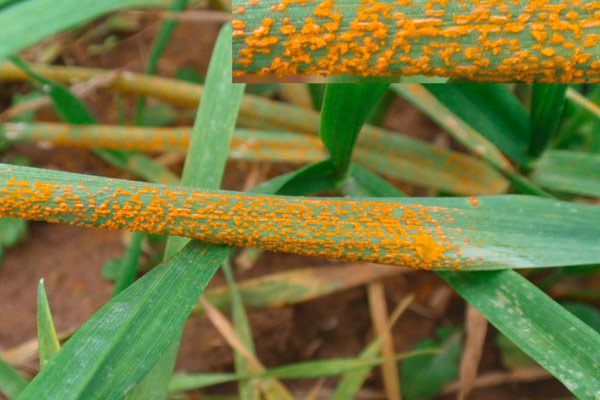
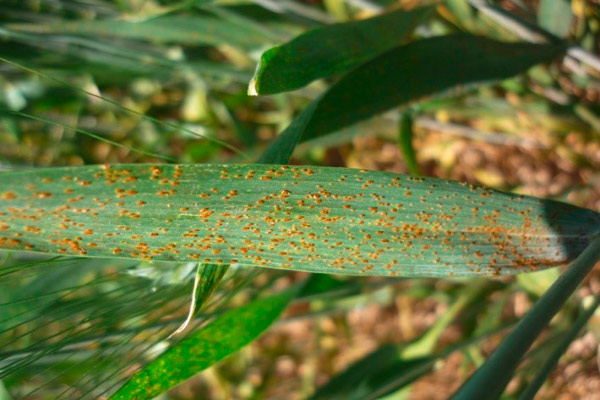
The period required to complete one cycle is of essential importance for the mass spread of a given disease. Thus, for example, the duration of one cycle (incubation period) for the causal agent of brown rust (Puccinia triticina) is 8–10 days under temperature and humidity optimal for the development of the fungus. For Zymoseptoria tritici, the causal agent of early leaf blight (septoria leaf blotch), the incubation period (asymptomatic development of the pathogen) is from 14 to 28 days depending on climatic conditions and cultivar susceptibility. This means that from infection of the tissues to the appearance of sporulation, 28 days may elapse during which no symptoms are observed.
The source of primary infection also affects the development of foliar pathogens during the vegetation period. In our country the causal agents of powdery mildew, brown rust and early leaf blight can overwinter in the crops, which, especially in the case of early leaf blight, is of essential importance for its early manifestation in spring. Other pathogens, such as the causal agent of yellow rust, cannot survive the summer and therefore cannot overwinter here, and thus the primary infection is carried by air currents from regions with warmer winter conditions. In certain years the causal agent of brown rust also cannot overwinter in Bulgaria, and therefore the primary infection is carried by air currents from other regions.
Climatic conditions are the second main factor determining pathogenesis and cyclicity of foliar pathogens in wheat. The development of each pathogen occurs within certain temperature limits. Blumeria graminis f.sp. tritici, the causal agent of powdery mildew, develops within a temperature range of 5 to 30°C, with an optimum of 15–22°C. The development of Puccinia striiformis f. sp. tritici, the causal agent of yellow rust, occurs at temperatures from 0 to 23°C, with an optimum of 9–15°C. It is important to note that these temperature ranges differ across the individual stages of pathogenesis.
Humidity is an important factor determining the development of a given disease. In most cases it is related to the process of infection. Blumeria graminis f.sp. tritici requires for its development a relative air humidity above 80%, while the presence of free water suppresses spore germination. Germination of Zymoseptoria tritici spores is possible in the presence of free water or relative humidity above 85% for more than 30 min/h or rainfall above 0.2 mm. The presence of rainfall above 1 mm for 4 days creates favourable conditions for infection. Overall, the combination of optimal temperature and humidity determines the duration of the incubation period and hence the number of developmental cycles of a given pathogen during the vegetation period.
The host (the cultivar) is the third main factor influencing the pathogenesis of foliar pathogens. If a high infectious background is combined with climatic conditions optimal for the development of a given pathogen, the incubation period in highly susceptible cultivars is significantly shorter than in cultivars with partial resistance. This also applies to cultivars that have lost resistance due to changes in the virulence potential within the population of a given pathogen.
One of the main reasons for loss of resistance is the “selection” pressure exerted on the respective pathogen through the mass spread of cultivars with identical race-specific resistance. An example is the epiphytotic development of brown rust in our country in 2018. The massive introduction of foreign cultivars into the country led to changes in the virulence potential of the pathogen, as a result of which cultivars that had shown good resistance in previous years were drastically affected!
The stage of ontogenetic development of the host (phenophase) plays an important role in the manifestation and damage caused by a given disease. Information on the critical phenophases of crop development is of essential importance for the effective application of fungicides. Numerous studies show that the flag leaf has the largest share in yield formation in wheat among the leaves that developed during the stem elongation period (after the 1st node stage). It, together with the ear, provides about 65% of the yield (the figure) – the 2nd and 3rd leaves below the flag leaf provide approximately 30% of the yield, while the share of the 4th leaf is below 5%, and that of the 5th – 0%. This should determine the strategy for fungicide application against foliar pathogens, i.e. protection should be aimed at preserving the last three leaves of the plant.
The proportional contribution of the leaves and the ear to yield formation makes it possible to forecast the development of foliar pathogens and to apply fungicides effectively upon reaching a certain economic injury level (EIL). According to Order No. RD11-536/21.03.2017 of the Executive Director of the Bulgarian Food Safety Agency, the EIL in wheat with respect to foliar pathogens is as follows:
- Phenophases 1st – 2nd node. 10% infestation of the leaf area by powdery mildew and 5% infestation by septoria diseases, yellow and brown rust;
- Phenophases flag leaf emergence–heading. 10% infestation of the leaf area below the flag leaf by powdery mildew and 5% by septoria leaf blotch, yellow and brown rust.
Compliance with the specified EIL by phenophases ensures effective application of fungicides. This, however, does not mean that during the vegetation period no changes may occur that would necessitate treatment between the indicated phases. Overall, fungicides have a certain period of activity after which their efficacy weakens or ceases. In most cases this period does not exceed 10–14 days, so their application as a preventive measure in the absence of the above-mentioned factors would lead to a significant increase in costs without economic effect. Yellow rust can be cited as an example. In most years the first symptoms of this disease are observed at the ligule emergence stage of the flag leaf, but due to rising temperatures the development of the pathogen ceases. In some years symptoms may be observed after formation of the 2nd node and before the appearance of the flag leaf. This necessitates continuous monitoring of the crops during the stem elongation period and immediate application of a fungicide upon the appearance of symptoms and the presence of suitable conditions.
As already mentioned, the duration of the incubation period is of essential importance for determining the timing of treatment. The causal agents of powdery mildew, yellow rust and brown rust have a relatively short incubation period, which allows for rapid manifestation of symptoms and hence for timely organisation of plant protection measures. The longer incubation period of the causal agent of early leaf blight (14–28 days) does not allow effective chemical control after the appearance of the first symptoms, as it is impossible to predict the extent to which the yield-contributing leaves are affected. In this case, monitoring at the 2nd node phenophase and the corresponding application of a fungicide would not protect the third leaf if it has already started to unfold. Specifically for early leaf blight monitoring should be carried out at the rosette erection phenophase. If primary infection is present (most often the result of overwintering of the pathogen in the crop), climatic conditions are favourable, stand density is high and other conditions for prolonged moisture retention in the crop are present, an appropriate fungicide should be applied. The use of a fungicide under these conditions should be aligned with the possibility of protecting the 3rd leaf below the flag leaf. Autumn application of fungicides against this disease can limit its development, but cannot prevent it in spring, and is therefore not recommended.
Determining the timing of treatment is of essential importance for effective control of foliar pathogens. The optimal moment is when the leaves we want to protect are fully unfolded. Treatment at a time when the leaves are not fully unfolded reduces the efficacy of the fungicide, especially if it has contact or penetrating activity. With later treatment there is a risk of infection occurring before the fungicide is applied, which reduces its efficacy. An example is the ineffective control of brown rust in 2018. Despite two or three treatments of the crops, many farmers found significant infestation of the flag leaf, even though there were no symptoms at the time of fungicide application.
The analysis made so far of the factors influencing the efficacy of fungicides against foliar pathogens shows that their application should be carried out after thorough monitoring of the crops in the phenophases critical for crop development and in the presence of conditions favourable for the development of the pathogens. Neglecting these factors leads to unnecessary increases in production costs. The increased number of treatments, especially with fungicides from the same MOA group, creates a risk of the emergence of fungicide-resistant forms in pathogen populations, which drastically reduces their efficacy.