

At the beginning of spring, some cold-tolerant crops are planted.
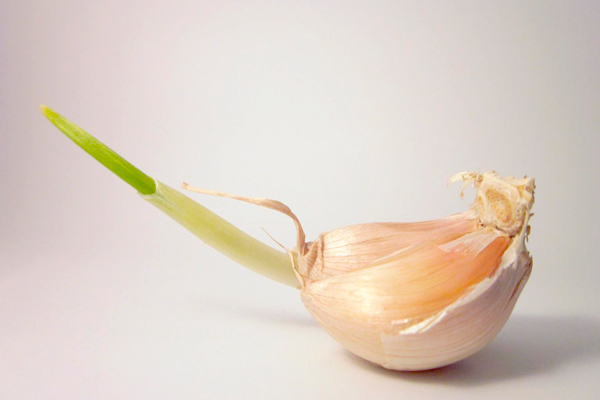
Summer garlic for bulb production is planted during the second half of February until mid-March. Bulbs with well-developed cloves are used. Only the outer cloves are planted, as they are larger and produce vigorous plants. It is very important that they originate from completely healthy bulbs. Planting material can transmit the garlic form of the stem nematode, which attacks garlic and onion and is extremely harmful. The attacked cloves are strongly separated from one another in the bulb, often have a yellow-brown colour and an unpleasant odour. In storage, the nematode continues to develop and heavily attacked bulbs usually perish. Garlic should not be planted in the same place earlier than every 3–4 years.
Disinfection of the cloves before planting is carried out by soaking in water. They are placed in a perforated container, the bottom of which is in contact with the water. The nematodes migrate into the water, which is changed and discarded every 24 hours. It is even better if the water is running. The procedure lasts for 3 days. Thereafter, the cloves are immersed in a 1% formalin solution and spread out in the sun for several days to dry thoroughly. They are stored at 4–5°C.
Tomatoes, peppers, eggplants, marigolds and hops are not attacked by the nematode that infects garlic.
Towards the end of February–beginning of March, onions for bulb production are sown by direct seeding either from seed or from onion sets. Well-aerated soils rich in nutrients, well-drained, well exposed to sunlight and free from weeds are used. It is preferable that the crops previously grown on the plot have been fertilised with farmyard manure, because onion does not tolerate direct manuring with it. Before sowing, onion seeds must be disinfected to protect them from early infection with the causal agents of white and grey rot and Fusarium wilt.
For uniform and rapid sprouting of onion sets, the dry part of the neck is cut off before planting, taking care not to injure the growing tip. The sets are soaked in water at room temperature. The small bulbs are inserted at a depth of 2 to 4 cm, pressed well into the soil and irrigated.
After onion planting, the main care is to keep the soil loose and free from weeds. Experience shows that when onions for seed are planted in February and March, yields are higher than when planted in autumn.
Carrots for early field production are sown from mid-February until around 20 March. Their seeds can transmit black rot, a dangerous disease for root crops. Therefore, only seeds taken from healthy plants and undamaged by insects should be sown. Areas selected for the crop should be distant from those where carrots were grown the previous year. Good predecessors are leguminous crops and cucumbers. The soil must be well cultivated and free from weeds.
During this period of the year it is also time to sow parsley, dill and parsnip. Celery seeds are sown to produce seedlings, which are grown for about 70 days before transplanting outdoors. Peas are sown from the end of February to mid-March. Now is also the right time for sowing radishes and spinach.
During this early period, care is taken to prepare the seed potatoes, which in vegetable production are grown as an early spring crop. During the winter season, the tubers are subjected to various treatments in order to obtain good, short and varietal-coloured sprouts. Planting of early potatoes begins in early March in the warmest regions of the country. Three weeks beforehand, the tubers are hardened by darkening the premises and cooling them to 2–3°C. Under these treatments, various disease symptoms appear on the tubers. If they carry infection, it is very important that tubers showing even the smallest spots of rot be removed, because the infection increases during storage. Therefore, planting healthy seed material is a very important condition for preventing attacks by dangerous diseases. For example, in the case of late blight, field infection is renewed mainly from diseased tubers.