Questions and answers about the mass infestation of crops in Dobrudzha by brown rust
Author(s): проф. д-р Иван Киряков, Добруджански земеделски институт в гр. Ген. Тошево
Date: 31.05.2018
28572
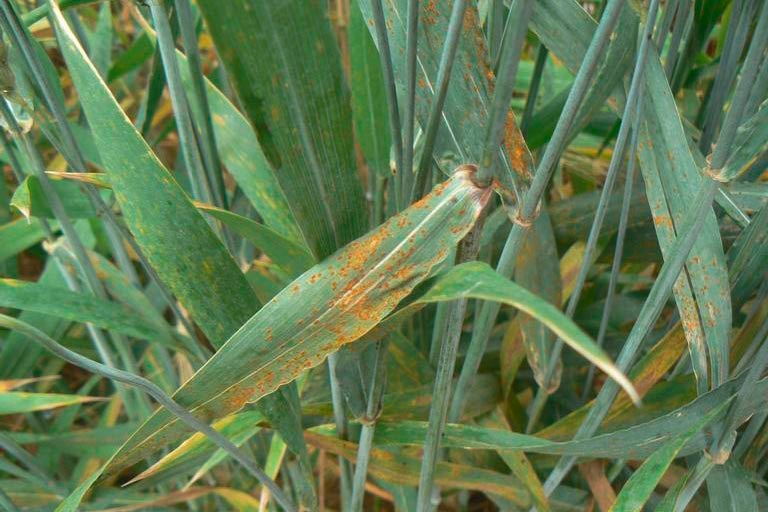
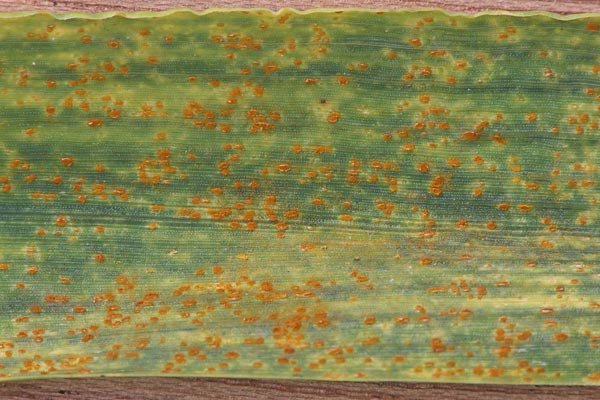
Over the past week I have received a number of inquiries from grain producers in Dobrudzha related to a widespread infestation of crops by brown (leaf) rust. In general, the most frequently asked questions can be formulated as follows:
- Why are the varieties we use, which in previous years were resistant to brown rust, now so heavily affected by the disease?
- What is the reason that, after 2–3 fungicide applications on the crops, they are still highly infested?
I will briefly attempt to clarify the issues raised.
Populations of phytopathogens, including brown rust, are characterized by significant virulence diversity. This means that the pathogen population consists of a huge number of individuals with different abilities to overcome resistance controlled by the so-called race-specific genes. The virulence diversity in the pathogen population is determined mainly by the resistance of the varieties introduced into practice. When varieties possessing resistance to the existing virulence diversity in a given area are used, “selection” pressure is exerted on the pathogen. Or, more simply put, in the pathogen population there is an increase in the proportion of individuals that can attack the resistant varieties. This process is relatively prolonged and may take several years. The final result, however, is associated with an increase in the virulence potential of the pathogen and, from there, with the occurrence of an epiphytotic under conditions favourable for the development of the disease.
Until 2013, the varietal structure of wheat in our country consisted primarily of varieties from domestic breeding programmes. Despite the fact that most of them possess genes for resistance to brown rust, years with significant incidence of this disease were not uncommon. With the introduction of foreign varieties into production, Bulgarian breeding began to lose market share and today it accounts for no more than 20%. The initially introduced foreign varieties showed considerable resistance to the key wheat diseases in the country. However, the gradual increase in the areas sown with foreign-bred varieties exerted “selection” pressure on the brown rust population, which in turn led to its mass development this year. It is important to note that at present most of the varieties of the DAI – General Toshevo show higher resistance compared to the widely grown foreign varieties.
In recent years, it has become common practice to apply fungicides to wheat crops two, three, and sometimes even four times. In most cases, these treatments are pointless because they do not take into account the presence and magnitude of primary infection, climatic conditions and the genotypic characteristics of the varieties. It is important to emphasize that the efficacy of fungicides is largely related to the timing of their application. Specifically for this year, it can be said that the most appropriate time for preventive spraying against brown rust was the beginning of wheat flowering. I will clarify what I mean. For the Northern Black Sea and Dobrich regions, symptoms of brown rust were observed in the first ten days of April, and then mainly in thinner stands. Since this month was characterized by extreme drought, fungicide applications could have been postponed. The severe drought led to early heading of wheat crops (25 April – 5 May). During the heading period, a moist front passed over the country, and precipitation in some areas exceeded 25–30 l/sq.m. The humid conditions, combined with favourable temperatures, created conditions for infection and development of brown rust.
One of the questions I have been asked is why there is rust, given that the crop was treated 5 days earlier, when there were no symptoms? Note, not at a specific growth stage, but 5 days earlier. There is only one answer. You treated after infection had already occurred! It is important to know that from the moment of infection until the appearance of symptoms, 7–10, and sometimes even 15 days may pass, depending mainly on temperature. This period of hidden disease development is called the incubation period or latent period.
Are fungicides effective or are they counterfeit? This is the question we ask ourselves when we do not observe the expected effect from fungicide application. I have already explained that one of the factors determining fungicide efficacy is the timing of their application. Most of the fungicides registered in our country for rust control are penetrating with systemic acropetal action. A characteristic feature of these products is that they have a curative effect if applied within 72 hours of tissue infection, after which they no longer affect the pathogen. However, there is another possibility, on which, unfortunately, no research is being conducted in our country, namely the emergence of fungicide-resistant forms of the pathogen. Triazoles (group G by mode of action) generally affect sterol biosynthesis in the membranes of fungal pathogens. On the other hand, they are among the most commonly used fungicides for preventive treatments in wheat crops. Their repeated use, however, leads to the emergence of individuals (mutants) in pathogen populations that are resistant to all active substances belonging to the triazole group. To prevent these processes, it is necessary to select different active substances (from different groups) for multiple treatments of the crops or to use products containing two or more active substances from different groups by mode of action.