Do you know the southern green stink bug?
Author(s): проф. д.с.н. Ангел Харизанов
Date: 05.03.2019
13143
-M69-Island-Sapcote-SP-4635-9382-(taken-26.4.jpg)
The widespread occurrence of the southern green stink bug, its tendency to migrate into residential buildings, and the insufficient knowledge about it cause concern among a large part of the population in many parts of the country. The mass reproduction of the bug during dry and hot summers is often the reason for damage to vegetable crops such as tomatoes, peppers, eggplants, and green beans in home gardens and on areas near settlements in many regions.How can the harmful activity of the stink bug be limited?
Adult insects and nymphs damage plants from more than 30 families but prefer tomatoes, peppers, eggplants, green beans and other crops forming fruits and pods. They damage all plant organs, but prefer developing fruits, growing shoots and apical parts, and young pods. During feeding, the bugs “inject” digestive enzymes into the damaged organs and suck out the liquefied substance. The tissues around the feeding site die. The fruits become speckled with numerous spots which are initially grayish-white and later turn brown and darken. Young tomato fruits grow poorly, become deformed and most often dry out. Under severe damage they resemble sulfur phytotoxicity. The shoots and apical parts are speckled with grayish-white and brownish spots and, under heavy infestation, grow poorly and lag behind undamaged plants. Damage in field conditions is most severe on tomatoes, and in greenhouses – on peppers, tomatoes, and eggplants. First-instar nymphs do not feed; second–fourth instars cause slight damage, while the most harmful are the adults and the fifth-instar nymphs.
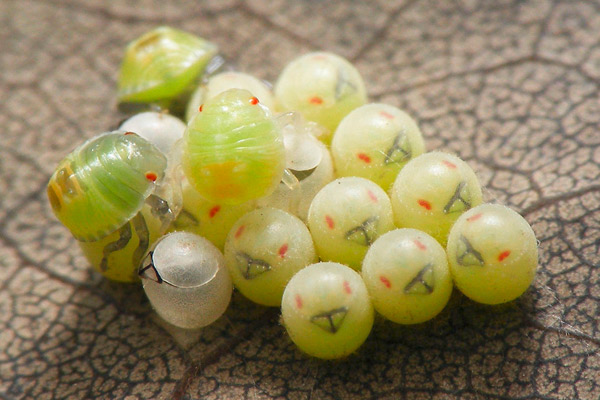
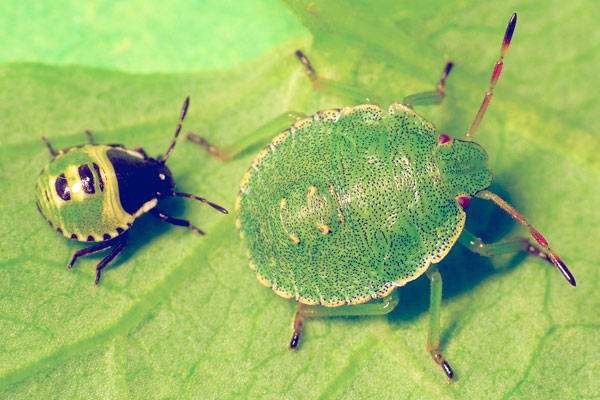
During the summer months the adult bug is green, while in the autumn-winter period it is yellowish-brown. On the front of the pronotum there are 3–5 whitish spots, and on the sides of the body – longitudinal black spots. The eggs are pale yellow shortly after being laid, and later – light orange, barrel-shaped, with radiating projections on the upper side. The first-instar nymph is reddish with light legs and antennae; the second instar – with a red abdomen and black head, thorax, and legs; the third and fourth instars – with a green head and dorsal side and yellow spots on the upper side and on the sides of the abdomen, and the fifth instar – with a yellow-green abdomen and red longitudinal spots on the body.
The species develops two and partially a third generation per year in the open and overwinters as an adult insect in plant residues, under tree bark, in the soil, in abandoned and residential buildings and in other sheltered places. In the evening and at night the bugs are strongly attracted to light. The development of one life cycle depends mainly on temperature, host plant, and relative humidity. Optimal conditions are a temperature of 28–30°C and relative humidity of 65–80%. Under such conditions and with the preferred host tomato, one generation develops in 20–25 days, and under other conditions – from 25–35 to 40–65 days. The first-instar nymph develops the fastest – in 3 days, and the longest – 8 days – is the development of the fifth-instar nymph. The bugs begin to leave their overwintering sites when the temperature rises above 14–15°C – in the second half of April – early May. They feed intensively for several weeks, mate and begin to lay eggs at night. Oviposition starts in the second half of May. The eggs are laid on the underside of leaves, on young fruits, on pods and on shoots in groups of 25–30 to 120–130 eggs per group. They are glued to each other and to the laying site. One bug lays up to 250 eggs with interruptions for additional feeding. Under optimal conditions the egg stage lasts 5–6 days, and the nymphal stage – 15–25 days. Nymphs begin to hatch towards the end of May–early June. Young nymphs (first instar) remain in groups around the egg chorions (hatching of all eggs in the group occurs almost simultaneously), a behavior developed during individual development to ensure protection from natural enemies, unfavorable temperatures and low relative humidity. Second- and third-instar nymphs also live gregariously, while fourth- and fifth-instar nymphs lead a solitary way of life and most often inhabit the apical parts of plants in the morning. When shaken or subjected to other mechanical impact, they fall onto the soil surface and remain motionless for a certain period of time – a behavior known as catalepsy, akinesis, and thanatosis, which is important for forecasting.
Adult bugs of the first generation appear towards the end of June–early July, and of the second generation – at the end of July–first half of August. In July, August and the first half of September, conditions for reproduction and harmful activity are most favorable and damage is most severe on tomatoes, sweet peppers and eggplants under irrigated conditions. Bugs of a partial third generation appear in the second half of September. At the end of September and in October the bugs gradually move to their overwintering sites. Low temperatures during the winter months in countries of the temperate zone limit the distribution of the bug, and in very cold winters its mortality reaches 70–80% (the winter of 2017). Female bugs, darker-colored forms and individuals well supplied with fat withstand low temperatures more successfully. In autumn, adult bugs migrate en masse into residential buildings, attracted by light. During the period 2007–2013 and in 2016, the species reproduced massively due to dry and hot summers and caused severe damage to tomatoes, peppers, eggplants and green beans in home gardens and on areas near settlements in many regions of the country.
How can the harmful activity of the stink bug be limited?
*Soil cultivation, balanced fertilization of the crop, irrigation, implementation of operations on the green parts of the plants;
*Cleaning of the fields from plant residues immediately after harvesting;
*Sowing of processing beans in April and June to attract the bugs and destroy them with insecticides;

Clavitus is an insecticide of entirely organic origin and is formulated on the basis of potassium salts and fatty acids. It does not contain conventional pesticides and represents a triple combination of potassium salts of fatty acids, vegetable oils and essential oils, which ensures effective protection against the southern green stink bug.
* The article was updated on 29.02.2024.