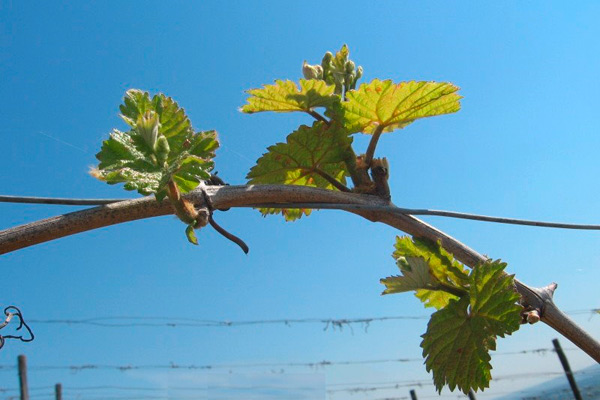
Pruning is carried out on warmer and dry days in February and it is advisable to be completed before the start of sap flow. It is performed selectively, starting with vineyards planted on sites with the lowest risk of frost damage, and with wine grape varieties, because they are relatively more cold-resistant. Pruning of table grape varieties is left for a later stage.
By cutting out, removing and burning all dead diseased vines, infected, dried and poorly developed cordons, arms, trunks and shoots, vines with spotting and discoloration of the bark, the sources of primary infection are reduced from:
Bacterial crown gall Agrobacterium vitis, which causes the formation of primary and secondary tumors. Initially, the tumors are soft, light yellow or pink and their surface is smooth. Subsequently, they become hard, rough, brown, spongy and are preserved in the infected plants immediately below the soil surface or at a height of up to 1 m above it. When plants attacked by bacterial crown gall are detected within the first 3 years after the establishment of the vineyard, they are uprooted and completely destroyed.
Esca (white wood rot) fungi of the genus Phaeoacremonium, the wood of the attacked vines is soft, friable, tinder-like, with whitish-yellow spongy tissues. The trunks are longitudinally cracked. In severe cases the entire plant dies.
Excoriosis of grapevine Phomopsis viticola, overwinters as mycelium and pycnidia on the attacked parts. On mature shoots the attack on the bark is manifested by spotting, fading and/or whitening. The attack on the bark of one-year-old wood varies from small single to numerous, merging spots. In most cases the bark is torn at the site of damage.
Anthracnose Sphaceloma ampelinum. The infected shoots have dark brown, irregularly rounded spots which expand, the tissues in the centre fade, become sunken and tear. Under severe attack the bark tears and separates from the wood.
First, healthy plants are pruned, and then the diseased ones. When moving from one plant to another, the tools are disinfected by immersing the pruning shears in denatured alcohol, a 10% bleach solution or a 5% formalin solution.
By scraping off and removing the old cracked bark, as well as by cutting out, removing and burning all attacked, dried and poorly developed above-ground parts the pests overwintering under the bark and in the trunks of the vine are destroyed:
European grapevine moth Lobesia botrana - overwinters as a pupa under the vine bark in a spindle-shaped cocoon.
Vine leafroller Sparganothis pilleriana - overwinters as a young unfed larva in a silken cocoon under the vine bark, in cracks, crevices and other parts of the fruiting wood.
Vine bud moth Theresimima ampellophaga - overwinters as a second-instar larva in a silken cocoon under the vine bark, in fallen leaves and other protected places.
Vine scale Pulvinaria vitis - overwinters as a second-instar larva under the old bark of the trunk and on the spurs of one-year-old shoots. The overwintering larvae of the pest are located mainly on the fruiting canes and are clearly visible.
Yellow vine mite Schizotetranychus viticola - overwinters as a fertilized female under the old cracked bark of the vine, from several tens to several hundreds of mites together.
European red mite Panonychus ulmi - overwinters as an egg on the bark, spurs, buds, in cracks and in other places on the vine. At high population density the attacked places look as if sprinkled with red pepper.
Soil tillage to a depth at which the root system of the vines is not damaged. Through it the soil structure is improved and the pests overwintering in it are destroyed:
Turkish vine weevil Otiorrhynchus turca - overwinters as a larva of different ages and as an adult insect in the soil.
Vine beetle Lethrus apterus - overwinters as an adult insect deep in the soil.
Chafer Tropinota (Epicometis) hirta - overwinters as an adult insect in the soil.
During the dormant period, against the winter eggs of the European red mite, spraying is carried out with the authorised plant protection product Para zomer - 3%. Its action is based on the formation of an air-impermeable oil film which covers the eggs and suffocates them.