Rose knapweed - Acroptilon repens
Author(s): проф. д-р Щелияна Калинова, Аграрен Университет Пловдив
Date: 17.02.2019
12440
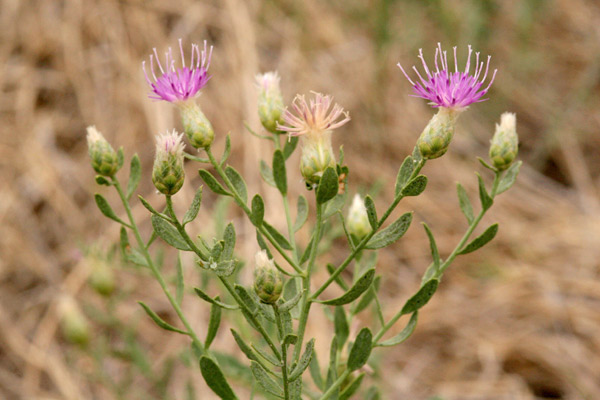
The pink cornflower, originating from Central Asia, is now cosmopolitan, with the exception of Africa.
It infests: cereal, row, vegetable, fruit, industrial, fodder crops, meadows and pastures. It can also be found along canals, roads, rivers and other locations. In our country it has been established in alfalfa stands, with seed imported from Ukraine.
The pink cornflower is a perennial weed. Propagation occurs by seeds, root suckers and rhizomes. Some of the horizontal roots are directed towards the surface, but before reaching the surface they turn vertically downwards and form a vertical root. At the bend of the root numerous buds are formed, from which aerial stems develop. Without moisture and light the roots remain viable for 5–6 years. Its development begins early in spring. New stems are formed until late autumn, but the most intensive sprouting occurs in June and July. The pink cornflower blooms in May–June and matures in June–July, together with the cereals in solid-seeded stands.
Botanical description:
Stem erect, branched from the base, strongly leafy and up to 70 cm high. The leaves are alternately arranged, sessile. The lower ones are toothed and pinnate, and the upper ones – smaller and entire.
Inflorescences are solitary heads with an elongated ovoid shape, located at the ends of the stem branches (with a diameter of 1–1.2 cm).
Flowers are small, uniform in size, pink-coloured. Each head contains from 2 to 26 seeds, and the number of heads per plant reaches up to 700. The seeds remain in the heads until they decay in the soil or are released when the heads are crushed during threshing.
Seeds are broadly ovoid, narrowed at the ends, slightly longitudinally striated, glabrous, light grey to yellow. On the broad part of the seed whitish hairs are formed, which are three times longer than the seed. Seed length is 3–3.5 mm, width 2 mm and thickness 1–1.8 mm.
Dispersal: over long distances occurs with contaminated seed material of cereal and forage grasses. After the cornflower seeds germinate, it subsequently reproduces vegetatively. The pink cornflower has a well-developed root system with a main root reaching great depth and lateral roots horizontally arranged mainly in the arable layer.