Witchgrass, Panicum capillare L., fam. Poaceae
Author(s): проф. д-р Щелияна Калинова, Аграрен Университет Пловдив
Date: 17.02.2019
12368
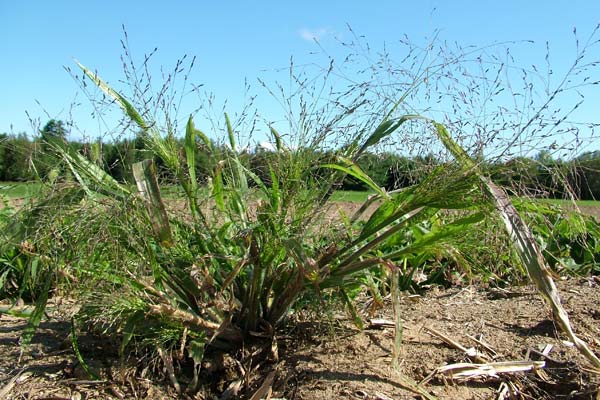
It is distributed in America (Canada, USA, Mexico, Argentina, Uruguay, Chile), Europe (England and Southeastern Europe), Asia (the Middle East and India), etc. The native land of bristly millet is North America. In Bulgaria this species has been found in the Danube Plain and in the Sofia region. The plants reach a height of up to 80 cm. The stems are geniculate, erect or slightly prostrate. A single plant forms from 5–6 to 8 tillers. The leaves are lanceolate, covered with fine hairs. The inflorescence is a panicle, 25–40 cm long. One plant forms on average from 20 to 40 panicles. They are loose, with thin branches, which can reach up to 28 in number.
The seeds of bristly millet are spindle-shaped, coloured from olive-grey to beige-brown. Studies have shown that one panicle may contain from 473 to 1187 seeds, with a maximum of up to 2426, while a single plant forms from 13,000 to 30,000 seeds. Under favourable conditions and without competition, one plant can produce about 67,200 seeds.
Bristly millet is an annual plant. It reproduces by seeds, which are dispersed by animals (mainly birds), through sowing material, wind, etc. The plants emerge massively in May, June and July. They flower and set seed from August to October. Under dry and unfavourable conditions, neotenic plants are formed, which produce seeds. The optimal depth from which the seeds emerge is up to 3 cm.
Bristly millet has high seed productivity, spreads easily and possesses great ecological plasticity. The species can increase in number and spread in arable land in our country. It is necessary to detect the foci of this weed in a timely manner and to destroy them periodically. According to literature data, a large part of the herbicides used for the control of grass weeds are also effective against bristly millet.