Iva xanthifolia, Iva xanthifolia Nutt., fam. Asteraceae
Author(s): проф. д-р Щелияна Калинова, Аграрен Университет Пловдив
Date: 15.02.2019
10140
.jpg)
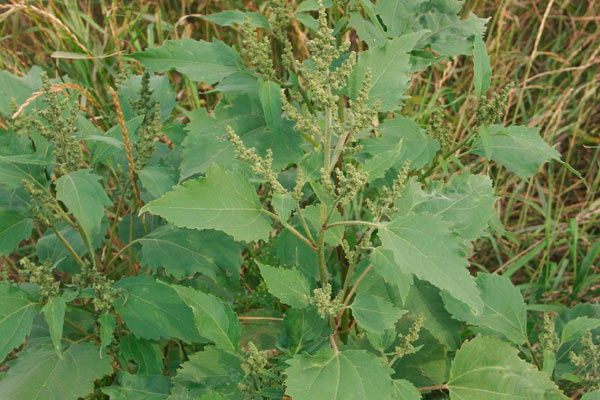
It has been found in the Znepole region and in the Kostinbrod area, Sofia District. The plants reach a height of 50–200 (300) cm. The stems are erect, cylindrical, with slightly pronounced longitudinal ridges, branched towards the top, with a thickness at the base from 0.5 to 2.5 cm. The lower leaves are triangular-heart-shaped to broadly ovate. The upper leaves are ovate-lanceolate. All leaves are pointed at the tip and serrately toothed at the margins, grey-dark green, lighter on the underside. At the base of the upper leaves branches are formed, which terminate in panicles. A single plant forms from 10 to 17 branches. The flowers are heads, grouped in panicles. The seeds are obconical, slightly flattened, dark brown in colour, with numerous dark spots on the surface.
Iva xanthifolia is an annual plant. It propagates by seed. Under the conditions of Bulgaria its young plants emerge at the end of March, and en masse in April and May. They bloom in August–September and bear fruit in September–October. A single plant can produce up to 1,790,500 seeds. They retain their germination capacity in the soil for 5–8 years and emerge from a depth of 6–8 cm. There is a seasonal periodicity in seed germination, with the highest percentage emerging in spring and the lowest in autumn. The uneven germination during the growing season is due to a certain cyclicity in the dormancy of the seeds of Iva xanthifolia. This makes it possible to maintain a continuous reserve of them in the soil and they are a permanent source of infestation. Seeds that have remained in water for up to 6 or more months retain their germination capacity – a biological characteristic that facilitates their spread also through irrigation water. The weed is further spread by seed material, farmyard manure, birds, etc. It occurs along roadsides and in farmyards. It infests winter cereals, row crops and vegetable crops, alfalfa, etc. Summer droughts do not adversely affect the growth and development of Iva xanthifolia.
Research and observations show that this species can easily and successfully develop under the conditions of Bulgaria. When foci of Iva xanthifolia are detected, it is necessary to destroy the plants urgently and periodically, before they have formed seeds. Annual inspections of these foci are required until the complete eradication of this dangerous weed. Preparations based on bentazone (Basagran 600 SL) and oxadiargyl (Raft 800 WG) show good efficacy at the recommended rates and times of application for the respective crops.