Asiatic dayflower, Commelina communis L., fam. Commelinaceae
Author(s): проф. д-р Щелияна Калинова, Аграрен Университет Пловдив
Date: 14.02.2019
8533
It is distributed in Serbia, Turkey, the southwestern and central regions of the European parts of Russia, the Caucasus, Siberia and the Far East, in Japan, China, and North America. The native land of Asiatic dayflower is China. In our country it has been found in the Thracian Plain, in the Eastern Fore-Balkan, in the regions of Pleven, Veliko Tarnovo, Varna and Sofia. More often it is introduced as an ornamental plant in flower gardens, and soon after that it rapidly spreads to the remaining parts of the yards.
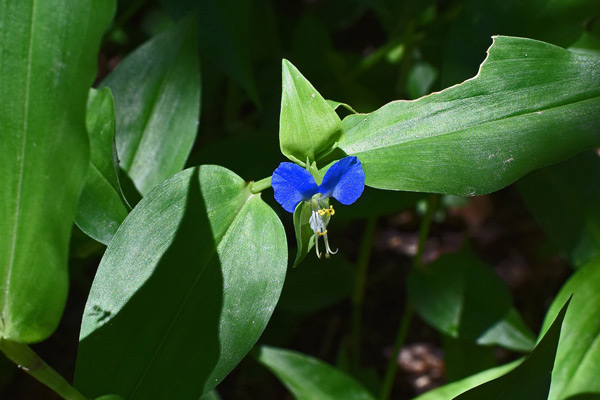
Asiatic dayflower is an annual species. It reproduces by seeds and by stem fragments. The stem is glabrous, slightly ribbed, strongly branched and may reach up to 1.5 m in length. The leaves are thick, fleshy, entire, pointed, with a broad base that clasps the stem. The lower leaves are elongate-ovate, and the upper ones are almost ovate. The flowers are borne on long pedicels arising from the leaf sheaths, with broadly heart-shaped greenish bracts. The corolla consists of three unequal bright blue petals, one of which is significantly smaller than the others and pale. The fruit is a two- or three-celled capsule, similar in size to a wheat grain.
The seeds of Asiatic dayflower are almost triangular, flatly truncated on one side and varying in size and shape. They are dark, usually the color of the soil, and are difficult to distinguish. The first plants emerge in March–April. Flowering begins from the end of May until the end of the growing season, and fruiting continues until the onset of frost. Seasonal variability in seed germination has been established, with the highest percentage (up to 95) germinating in spring – until the end of April, which defines the species as an early spring weed under the conditions of Bulgaria. It should be specified that the development of the plants continues until the onset of cold weather. The seeds of Asiatic dayflower emerge from a depth of 12–13 cm. They retain their viability in the soil for up to 6 years.
Asiatic dayflower possesses high vitality and ecological plasticity. It withstands prolonged drought, which is due to the specific characteristics of the species – the leaves close upward in a boat-like shape, which limits transpiration. In addition, there is evidence that the species contains abscisic acid, which exhibits antitranspirant action by promoting stomatal closure and suppressing photosynthesis. Another characteristic of the plant is that at each stem node it can form roots, with which it additionally absorbs water and nutrients from the soil.
Asiatic dayflower infests various field and vegetable crops, orchards, and grows along roads and in gardens. It is spread mainly through seed material, humans, birds, animals, etc. Stem fragments root very easily, which makes mechanical control in row crops very difficult. One of the mandatory measures should be the restriction and eradication of existing foci of this weed in the country. During the vegetation of Asiatic dayflower, in the growth stage from the 2nd–3rd to the 5th–6th leaf, treatments can be carried out with bifenox (Modown 4 F) and bentazone (Basagran 600 SL). These products are recommended against Asiatic dayflower only for crops for which they are approved for use.