Invasive weed species
Author(s): Растителна защита ; проф. д-р Щелияна Калинова, Аграрен Университет Пловдив
Date: 14.05.2019
10309
![MultipartFile resource [file_data]](/assets/img/articles/млада-амброзия.jpg)
![MultipartFile resource [file_data]](/assets/img/articles/амбразия-поле.jpg)
Invasive species are proving to be a rapidly growing threat to biological diversity both in Europe and in our country. Plants that enter new habitats foreign to them, can take over part of the territory of the native flora and damage the environment are known as invasive weeds.
They also exert social and economic impacts, for example on human health (allergies), agriculture and food production. The increase in trade, tourism and the free movement of goods across the borders of the EU Member States has accelerated their spread. Invasive species are a real threat to biological diversity in Europe. In addition, the control of invasive species leads to additional costs. Most invasive species originate from North America and Asia. There are numerous examples – Japanese knotweed, introduced from Asia in the 19th century as an ornamental plant, first conquered France and later spread to other European countries.
A considerable number of invasive weeds, however, originate from one part of Europe and are transferred to another part. The single European market and borderless travel maintain this flow.
The diversity of ecological conditions in Bulgaria creates favourable conditions for the multiplication, spread and development of plant species from different regions of the world.
Since 2007, Bulgaria, as an EU Member State, has fully harmonised its phytosanitary legislation with European Directive 2000/29 with Ordinance No. 8 of 27.02.2015 on phytosanitary control, and a number of species that are new to the country and of great economic importance are not subject to official control.
The list of invasive species in our country includes a number of weeds,
the more important of which are: Common ragweed, Ambrosia artemisifolia L., fam. Asteraceae, Asiatic dayflower, Commelina communis L., fam. Commelinaceae, Iva xanthifolia, Iva xanthifolia Nutt., fam. Asteraceae, Witchgrass, Panicum capillare L., fam. Poaceae, Russian knapweed - Acroptilon repens,
Common ragweed, Ambrosia artemisifolia L., fam. Asteraceae
It is widespread in the USA, Canada, Mexico, Argentina, in many European countries, including Hungary, Serbia, Ukraine and others. It originates from North America. In addition to being an especially dangerous weed in all arable, vegetable and forage crops, vineyards, pastures, etc., ragweed is very harmful to human health due to the allergies it causes.
Ragweed is a serious competitor to cultivated plants, with its powerful root system and abundant aboveground biomass, in terms of nutrients and soil moisture. Ragweed is also harmful to humans and animals due to the formation of huge quantities of pollen that cause allergies. These allergies create major problems in countries with massive distribution of this weed. Precisely for this reason, special requirements regarding the maximum permissible limits for Ambrosia spp. have been included in a specific Regulation on the import of feed, whereby the content of seeds of Ambrosia spp. must not exceed 50 mg/kg.
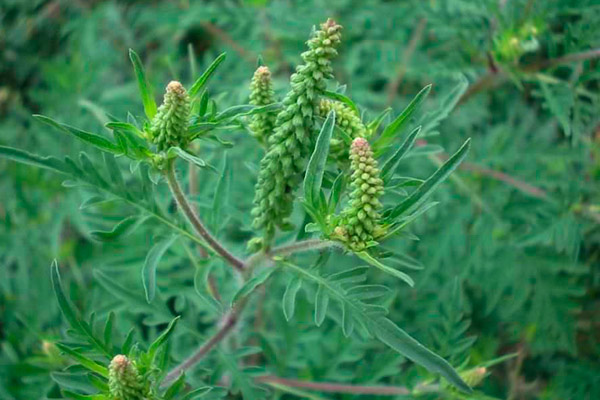
In appearance it resembles common wormwood. The whole plant is covered with fine white hairs. The upper surface of the leaves is dark green and the lower – silvery green. It is a monoecious plant. The male flowers are yellow, gathered in capitula arranged in spike-like inflorescences in the upper parts of the plants, while the capitula with the female flowers are located in the leaf axils or at the base of the male inflorescences. The seed (achene) is obovoid with a ribbed surface and a grey-green to chestnut-green colour.
Common ragweed is an annual weed. Young plants of common ragweed emerge at the end of March, and en masse in April and May. They flower from July to September and form seed from September to November. Under favourable conditions for growth and development it can reach 2.0–2.5 m in height, and under drought and on poor soils – 10–15 cm. It develops a powerful root system. It acts as a strong competitor to cultivated plants. It has high ecological plasticity and reproductive capacity.
A single plant can develop up to 50 branches. Even after repeated mowing, new regrowth develops, which flowers and forms seed – from 30,000 to 40,000, up to a maximum of 88,000 seeds, which retain their germination capacity in the soil for up to 40 years.
The spread of the seeds occurs through sowing material, feed, animals, irrigation water, etc. It has been established that seeds of common ragweed, remaining in water for up to 430 days, do not lose their germination capacity, which favours their transfer by irrigation water as well.
For the control of this species, herbicide products based on the following active substances are recommended: linuron (Afalon 45 SC), terbuthylazine (Terbutrex 50 WP), oxyfluorfen (Goal 2 E), fluorochloridone (Racer 25 SC), bifenox (Modown 4 F), 2,4-D + dicamba (Weedmaster), 2,4-D (Sanafen and others), bentazone (Basagran 600 SL), clopyralid (Lontrel 300 EC) and others. During the vegetation of common ragweed, bifenox (Modown 4 F) and bentazone (Basagran 600 SL) can be used. The above-mentioned herbicides are recommended against common ragweed only in crops for which they are approved for use.
The following weeds are also potentially dangerous for our country: among the perennial species – Foxtail sophora (Sophora alopecuroides L.), widespread in Turkey and Asia; povertyweed (Iva axillaris Pursh.), widespread in Canada, Mexico, the USA, Australia and others; Perennial ragweed (Ambrosia psilostachya D.C.), widespread in Europe (in certain regions of Russia), the USA, Canada; Knotgrass paspalum (Paspalum distichum L.), widespread in certain areas of Europe, America, Africa, Asia and Australia.
Among annual weeds, all wild sunflower species of the genus Helianthus, the species of the genus Solanum, Russian thistle (Axyris amaranthoides L.) and others pose a threat.