Participants in the composting process
Author(s): доц. д-р Цветанка Динчева, ИЗК "Марица" в Пловдив
Date: 07.02.2019
10071
It is of paramount importance to implement biocontrol and to induce plant resistance. To some extent this can be achieved through compost.
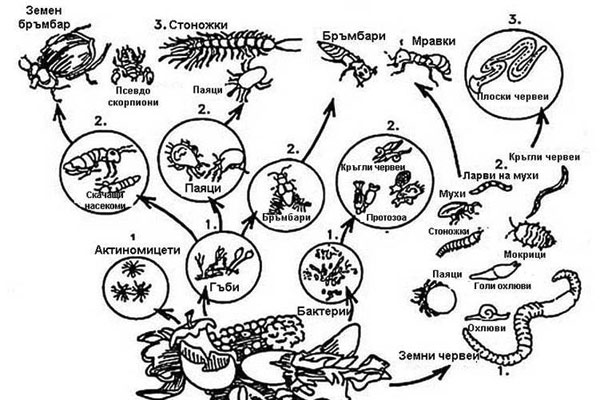
Bacteria. The beginning of the process starts with the activity of bacteria. In the composter/heap they break down the organic matter into a form that is assimilable for other organisms. For the successful course of the process, the conditions under which the highest bacterial activity is maintained must be monitored.
Actinomycetes. This type of microorganisms develops mainly on woody materials. They impart a specific odour to the compost. As a result of their biochemical activity, they release antibiotic substances that kill certain pathogenic microorganisms.
Fungi. Many species of mould fungi develop in the composting mass. The decomposition processes they carry out are slow compared to those of bacteria. Their presence in the composting material means that the compost is developing well.
Worms. They are secondary decomposing organisms. Two types of worms are found in composting mass: earthworms and tiger worms (reddish, with yellowish rings around the body, used as bait). Earthworms move in and out of the composting container, while tiger worms live in the composting material itself.
Other participants in composting are: centipedes, slugs and snails, woodlice, ants, etc.
The process of composting the materials can be divided into three stages – decomposition, transformation and maturation.
Decomposition
In this stage of the process, microorganisms participate which, during their life cycle, use different chemical components of the biodegradable waste. While feeding and reproducing, they produce thermal energy that raises the temperature of the decomposing materials. The microorganisms that develop well at this higher temperature take over the further decomposition of the material until their nutrient sources are exhausted. In the household composter, the process starts each time new undecomposed products are added. This means that the materials contained in the composting container are at different stages of decomposition, depending on the time they have remained there.
Transformation
This stage begins when the temperature decreases due to reduced microbial activity at the end of the decomposition phase. Microorganisms that operate at lower temperatures replace the others in order to complete the decomposition process. At this stage, it is already difficult to recognise most of the initial organic materials.
Inside the composter this process occurs mainly at the bottom because the material there has remained for the longest time.
Maturation
During this final stage, microbial activity subsides, the material cools down and provides the ideal environment for earthworms, insects and larvae to complete the process. The result is compost, a dark brown material with an intense earthy smell. Home-produced compost usually contains some undecomposed particles, such as twigs and eggshells. Therefore, it may look different from the compost sold in garden centres.
When producing large quantities of compost, the incoming biodegradable materials are first shredded and then composted in heaps. The resulting compost is sieved in order to remove the coarser particles, which can be returned again for further decomposition. Better quality of home-made compost can be achieved by sieving through a screen.
There are many possibilities for compost production. Ready-made containers can be used, self-made ones from waste materials can be constructed, or a small area in the garden can be used directly.
To obtain quality compost, the following requirements must be observed:
Ratio of fresh to dry materials.
For greater clarity, nitrogen-rich materials can be described as “green”/fresh, and carbon-rich materials as “brown”/dry. As “green” can be defined those materials that are soft and juicy. Most food waste is of this type, as well as mown grass and weeds. They are rich in nitrogen, contain less carbon and decompose more easily. They also contain moisture – an important factor for their rapid decomposition. “Brown” materials are drier and fibrous, such as paper, sawdust, dry leaves, which are characterised by higher carbon values and less moisture, as a result of which they decompose much more slowly. The best results are obtained by using a mixture of hard materials (thin twigs, straw) mixed with soft and juicy products (freshly mown grass, fruit and vegetable peelings). Consequently, the successful course of the process largely depends on the balanced combination of these two types of materials.
Maintaining optimal moisture.
It is necessary to maintain optimal moisture of 70–80% of field capacity. It is important to achieve the correct balance. The determination of moisture is carried out by means of a field test. For this purpose, material is taken and squeezed in the palm of the hand with the fingers. If the material crumbles, this means that the amount of moisture is insufficient and the heap is dry. If drops of water seep between the fingers when squeezing, this means that the heap is too wet. Optimal moisture is considered to be the condition when the material does not crumble and no water is released, but it retains its shape when pressed. The moisture of the composting mass is of essential importance for the composting time and the quality of the compost. If there is too much water, the compost will become waterlogged; if it is too dry, composting will stop.
Aeration of the composting heap.
For the proper course of the process, aeration of the composting mass is necessary. This is achieved by turning the heap or the materials in the composter with a fork. In this way, access of oxygen to the centre of the heap/composter is ensured, the moisture is evenly distributed and a favourable environment is provided for the development of microorganisms.