Compost – a means of plant protection
Author(s): доц. д-р Цветанка Динчева, ИЗК "Марица" в Пловдив
Date: 06.02.2019
15143
A current issue in agriculture is the cultivation of healthy plants with high productivity, which necessitates the selection of areas with favourable fertility and good soil structure. However, intensive crop cultivation and soil compaction deteriorate the quality and health status of soils, while at the same time numerous pathogens appear and multiply. Therefore, it is of primary importance to implement biocontrol and to induce plant resistance. To some extent this can be achieved through compost.
The application of the organic product in the soil increases microbiological activity and creates microbiological populations with antagonistic action, which explains the suppressive effect against several types of soil-borne pathogens. This organic soil improver has the potential to provide biological control of many plant diseases and can suppress the development of pathogens on leaves, the vascular system and roots. The starting material for composting has a significant influence on the possibility for biological control and microbiological activity. On the other hand, the heat accumulated in the composting process kills or deactivates pathogenic microorganisms, but along with them also the biocontrol agents, with the exception of Bacillus spp.
In compost, as agents for biocontrol, bacteria have been identified from the species: Bacillus spp., Enterobacter spp., Flavobacterium balustinum, Pseudomonas spp., Streptomyces spp., Penicillium spp., several species of Trichoderma spp., Gliocladium virens and other fungal species. A great diversity of microorganisms has been recorded, which play a significant role in deactivating pathogenic organisms, stimulating the development of beneficial species and decomposing organic soil materials, turning them into a form easily assimilable by plants. It has been established that compost protects cucumbers from attack by Pythium ultimum, suppresses the development of Rhizoctonia solani on basil and reduces attack by Rhizoctonia solani on potatoes. In cases where compost from tree bark has been used as a substitute for peat and as a substrate for seedlings, less damage from root rot (Phytophthora) has been recorded. In some studies it is considered that compost control of root rot can be as effective as that achieved with fungicides.
Compost can influence the multiplication of soil-borne pathogens. The reason for this is its quality as a final product. Composts with low pH values increase the incidence of disease caused by Pythium and Phytophthora, unless they are applied months before planting. Compost obtained from domestic wastewater has a low carbon-to-nitrogen ratio, which increases plant attack by Fusarium.
Compost is a means of increasing plant resistance against soil-borne pathogens in vegetable and ornamental crops. It inhibits pathogens of the genus Pythium spp., Phytophthora spp., Rhizoctonia spp. and Fusarium spp. It has been established that compost can be used as an effective means of controlling root rot in cucumbers caused by F. solani, P. ultimum, Rh. solani and Sclerotium rolfsii. A positive effect has been observed against nematodes in cucumbers and a reduction in the number of galls on plants.
Composts can affect plant health in a positive or negative direction, depending on the type of organic substance, the nutrient content, the diversity of microorganisms and the conditions of composting.
What is composting?
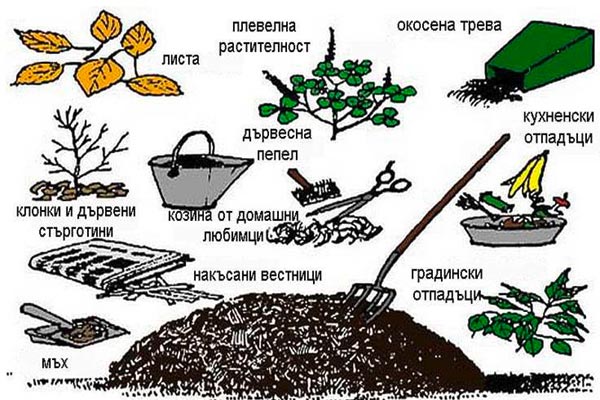
Composting is a natural process carried out by bacteria, insects, fungi and worms, which decompose garden and kitchen waste into a soil-like material, with a dark, friable substance. Compost provides nutrients to plants, improves soil structure and induces plant resistance against soil-borne pathogens. Materials suitable for composting are presented in Fig. 1. Most kitchen and garden waste can be placed in the composter. For example: fruit and vegetable peels, tea bags, ground coffee, eggshells, mown grass, pruned twigs, leaves, annual weeds. The following materials should not be composted: cooked food, meat, fish, dairy products, cat and dog faeces, bones, diseased plants.
Where should composting be carried out and where should the compost bin be placed?
An unused corner in the garden is selected for forming the pile of materials. The bin should be placed in an easily accessible location, directly on the soil. This will allow worms and other organisms to enter it. The leachate formed from moisture and decomposition by-products will drain into the soil. It is advisable to have direct sunlight during the winter months, but in the hot summer months the composter should be placed in a shady spot.
Composting time
This depends on a number of factors, but mostly on the season. In spring and summer the process is accelerated by the increased ambient temperature. If composting starts in spring, about 3 months will be needed. In autumn and winter the process slows down, because due to the low temperatures most organisms reduce their activity. When composting starts in autumn, the process will in practice begin in spring and 9 months will be required to obtain compost. Maintaining constant moisture in the soil is a factor for the optimal course of the processes and for accelerating the decomposition of materials. Aeration is also an important factor for the accelerated progress of composting.
Signs for recognising finished compost
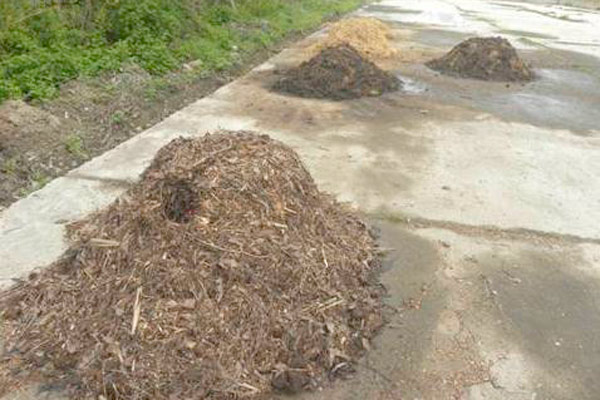
The finished product is dark brown in colour, a soil-like material with a specific soil aroma. It is homogeneous in structure. It may contain some undecomposed components, especially those that were added whole. They can be separated and returned to the bin again to continue their decomposition.
Why should we compost?
By producing one’s own compost, soil pollution from the creation of landfills is prevented and money is saved by reducing the need to purchase:
- soil improvers;
- artificial fertiliser;
- organic fertiliser.
Compost supports plant growth in the garden by:
- improving soil structure;
- providing nutrients to plants;
- supporting the water-holding capacity of the soil.
Compost protects the environment by:
- reducing the amount of waste sent to landfills;
- reducing the need for artificial chemical fertilisers.