Metcalfa pruinosa
Author(s): Боряна Катинова, Централна лаборатория по карантина на растенията; М. Лагинова
Date: 25.01.2019
17499
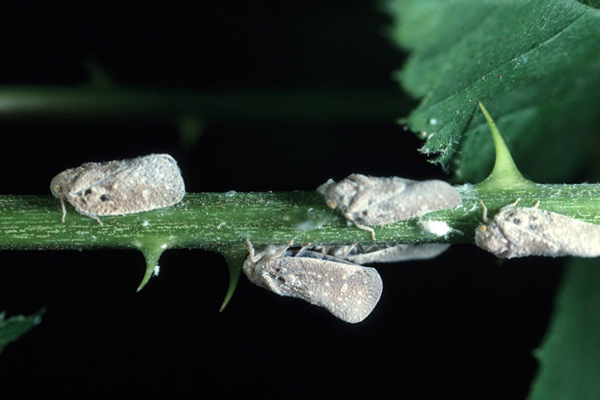
Metcalfa pruinosa is a planthopper from the family Flatidae (Hemiptera, Fulgoromorpha), originating from North America. In 1979 the species was detected in Europe (Northern Italy), which is the first report outside the range of its natural habitats. Globalization and the increased growth of trade have led to the establishment of this species in new areas, and it has gradually spread in France, Slovenia, the United Kingdom, Croatia, Switzerland, Spain, the Czech Republic, Austria, Serbia, Montenegro, Greece, Hungary, Turkey, Bosnia and Herzegovina, Romania, Russia, Germany and others. The species is polyphagous and in Europe it has more than 330 host plant species (trees, shrubs and herbaceous species) from 78 botanical families. Besides forest and park vegetation, the planthopper also damages a large number of agricultural crops such as vineyards, peaches, apricots, blackberries, raspberries, eggplant.
Biology
The species overwinters as eggs in woody tissue or under the bark of trees; the first nymphs are found on the leaves and stems in May. The total development period of this stage is on average 42 days and passes through five instars from May to September, with one annual cycle. The nymphs are slightly flattened, whitish, covered with powdery and filamentous wax. Size – from 1 mm in the first instar to 3.3 mm in the fifth. They secrete wax, are highly mobile and jump easily when disturbed. They are usually found on the underside of the leaf. The nymphs are covered with long, waxy filaments that protect them. Adults occur from July to October, and their size is 7–9 mm. They are very mobile, their body is dark, covered with a white or bluish-grey waxy coating. They prefer cool, shady habitats and areas with higher humidity. They are found mainly on the terminal branches of trees and shrubs.
Damage
Intense excretion of honeydew, causing the appearance of sooty moulds on leaves and petioles, deformation of young shoots, weakening of the plant. Appearance of white cotton-like filaments along the terminal branches and leaves. In cases of rapid population increase of the pest, the plant may die.
Control
The increase in the population of the species and the failure to take measures for its regulation create a precondition for the planthopper Metcalfa pruinosa to become a serious pest of ornamental and park vegetation, which may cause a significant environmental and social problem, as well as lead to economic losses for the yield of a number of agricultural crops, such as vineyards, peaches and apricots and others.
Chemical control against Metcalfa pruinosa is not appropriate due to the large number of diverse host plants and the impossibility of using plant protection products simultaneously on all of them.
The most effective method for controlling populations of M. pruinosa is the biological one. The parasitoid Neodryinus typhlocybae (Hymenoptera, Dryinidae) was introduced from North America into Italy and successfully reduces pest populations. N. typhlocybae is highly effective and is specific to the nymphal stages of M. pruinosa. Good results from the application of this bioagent against M. pruinosa have been obtained in countries such as Austria, France, Italy, Slovenia, Switzerland, Croatia and Spain.
The situation in Bulgaria
In Bulgaria M. pruinosa was recorded for the first time in 2004 on imported planting material of thuja. In 2013 in the botanical garden in Balchik a mass population increase of the species was observed, and in 2015, in addition to the northern parts of the Black Sea coast, a high density of the planthopper was recorded in the parks in Pleven. In recent years the species has been found on park vegetation, fruit trees and vineyards simultaneously in the regions of: Burgas, Varna, Vidin, Vratsa, Blagoevgrad, Dobrich, Kardzhali, Pleven, Ruse, Stara Zagora, Shumen, and Plovdiv. The most serious damage is to park vegetation.
The affected municipalities, as well as the Ministry of Agriculture and Food, are turning to plant protection specialists at the Bulgarian Food Safety Agency for assistance and for dealing with the problem.
In July 2016 Varna Municipality submitted a report to the BFSA on an attack on the vegetation in the Sea Garden by an invasive species – the planthopper Metcalfa pruinosa. This was the second consecutive year in which a mass infestation by the pest was established in the green systems of the city. The infested trees have “whitened” from planthoppers, their leaves are covered with sticky honeydew, which drips around the trees and forms large, sticky spots that soil streets, benches, shrubs and herbaceous vegetation. The damage caused by the harmful activity of the invasive species has been widely reported both in the press and in social media.
To reduce the population density of the planthopper, on the recommendation of the inspectors from the Regional Food Safety Directorate Varna, the green areas in the city were treated with biocidal products. In August an expedition was organized in Varna with the participation of specialists from the Central Plant Quarantine Laboratory, BFSA, scientists from the N. Pushkarov Institute of Soil Science, Agrotechnologies and Plant Protection, Sofia University “St. Kliment Ohridski” and Viterbo University, Italy. During this expedition a mass infestation by M. pruinosa was established on a large number of woody and herbaceous species in the Sea Garden, the central pedestrian zone and the surrounding streets. In the places where treatments with biocides were carried out, no satisfactory effect on the pest was established. To address the problem, Varna Municipality was advised to introduce the bioagent Neodryinus typhlocybae.
On the basis of Art. 10, para. 1 of the Plant Protection Act, under the conditions and according to the procedure of Ordinance No. 14 of 2016 on the protection of plants and plant products from economically important pests (SG No. 77 of 4 October 2016), the Bulgarian Food Safety Agency initiated a procedure for including the bioagent Neodryinus typhlocybae in the List of biological agents that may be applied in the Republic of Bulgaria.
In 2017 Varna Municipality launched the financing of a pilot project for biological control of M. pruinosa, carried out with the support and under the methodological supervision of specialists from the Regional Food Safety Directorate – Varna.
The project of Varna Municipality for biological control aims at maintaining very low population levels of Metcalfa pruinosa and coexistence with its natural “enemy” Neodryinus typhlocybae. The control will continue in the coming years, with periodic field surveys and monitoring of the development of the populations of the bioagent and the pest. Depending on the results, a plan for specific actions will be developed.
In 2018 Sofia Municipality turned to the BFSA for assistance regarding a problem probably with the planthopper Metcalfa pruinosa around Borisova Garden. A large-scale survey for the species was carried out on the entire territory of Sofia Municipality with the participation of experts from the Central Plant Quarantine Laboratory, inspectors from the Regional Food Safety Directorate Sofia City and an expert from the “Green System” Directorate of Sofia Municipality.
After a route survey in the urban and suburban parts of the capital, the pest was detected in several zones in public green areas, parks and gardens in the central part of the city in the area of Knyazhevska Garden, Lake “Ariana”, around and in Borisova Garden, Tsarigradsko Shose Blvd. and Tsar Ivan Asen II St., “Nikolay V. Gogol” St., “Vasil Aprilov” St., “Sheynovo” St., “Krakra” St., in the area of Doctors’ Garden and the National Library, in the residential districts Darvenitsa, Dianabad and Izgrev, the residential district Orlandovtsi, as well as in the parks: Vrana, Zaimov, and the area of South Park.
Infestation by the planthopper was established on the following plant species: Acer campestre, Acer palmatum, Aesculus hippocastanum, Ailanthus altissima, Aristolochia sp., Catalpa sp., Cydonia oblonga, Cornus spp., Corylus avellana, Fraxinus sp., Hedera helix, Hibsicus syriacus, Ilex sp., Juglans regia, Malus domestica, Morus spp., Laurocerasus officinalis, Lonicera sp., Lygustrum sp., Phytolacca sp., Prunus cerasifera, Prunus avium, Platanus occidentalis, Quercus sp., Rosa sp., Robinia pseudoacacia, Rhododendron sp., Sambucus nigra, Spirea sp., Syringa vulgaris, Symphoricarpos spp., Tilia parviflora, Tilia grandifolia, Tagetes sp, Ulmus sp., Vitis vinifera.
The infestation density varies in different areas. On roadside trees and shrubs along the boulevards, symptoms of pest attack are found on almost every plant, as well as around water sources and canals. In the parks, higher density is observed in the outer parts, facing the main streets and car traffic, and gradually decreases towards the interior.
In conclusion, we can say that on the territory of Sofia Municipality a moderate level of infestation by the planthopper Metcalfa pruinosa has been established, limited to the central and eastern parts of the city. It is necessary that Sofia Municipality take measures to limit the spread of the pest, since under favourable conditions in the following year it will inevitably expand its distribution range.
To solve the problem with the planthopper Metcalfa pruinosa on the territory of the entire country, it is advisable to apply the biological method of control, since it is specific to the nymphal stages of the pest and successfully reduces its populations.